Quick Answer
Collapsible booth design market trends 2026 point to one clear shift: brands want booths that pack down fast, ship light, and set up without tools. The market is growing because exhibitors want to cut shipping and labor costs while still looking sharp on the show floor. The biggest drivers are lighter materials, tool-free frames, reusable parts, and smarter use of screens and lighting.
Table of Contents
Why This Topic Matters Right Now
Trade shows are busy again. Booths cost more to ship, store, and staff than they did five years ago. At the same time, marketing teams are smaller and events happen more often.
That mix of pressure is why collapsible booth design market trends 2026 matter to almost any brand that exhibits, even once a year.
This guide breaks down what is changing, why it is changing, and how to plan a smarter booth without guessing.
What Is a Collapsible Booth?
Definition: Collapsible booth is a display system built with folding frames, roll-up graphics, or panel-based walls that pack into cases or bags. It sets up without permanent construction and can be reused at many events.
Collapsible booths are different from custom-built exhibits. A custom booth is often built once for one show and stored in pieces. A collapsible booth is designed from day one to travel, fold, and travel again.
Common types include:
- Pop-up fabric walls
- Roll-up banner stands
- Modular panel systems
- Folding frame counters
- Portable lightbox displays
Why the Collapsible Booth Market Is Growing in 2026
Three forces are pushing this market forward.
1. Shipping and labor costs keep rising. Freight, drayage, and union labor at convention centers are some of the largest line items in an event budget. A lighter, smaller booth means lower freight weight and less time to build.
2. Brands attend more shows, not fewer. Many companies now split their marketing budget across several smaller regional events instead of one big annual show. A booth that works in different room sizes saves money across the whole year.
3. Sustainability is now a real buying factor. Buyers and attendees notice waste. A booth that gets thrown away after one show sends the wrong message. Reusable, collapsible systems solve that problem in a visible way.
Key Takeaway
This year’s shift in booth design is less about looking small and more about working smart. Brands are choosing modular systems that save money over many shows, not just the first one.
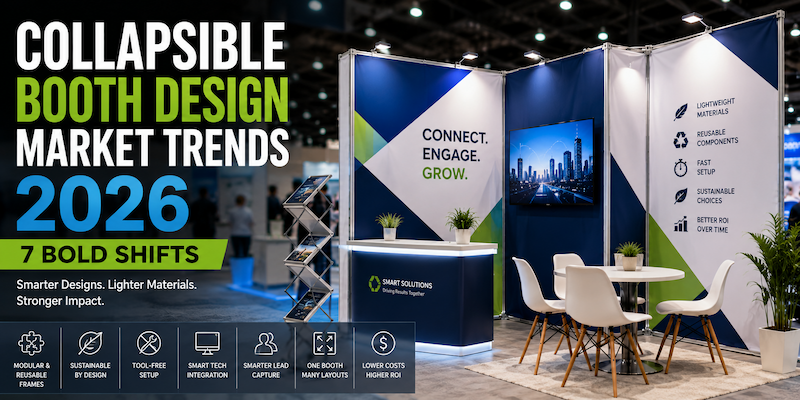
The 7 Collapsible Booth Design Market Trends 2026 to Watch
These are the shifts showing up again and again across exhibitors, booth builders, and event planners this year.
1. Modular, Reusable Frames
Instead of buying a new structure for every event, companies now buy a base frame kit. Panels, graphics, and counters snap onto that same frame for different shows.
This cuts cost per event and cuts waste. A single frame can serve a company for three to five years across many shows.
2. Lighter, Stronger Materials
Aluminum frames are getting thinner without losing strength. Fabric graphics are replacing rigid printed panels because fabric folds flat and weighs less to ship.
Recycled composite panels are also showing up more in 2026. They cost a bit more upfront but often qualify for a longer warranty and lower shipping weight.
3. Tool-Free, Faster Setup
Booth teams are smaller than they used to be. That means setup has to be simple enough for two people to finish in under an hour, often without a single screwdriver.
Push-fit connectors, magnetic panels, and pre-tensioned fabric are common in 2026 booth kits for exactly this reason.
4. Sustainability Built Into the Design, Not Bolted On
This is one of the strongest shifts in modular exhibition booth design this year. Buyers want proof, not a green logo on a brochure.
Real examples include:
- Fabric graphics printed with water-based ink
- Frames made from recycled aluminum
- Reusable shipping cases instead of foam crates
- LED lighting instead of older halogen fixtures
5. Smart Screens and Purposeful Tech
Screens are not new at trade shows. What is new in 2026 is restraint. Instead of covering every wall with video, booths use one or two well-placed screens that explain the offer fast.
A short looping video that answers “what does this company do” in 15 seconds does more work than five walls of static graphics.
6. Lead Capture Gets Smarter, Not Bigger
Small teams cannot follow up with hundreds of business cards by hand. In 2026, collapsible booths are being paired with simple lead scanning tools, short digital forms, or kiosk check-ins.
This keeps the booth itself simple while the follow-up process gets more organized behind the scenes.
7. One Booth, Many Floor Plans
Flexibility is now a design requirement, not a bonus feature. A booth that only fits a 10×10 space is a problem if the next show only offers a 10×20 or a linear row.
Modern collapsible systems are built in sections so exhibitors can rearrange the same pieces into different shapes and still look intentional.
Lighting and Graphics: The Small Details That Change a Booth
Frame and material choices get most of the attention, but lighting and graphics often decide whether a booth feels premium or flat.
Lighting trends in 2026:
- LED strip lighting built into the frame itself, not added later
- Warm white tones instead of harsh blue-white light
- Backlit fabric panels that glow instead of relying on spotlights
- Battery-powered lighting kits for booths without easy power access
Graphics trends in 2026:
- Fewer words on the main backdrop, larger type
- One clear headline that answers “what do you do” in under six words
- Photos of real people over stock illustration
- QR codes placed at eye level, not on the floor graphic where nobody looks
A collapsible frame with strong lighting and simple graphics often outperforms a bigger, more expensive custom booth with a cluttered wall.
Regional Differences Worth Knowing
Portable exhibit design does not look identical everywhere in 2026.
United States: Cost control and speed lead the conversation. Exhibitors care most about shipping weight, drayage fees, and fast setup because labor at convention centers is expensive.
Europe: Sustainability carries more weight in buying decisions. Recycled materials, reusable cases, and clear end-of-life plans for booth materials come up earlier in vendor conversations.
Asia-Pacific: Growth in mid-size regional shows is pushing demand for flexible, multi-size booth kits that can move between cities quickly.
Knowing which pressure matters most in your market helps you pick the right vendor and the right features first.
Staffing a Smaller, Smarter Booth
Smaller collapsible booths often mean smaller teams. That changes how a booth needs to work.
- Train every staff member on the same one-sentence pitch
- Assign one person to greet, one to demo, and one to capture leads
- Keep a simple printed setup guide inside the shipping case
- Practice the full teardown once before the actual show, not just the setup
A well-run two-person booth often beats a confused five-person booth. The design should make that easier, not harder.
Best Practice Box
When shopping for a booth in 2026, ask the vendor three questions: How many events can this frame survive? How long does setup take with two people? What happens to this booth at the end of its life? A strong vendor will have a clear answer to all three.
Collapsible Booth vs Custom-Built Booth: A Side-by-Side Look
| Factor | Collapsible Booth | Custom-Built Booth |
|---|---|---|
| Setup time | Under 4 hours, often less | 1 to 3 days |
| Shipping cost | Lower, fits standard cases | Higher, needs freight crates |
| Reuse across shows | High, built for many events | Low, often show-specific |
| Upfront cost | Lower to moderate | High |
| Design flexibility | Good, modular pieces | Excellent, fully custom |
| Storage needs | Small, fits in cases | Large warehouse space |
| Best for | Startups, frequent exhibitors, regional shows | Large flagship shows, big budgets |
Materials Comparison Table
| Material | Weight | Durability | Sustainability | Typical Use |
|---|---|---|---|---|
| Standard aluminum frame | Light | High | Moderate | Frames, counters |
| Recycled aluminum frame | Light | High | High | Frames, structural parts |
| Tension fabric graphics | Very light | Moderate | High (reusable) | Backdrop walls |
| Rigid printed panels | Heavier | High | Low | Feature walls |
| Recycled composite panel | Moderate | High | High | Counters, panels |
Cost Trends in 2026
Prices vary a lot by size and vendor, but a few patterns are consistent across this year’s modular booth market.
- Entry-level 10×10 pop-up kits often run in the low thousands.
- Modular 10×20 systems with lightboxes cost more upfront but lower the cost per show over time.
- Buyers increasingly ask for total cost of ownership, not just sticker price, because a reusable frame changes the math after three or four events.
Numbered Steps: How to Choose a Collapsible Booth for 2026
- List every show size you plan to attend this year, from smallest to largest.
- Pick a frame system that can adjust between those sizes.
- Choose fabric graphics over rigid panels if you attend more than three shows a year.
- Ask the vendor about recycled materials and end-of-life recycling options.
- Test the setup with your actual booth staff, not just the sales team.
- Add one purposeful screen instead of several small ones.
- Confirm the shipping case fits standard freight or airline limits.
- Plan storage between shows so the frame does not sit bent in a corner.
Real Example
A regional software company attended eight trade shows in one year. In year one, they used a custom-built 10×20 booth that needed a three-person crew and a full day to set up.
In year two, they switched to a modular collapsible system with fabric graphics and a folding frame. Setup dropped to under two hours with two people. Shipping weight dropped by more than half. The same frame pieces were rearranged into a 10×10 layout for smaller regional shows and a 10×20 layout for larger ones.
By the fourth show that year, the frame had already paid for itself in freight and labor savings, and the booth still looked fresh because the graphics were reprinted, not the whole structure rebuilt.
This kind of story is becoming common. It is a practical, on-the-ground version of the folding, modular booth trend shaping this year’s trade show floor.
Buy vs Rent: Which Fits Your Plan?
Buy if you attend four or more shows a year and want one consistent look across events.
Rent if you are testing a new market, trying a new show for the first time, or only attending once or twice a year.
A hybrid approach also works well. Many companies buy the frame and graphics but rent extra furniture or lighting per show.
Common Mistakes to Avoid
- Choosing the cheapest frame without checking how many events it can survive
- Skipping a practice setup before the real show
- Ignoring shipping case size until the day before the show
- Adding too many screens instead of one clear message
- Treating sustainability as a marketing line instead of a real material choice
How This Connects to Your Wider Marketing Plan
A booth is only one part of event marketing. The name of your campaign, your booth graphics, and your brand colors should all match the story you tell online. If you are still shaping that story, it helps to look at how to give your marketing campaign a name before you finalize booth graphics, so both stay consistent.
Visual identity matters just as much on the show floor as it does online. Booth graphics, brand colors, and signage should follow the same rules you use for brand colors and visual identity in other marketing materials.
If your team is small and handles event marketing alongside everything else, it can help to lean on tools built for lean teams. Many companies exhibiting at multiple shows a year also rely on SaaS tools built for startups to manage lead follow-up after the event ends.
Booth follow-up and lead scoring also connect to how your brand shows up online after the event. Teams tracking AI search visibility metrics and KPIs can use booth-driven traffic as one signal among many.
Finally, a strong booth presence should feed into your reputation online too. Positive show-floor moments are worth pairing with a plan for online reputation management so good impressions carry past the event.
Frequently Asked Questions
What is a collapsible booth in trade show marketing? A collapsible booth is a portable display system with folding frames or roll-up graphics. It packs into cases, sets up without tools, and can be reused at many different trade shows.
Why is the collapsible booth design market growing in 2026? Rising shipping and labor costs, more frequent smaller shows, and stronger sustainability expectations are pushing exhibitors toward lighter, reusable booth systems.
Is a collapsible booth cheaper than a custom-built booth? Yes, in most cases. Upfront cost is often lower, and total cost drops further because the same frame can be reused across many shows instead of being rebuilt each time.
How long does it take to set up a collapsible booth? Most modern collapsible systems set up in under four hours with two people, and many tool-free kits are ready in about an hour.
Can one collapsible booth work for different show sizes? Yes. Modular frame systems are built in sections, so exhibitors can rearrange the same pieces into a 10×10, 10×20, or linear layout.
What materials are trending in collapsible booth design for 2026? Recycled aluminum frames, tension fabric graphics, and recycled composite panels are the most common choices this year.
Should a small business buy or rent a collapsible booth? Buying makes sense for four or more shows a year. Renting fits smaller brands testing a new market or attending just once or twice.
Do collapsible booths look less professional than custom booths? Not anymore. Better frames, backlit fabric graphics, and cleaner lighting mean a well-designed collapsible booth can look just as premium as a custom build.
How often should a collapsible booth frame be replaced? Most quality aluminum frames last three to five years of regular use if stored properly and not forced into cases that are too small.
What is the biggest mistake exhibitors make with collapsible booths? Buying a frame that only fits one show size. It ends up unused once the exhibitor is booked into a different booth footprint.
Key Takeaway
The collapsible booth design market trends 2026 all point the same direction: less weight, less waste, faster setup, and a smarter use of budget across many shows instead of just one.
A Note on Sourcing
Industry data on exhibition spending and attendee expectations is tracked by groups like the Center for Exhibition Industry Research, which publishes ongoing studies on trade show performance and exhibitor behavior.
Final Thoughts
A booth does not need to be huge to work. It needs to be planned. The brands winning on the show floor in 2026 are the ones treating their booth like a long-term tool, not a one-time expense.
If you exhibit more than once a year, the math almost always favors a collapsible, modular system over a custom build. Start with your show calendar, pick a frame that flexes with it, and build your graphics around a message you can explain in fifteen seconds.
That is the real story behind this year’s shift toward folding, modular exhibit systems, and it is a trend worth following into next year too.