Every modern business operates within a strict network of statutory requirements, fiduciary obligations, and regulatory frameworks. Corporate law forms the foundation of how commercial entities enter the marketplace, raise capital, manage stakeholder relationships, and maintain operational compliance. Failing to understand these rules exposes founders, directors, and investors to severe financial penalties and personal liability.
This guide provides a detailed breakdown of corporate legal systems, operational lifecycles, and regulatory standards.
Table of Contents
What Is Corporate Law?
Corporate law is the body of legislation, administrative rules, and judicial precedents that govern the formation, operation, ownership, and dissolution of corporations. It dictates how businesses interact with shareholders, directors, employees, creditors, and government authorities.
Unlike general contract law, corporate legal doctrine treats a business as a distinct legal entity possessing rights, duties, and liabilities separate from its individual owners.
Legal Entity Separation = Business Assets & Liabilities ≠ Personal Assets & Liabilities
This legal construct allows companies to enter contracts, sue or be sued in their own name, hold real property, and outlive their original founders.
Why Corporate Law Is Important for Businesses
Operating a business without adhering to corporate law exposes management to severe structural risks. Corporate legal compliance provides statutory protection against external claims while creating a stable framework for capital investment.
Proper compliance safeguards business assets by enforcing the corporate shield. When companies follow statutory formalities, courts uphold limited liability protection, keeping personal assets safe from business creditors.
Investors require clean legal structures before committing capital. Proper share issuance protocols, clear voting rights, and transparent capitalization tables reassure venture capital funds and institutional lenders that their equity rights are legal and enforceable.
Clear corporate governance prevents costly disputes among founders, equity partners, and executive officers.
The Main Objectives of Corporate Law
Corporate law balances commercial efficiency with public and investor protection. It sets operational boundaries that prevent fraud, clarify management powers, and encourage economic growth.
- Asset Partitioning: Separates personal wealth from corporate obligations to encourage risk-taking and innovation.
- Investor Protection: Shields minority equity holders from predatory actions by controlling shareholders or rogue management teams.
- Market Stability: Requires publicly traded companies to publish accurate financial reports to maintain market confidence.
- Capital Mobility: Facilitates the buying, selling, and transfer of ownership shares without disrupting ongoing business operations.
Key Principles of Corporate Law
Five foundational doctrines form the core of global corporate legal frameworks.
Legal Personality
A registered corporation is a legal person in the eyes of the court. It holds statutory standing independent of the individuals who manage or own its stock.
Limited Liability
Shareholders are liable for corporate debts only up to the total capital they invested. Personal bankruptcy does not trigger automatically if the corporate entity becomes insolvent.
Transferable Shares
Equity interests can be bought, sold, or assigned without dissolving the core enterprise, allowing continuous operations during ownership changes.
Delegated Management
Corporate operations are directed by a board of directors chosen by equity owners. Board members delegate daily management to executive officers.
Types of Business Entities Governed by Corporate Law
Selecting the proper business structure directly dictates tax obligations, governance burdens, and owner liability exposure.
Sole Proprietorship
An unincorporated business owned and run by a single individual. The owner keeps all profits but faces unlimited personal liability for all business debts and court judgments.
Partnership
An agreement where two or more persons share business profits and management duties.
- General Partnership: All partners share joint and several liability for partnership debts.
- Limited Partnership: Includes general partners with active control and unlimited liability, alongside limited partners who act as passive investors with capped liability.
Limited Liability Company (LLC)
A hybrid structure combining the pass-through taxation of a partnership with the limited liability protections of a corporate entity. Owners are called members, and governance is guided by an internal operating agreement.
Corporation
A fully independent legal entity owned by shareholders and governed by a board of directors.
- C-Corporation: Standard corporate structure subject to corporate income tax on profits, plus individual tax on dividends.
- S-Corporation: Tax status for qualifying small companies that pass corporate income, losses, and deductions straight to shareholder tax returns.
How Corporate Law Regulates a Company Throughout Its Lifecycle
Corporate legal standards oversee every stage of an entity’s existence, from formation through dissolution.
Company Formation and Incorporation
A business officially becomes a corporate entity by filing Articles of Incorporation with statutory authorities and paying regulatory registration fees. Founders draft internal bylaws to outline internal operating practices, board election rules, and equity issuance terms.
Corporate Governance
Corporate governance establishes internal controls to direct management and prevent executive misconduct.
Directors’ Duties and Responsibilities
Directors hold fiduciary duties to the corporation and its shareholders.
- Duty of Care: Directors must act with the skill, prudence, and diligence reasonable under similar conditions.
- Duty of Loyalty: Management must put company interest ahead of personal gain and avoid unapproved conflicts of interest.
- Business Judgment Rule: Courts refrain from second-guessing honest management choices if directors acted in good faith, with due care, and without conflicts.
Shareholder Rights and Protections
Shareholders hold statutory rights, including voting on board directors and major business changes, checking corporate books, and receiving declared dividends. Minority owners can file derivative lawsuits on behalf of the business if directors violate their fiduciary duties.
Corporate Meetings and Decision-Making
Companies must hold regular Annual General Meetings to approve board appointments, financial statements, and auditor selections. Major corporate changes demand formal board resolutions and shareholder votes recorded in official company minutes.
Mergers, Acquisitions, and Corporate Restructuring
Expanding via mergers, asset purchases, or equity transactions requires strict adherence to corporate statutes, shareholder approval thresholds, and antitrust rules.
Dissolution and Winding Up
Closing a corporate entity requires settling debts, liquidating assets, paying tax obligations, and distributing remaining funds to shareholders based on stock preferences.
See Our Guide to Owning a Senior Business
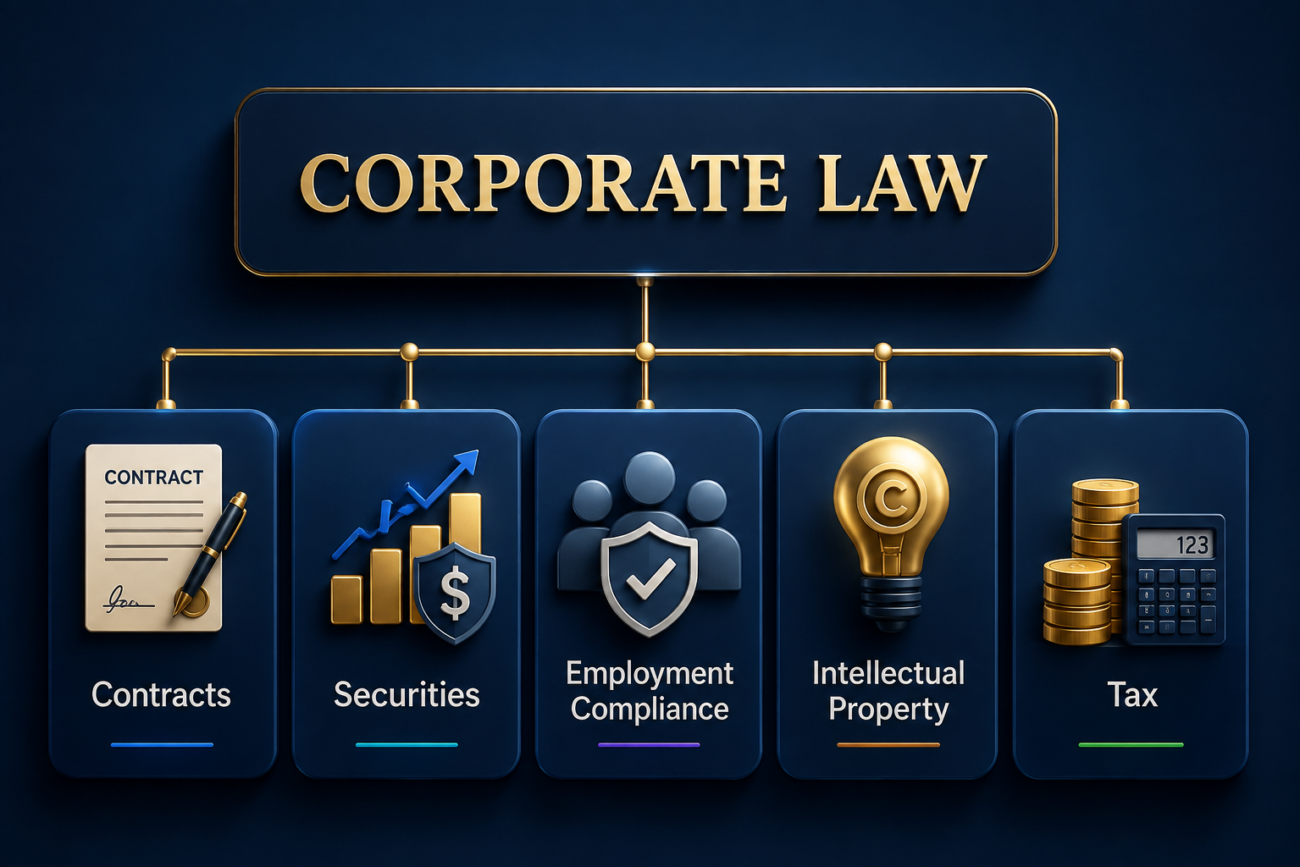
Major Areas Covered by Corporate Law
Corporate operations touch multiple legal specialties.
Corporate Contracts
Companies rely on binding legal agreements to operate safely.
- Vendor and supplier distribution contracts.
- Commercial real estate and equipment leases.
- Employment, non-disclosure, and non-compete agreements.
Securities and Investment Regulations
Issuing equity or debt instruments to raise capital requires complying with federal and state securities laws to prevent fraud and protect retail investors.
Employment and Workplace Compliance
Companies must abide by federal wage standards, safe workplace mandates, non-discrimination laws, and statutory employee benefit rules.
Intellectual Property Protection
Protecting enterprise value requires registering patents, securing trademarks, holding copyrights, and protecting trade secrets through robust confidentiality agreements.
Tax Compliance
Companies must navigate income taxes, payroll withholdings, state sales taxes, and international transfer pricing rules.
Corporate Finance and Capital Raising
Drafting terms for debt instruments, convertible notes, preferred equity rounds, and bank financing facilities requires precise legal alignment.
Risk Management and Regulatory Compliance
Establishing effective legal auditing protocols reduces the risk of white-collar crime, environmental violations, and regulatory fines.
Common Corporate Law Challenges Businesses Face
Growing entities encounter distinct structural friction points that require experienced legal counsel.
Fifty-fifty ownership structures frequently result in operational paralysis when founders disagree on strategic directions. Well-drafted buy-sell agreements prevent deadlocks from shutting down the business.
Failing to maintain corporate formalities, commingling personal and business funds, or running undercapitalized operations allows creditors to pierce the corporate veil, leaving personal assets exposed to corporate liabilities.
Misclassifying employees as independent contractors exposes companies to steep retroactive tax penalties, back-pay claims, and administrative fines.
Corporate Law vs Business Law: Understanding the Difference
While frequently used interchangeably, corporate law, business law, and commercial law govern distinct aspects of the economic landscape.
| Practice Area | Primary Focus | Typical Applications |
| Corporate Law | Entity creation, board governance, equity structures, and shareholder rights. | Bylaws drafting, board resolutions, stock issuances, mergers. |
| Business Law | Broader laws governing commercial operations, employment, and market entry. | Employment disputes, office leases, municipal licensing, bankruptcy. |
| Commercial Law | Transactions involving the sale of goods, trade logistics, and payments. | Sales contracts, letters of credit, shipping claims, security interests. |
Corporate Law vs Cyber Law
As enterprises digitize their operations, corporate law and cyber law increasingly overlap.
Corporate Law Focus
Regulates legal entity governance, corporate capital transactions, shareholder disputes, board duties, and corporate structural decisions.
Cyber Law Focus
Regulates internet activities, user data privacy, software licensing, online transactions, network security mandates, and digital crime.
How Corporate Law and Cyber Law Work Together
Modern corporations process massive volumes of proprietary data, making cybersecurity compliance a central board duty rather than just an IT concern. Organizations can also use a Website Security Scanner to identify vulnerabilities across internet-facing websites and web applications before those weaknesses lead to security incidents.
Corporate Duty (Board Oversight) + Cyber Law Rules (Data Regulations) = Corporate Compliance
Corporate boards face direct liability under regulatory rules like GDPR, CCPA, and SEC Incident Disclosure Regulations if they neglect digital risk management.
Failing to secure digital infrastructure can constitute a breach of a director’s fiduciary duty of care, opening board members to shareholder derivative lawsuits following major security breaches.
Why Modern Businesses Need Both Corporate Law and Cyber Law
Operating a modern enterprise requires aligning corporate governance with data protection mandates.
- Asset Preservation: Protecting proprietary code, customer lists, and financial records requires enforcing intellectual property laws alongside robust digital security policies.
- M&A Due Diligence: Acquiring another business requires reviewing corporate contracts as well as evaluating cyber liabilities and software code risks.
- Regulatory Compliance: Businesses must navigate corporate filing rules while meeting data privacy compliance requirements across multiple states and countries.
Legal Compliance Best Practices for Companies
Maintaining compliance demands continuous administrative discipline.
- Hold annual board and shareholder meetings and record clear minutes for all formal decisions.
- Keep personal expenses completely separate from business accounts to maintain the corporate shield.
- Conduct regular legal audits of vendor contracts, intellectual property registrations, and workforce classifications.
- Review executive compensation and insider equity transactions to ensure full transparency.
Common Mistakes Businesses Should Avoid
- Using generic Internet templates for core contracts without tailoring them to local jurisdiction rules.
- Failing to record stock issuances and vesting schedules in an official corporate cap table.
- Delaying foreign entity registration when expanding operations across state lines.
- Ignoring local licensing rules and statutory reporting deadlines.
Bring in corporate counsel when structuring initial founder equity splits, raising capital from external investors, navigating shareholder disputes, negotiating major commercial acquisitions, or preparing an enterprise for sale.
How Corporate Law Differs Across Jurisdictions
Corporate legal standards vary significantly across international boundaries.
United States
Corporate laws are set at the state level rather than federally. Delaware remains the leading incorporation jurisdiction due to its specialized Court of Chancery and predictable corporate precedents.
United Kingdom
Governed at the national level by the Companies Act 2006. The system relies on a central registrar, Companies House, to manage statutory filings and public company disclosures.
European Union
Combines national company laws with EU-wide directives to enable smooth cross-border operations. EU rules place strong emphasis on worker representation on boards and strict data privacy standards.
Other International Considerations
Cross-border entities must navigate foreign investment restrictions, currency controls, international tax treaties, and local labor rules.
Future Trends Shaping Corporate Law
Emerging legal and technological shifts continue to alter corporate governance standards.
Artificial Intelligence and Corporate Governance
Boards are using AI tools for risk monitoring and legal compliance, while courts work to define director liability for corporate errors caused by automated decision systems.
ESG and Sustainability Regulations
Regulatory agencies increasingly require public corporations to disclose climate impacts, supply chain sustainability, and workforce diversity metrics.
Data Privacy and Cybersecurity Compliance
Global regulations are toughening penalties for unreported data breaches, forcing corporations to build privacy compliance directly into their business operations.
Cross-Border Business Regulations
Taxing digital services across borders and tightening international trade rules require multi-jurisdictional compliance strategies.
Frequently Asked Questions
What is corporate law in simple words?
Corporate law is the system of rules that governs how companies are formed, managed, owned, financed, and operated legally.
What are the main functions of corporate law?
It establishes the legal entity, protects limited liability, defines management duties, safeguards investor capital, and governs business transactions.
What is the difference between corporate law and business law?
Corporate law focuses specifically on entity creation, governance, and shareholder relations. Business law covers broader commercial activities, including employment law, real estate leases, and municipal licensing.
Is cyber law part of corporate law?
No, cyber law is a distinct legal field focused on digital activity and technology. However, corporations must comply with cyber laws to protect data assets and meet regulatory mandates.
Why is corporate law important for startups?
It helps founders structure equity splits correctly, protect personal assets, secure venture funding, and prevent owner disputes early in the business lifecycle.
Do small businesses need corporate law?
Yes. Small businesses structured as LLCs or corporations must observe corporate formalities to preserve limited liability protections and enforce operational agreements.
Conclusion
Corporate law provides the underlying structure that transforms commercial ideas into legally protected, scalable business entities. By managing fiduciary duties, maintaining strict regulatory compliance, and aligning corporate governance with emerging cyber laws, business leaders can protect personal assets, attract investor capital, and build long-term enterprise value.