A department for demand generation and digital marketing leader has a bigger job than simply running ads or collecting leads.
The department connects brand awareness, digital channels, content, customer data, lead generation, sales, and revenue goals. Its job is to create interest in a company’s products and turn that interest into measurable business opportunities.
This matters because modern buyers do not follow one simple path.
A person may discover a company through Google. They may later see a LinkedIn post, read a guide, visit a product page, leave the site, receive an email, return through another search, and finally request a demo.
A good demand generation department connects these actions instead of treating them as separate marketing activities.
Quick Answer
A department for demand generation and digital marketing leader plans and manages programs that create market awareness, attract the right audience, capture demand, nurture potential customers, and support sales pipeline growth. It normally combines content, SEO, paid media, email, marketing operations, analytics, conversion optimization, and sales alignment.
Table of Contents
What Is a Department for Demand Generation and Digital Marketing Leader?
The phrase department for demand generation and digital marketing leader can describe either the marketing function responsible for demand generation or the senior leader who manages that function.
In many companies, the leader may have a title such as:
- Director of Demand Generation
- Head of Demand Generation
- VP of Demand Generation
- Director of Digital Marketing
- Head of Growth Marketing
- VP of Growth
- Revenue Marketing Director
- Integrated Marketing Director
Titles vary, but the main business goal is similar.
The team must create qualified demand and help convert that demand into pipeline and revenue.
Definition
Demand generation is the process of creating awareness and interest in a company’s products or services, educating potential buyers, capturing existing demand, and helping prospects move toward a buying decision.
Demand generation is therefore broader than lead generation.
Lead generation focuses mainly on identifying people or companies that may become customers. Demand generation includes the work that happens before, during, and after that lead is captured.
Demand Generation vs. Lead Generation vs. Digital Marketing
These terms are often used as if they mean the same thing. They do not.
| Area | Main Goal | Common Activities | Typical Measures |
|---|---|---|---|
| Demand generation | Create and capture market demand | Content, campaigns, events, SEO, paid media, nurturing | Pipeline, qualified opportunities, revenue |
| Lead generation | Capture potential buyers | Forms, landing pages, gated assets, webinars | Leads, CPL, conversion rate |
| Digital marketing | Reach people through digital channels | SEO, PPC, social, email, display | Traffic, clicks, conversions, ROAS |
| Brand marketing | Build recognition and trust | Brand campaigns, PR, research, storytelling | Awareness, branded search, reach |
| Growth marketing | Improve growth across the funnel | Experiments, acquisition, activation, retention | CAC, conversion, revenue growth |
Digital marketing provides many of the channels used by demand generation. Lead generation is one part of the demand process. Brand marketing helps create familiarity and trust.
Growth marketing may extend further into product usage, retention, and customer expansion. A strong department connects these functions instead of allowing them to operate as isolated teams.
Why Does a Business Need a Demand Generation Department?
Many companies already have marketing teams. So why create a specific demand generation function?
The answer is accountability. Traditional marketing departments sometimes organize work around channels. One person manages SEO. Another runs paid ads. Someone else manages email. A content team publishes articles. Social media has its own calendar.
Each team can produce good numbers while the business still struggles to generate pipeline.
For example, SEO traffic may rise by 40%, social impressions may double, and paid campaigns may generate thousands of clicks.
But did qualified buyers enter the pipeline?
That is the question demand generation tries to answer.
Key Takeaway
Demand generation changes the marketing question from “How much activity did we create?” to “Did our marketing create meaningful buyer interest and business opportunities?”
This shift can make marketing much easier to evaluate.
7 Core Responsibilities of a Department for Demand Generation and Digital Marketing Leader
The exact structure depends on the company’s size, product, sales model, and target audience. However, seven responsibilities usually sit at the center of the function.
1. Define the Ideal Customer
Demand generation becomes expensive when a company markets to everyone. The leader should first understand who is most likely to buy. This normally means defining an ideal customer profile, or ICP.
For a B2B company, the ICP may include:
- Industry
- Company size
- Revenue
- Geography
- Technology stack
- Business problem
- Buying triggers
- Typical budget
- Decision makers
- Buying committee members
The team can then create buyer personas within those target companies.
For example, a software company selling data security tools may target large financial companies. But several people could influence the purchase, including IT directors, security leaders, compliance managers, finance leaders, and procurement teams.
Content and campaigns should reflect these different needs.
2. Create Demand Before Asking for a Sale
Not every potential customer is ready to buy today. This is one of the most important ideas in demand generation. A company cannot force every visitor into a sales conversation. Instead, it can educate its market.
Useful content may include:
- Educational articles
- Original research
- Videos
- Industry reports
- Templates
- Checklists
- Webinars
- Podcasts
- Case studies
- Comparison pages
- Product guides
- Expert interviews
The goal is to help buyers understand a problem and recognize possible solutions.
This is where SEO can play an important role.
Companies can create content around the real questions buyers search for. Readers can discover the company while researching their problems instead of only seeing sales messages.
For a broader explanation of how organic visibility supports commercial outcomes, read AT HUB Technology’s article on how SEO turns search visibility into real business growth
3. Capture Existing Demand
Creating demand is only half the job. Some people already know what they need. They may search terms such as:
- “best payroll software for small businesses”
- “enterprise CRM pricing”
- “marketing automation platform”
- “best cybersecurity software”
These searches can show stronger commercial intent than a general educational search. A demand generation team should identify these high-intent opportunities.
Channels can include:
- Google Search
- SEO
- Paid search
- Review platforms
- Software directories
- Retargeting
- Partner marketing
- Comparison pages
- Product-led acquisition
Reviews and brand reputation can also influence buyers at this stage. A strong online reputation management approach helps businesses build trust when prospects compare reviews, search results, and competing providers.
The team should make it easy for high-intent buyers to take the next step.
That step could be starting a free trial, booking a demo, checking pricing, contacting sales, or creating an account.
Best Practice
Do not send every visitor to the homepage. Match landing pages with search intent, campaign intent, audience needs, and the stage of the buying journey.
4. Build a Multi-Channel Digital Marketing System
Modern demand rarely comes from one channel. A buyer might first find an article through organic search and later convert through an email campaign.
Another prospect may discover a brand on LinkedIn but return directly several weeks later. This makes channel coordination important. A department for demand generation and digital marketing leader may manage or coordinate:
Search Engine Optimization
SEO helps a company appear when buyers search for relevant questions, products, categories, and problems. The team should think beyond traffic.
Important SEO goals can include:
- Reaching relevant buyers
- Increasing non-branded discovery
- Building topical authority
- Ranking for commercial searches
- Supporting product education
- Increasing qualified conversions
Paid Search
Paid search can capture people who already show buying intent. However, clicks alone do not prove success. The department should connect advertising data with CRM and revenue data whenever possible.
A campaign with a higher cost per lead can sometimes be more valuable if those leads create better opportunities.
For companies evaluating agency-led paid acquisition, AT HUB Technology also covers the role of a performance marketing agency.
Social Media
Social platforms can create awareness before people begin actively searching.
For B2B organizations, professional networks can help companies distribute expertise, research, customer stories, product education, and executive insights. Teams can also use scheduling tools to auto post content consistently across their social channels. Tools such as predis AI can help marketing teams create video and posts for social media more efficiently, supporting a consistent publishing schedule.
The right platform depends on the audience.
Email Marketing
Email allows a business to continue the conversation.
Useful email programs may include:
- Newsletter campaigns
- Educational sequences
- Event follow-ups
- Product education
- Trial onboarding
- Lead nurturing
- Re-engagement campaigns
Good email marketing gives people a reason to keep reading. Sending repeated sales messages usually creates fatigue.
Content Marketing
Content connects many demand channels.
- SEO needs content.
- Email needs content.
- Social campaigns need content.
- Sales teams need useful material.Paid campaigns need landing pages and offers.
Demand generation leaders should therefore treat content as business infrastructure, not simply a publishing calendar.
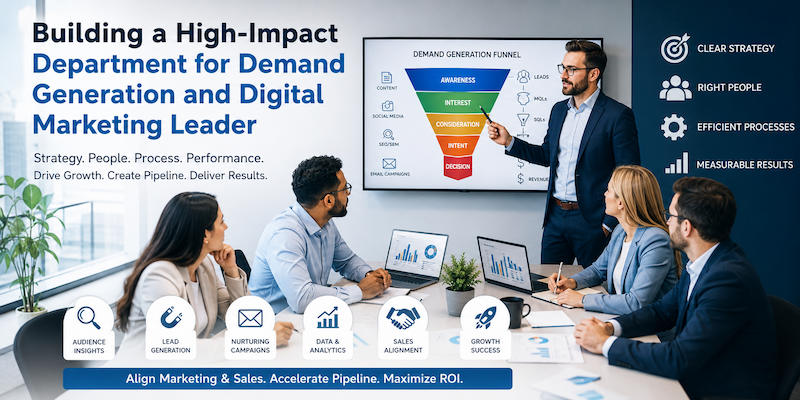
5. Create a Clear Demand Generation Funnel
A simple funnel can help teams understand how people move toward a purchase. One useful model has five stages.
Stage 1: Awareness
The buyer becomes aware of a problem or company. Useful channels include search, social media, podcasts, PR, communities, advertising, and events.
Stage 2: Education
The buyer learns more about the problem. Useful assets include articles, guides, videos, research, webinars, and newsletters.
Stage 3: Consideration
The buyer begins comparing possible solutions. Useful assets include case studies, product pages, comparison content, customer stories, and demonstrations.
Stage 4: Decision
The buyer becomes ready to act. Pricing pages, trials, demos, consultations, proposals, and sales conversations become more important.
Stage 5: Expansion
Demand generation should not always stop after the first purchase. Existing customers may buy additional products, upgrade plans, add users, or refer other customers.
Marketing can support this stage with customer education, product announcements, community programs, and relevant offers.
6. Align Marketing and Sales
Demand generation can fail when sales and marketing measure success differently. Marketing may celebrate lead volume. Sales may say those leads are poor. Sales may ask for more opportunities. Marketing may say sales does not follow up quickly enough.
This creates friction. The demand generation leader should establish shared definitions.
The teams should agree on questions such as:
- What is a qualified account?
- What is a qualified lead?
- When should marketing pass a lead to sales?
- How quickly should sales respond?
- What information should marketing provide?
- When should an unready lead return to nurturing?
- How will pipeline be attributed?
- Which metrics will both teams review?
Shared definitions reduce arguments based on opinion.
They also make reporting more useful.
Key Takeaway
Sales alignment is not a monthly meeting. It is a shared operating system built around common definitions, data, goals, and feedback.
7. Measure Revenue Impact
Demand generation leaders need metrics, but more metrics do not always mean better decisions.
A dashboard with 70 numbers can hide the few numbers that actually matter.
Useful metrics may include:
| Metric | What It Tells You |
|---|---|
| Qualified traffic | Whether relevant people reach the site |
| Conversion rate | How often visitors take a target action |
| Cost per lead | Cost of generating a lead |
| Cost per opportunity | Cost of creating a sales opportunity |
| Customer acquisition cost | Total cost required to win a customer |
| Pipeline generated | Opportunity value linked to marketing |
| Pipeline velocity | How quickly opportunities move |
| Win rate | Percentage of opportunities that become customers |
| Average deal size | Typical value of closed business |
| Marketing-sourced revenue | Revenue originating from marketing |
| ROAS | Revenue relative to advertising spend |
| LTV:CAC | Customer value compared with acquisition cost |
Not every business needs every metric.
Search measurement is also expanding beyond rankings and organic clicks. Teams tracking visibility across newer discovery environments can use AI search visibility metrics and KPIs alongside traditional SEO and revenue measures.
A self-service SaaS product may focus heavily on trials, activation, conversion rate, CAC, and recurring revenue.
An enterprise company may care more about target-account engagement, qualified opportunities, pipeline, sales cycle length, and deal value.
What Should the Demand Generation Department Structure Look Like?
There is no single perfect organization chart.
A small company may have three people doing work that requires 20 specialists at a large company.
A practical structure could look like this:
Head of Demand Generation
↓
Content and SEO
↓
Paid Acquisition
↓
Lifecycle and Email
↓
Marketing Operations
↓
Analytics and Conversion Optimization
Each function supports the same commercial goal.
Small Business Structure
A smaller company may have:
- One demand generation manager
- One content marketer
- One paid media specialist
- Freelance design or development support
Automation can reduce some manual work.
Mid-Market Structure
A growing company may add:
- SEO specialist
- Content manager
- Performance marketer
- Lifecycle marketer
- Marketing operations manager
- Designer
- Data analyst
Enterprise Structure
Large organizations may separate functions further.
Teams may include:
- Global demand generation
- Regional demand generation
- Account-based marketing
- Field marketing
- Paid media
- SEO
- Content
- Marketing operations
- Lifecycle marketing
- Partner marketing
- Analytics
- Conversion optimization
The right structure depends on business complexity, not simply company size.
Demand Generation Leader vs. Digital Marketing Leader
These jobs overlap, but their priorities can differ.
| Demand Generation Leader | Digital Marketing Leader |
|---|---|
| Focuses strongly on pipeline | Focuses strongly on digital channels |
| Works closely with sales | Often works closely with brand and web teams |
| Owns funnel strategy | May own channel strategy |
| Measures opportunities and revenue | Often measures traffic and conversions |
| Coordinates nurturing | Coordinates digital execution |
| Often owns marketing operations | May share operations with another team |
In many modern companies, one person may perform both roles.
This explains why the phrase department for demand generation and digital marketing leader can describe a broad leadership position rather than a narrow marketing specialty.
Skills a Demand Generation and Digital Marketing Leader Needs
The strongest leaders combine strategic, analytical, creative, and management skills.
Strategic Thinking
The leader needs to understand the market.
They should know:
- Who the company serves
- What buyers care about
- Why customers choose the product
- Why deals are lost
- Where demand exists
- Where new demand can be created
Data Literacy
A leader does not need to be a data scientist.
However, they should understand marketing data well enough to question reports.
They should be comfortable discussing:
- Conversion rates
- Attribution
- Funnel stages
- CAC
- Pipeline
- Revenue
- Cohorts
- Experiment results
Channel Knowledge
A leader should understand how major acquisition channels work even if specialists manage them.
This includes SEO, paid media, email, social media, content, landing pages, and analytics.
Communication
Demand generation touches many teams.
The leader may regularly work with:
- Sales
- Product
- Finance
- Customer success
- Data teams
- Executives
- Agencies
- Technology vendors
Clear communication becomes essential.
Experimentation
Marketing changes quickly.
Teams should test ideas instead of assuming every strategy will work.
Experiments might test:
- Headlines
- Offers
- Landing pages
- Audiences
- Ad messages
- Calls to action
- Email sequences
- Pricing-page layouts
Tests should answer a useful business question.
Technology Used by Demand Generation Departments
Technology can help teams operate at scale.
A common marketing technology stack may contain:
| Technology | Purpose |
|---|---|
| CRM | Customer and opportunity management |
| Marketing automation | Email and lead nurturing |
| Analytics | Website and campaign measurement |
| Advertising platforms | Paid acquisition |
| SEO software | Search research and performance |
| CMS | Website and content publishing |
| A/B testing tools | Conversion experiments |
| Data warehouse | Centralized business data |
| BI tools | Reporting and visualization |
| Intent platforms | Buyer-interest signals |
Examples of widely used platforms include Google Analytics, HubSpot, Salesforce, and LinkedIn. The goal is not to own the largest technology stack. Every tool should solve a clear problem.
A company with 30 disconnected marketing tools may have worse data than a company using six well-integrated systems.
Sales teams can extend this technology stack with B2B sales intelligence tools that combine contact data, account research, buyer signals and prospecting workflows.
A Realistic Demand Generation Example
Consider a fictional B2B cybersecurity company selling security software to mid-sized businesses. The company wants more qualified sales opportunities. Its team first studies existing customers. It discovers that IT directors often begin researching after a security audit exposes gaps in their current processes.
The demand generation team builds a campaign around this trigger.
Step 1: Educational Content
The company publishes a guide explaining what to do after a failed security audit.
The guide targets useful informational searches.
Step 2: Search Visibility
The SEO team creates related content answering common audit, compliance, and security questions.
Step 3: Paid Distribution
The paid media team promotes selected resources to IT leaders at target companies.
Step 4: Retargeting
People who read the guide can later see relevant product education.
Step 5: Email Nurturing
Visitors who choose to subscribe receive useful security resources rather than immediate sales emails.
Step 6: High-Intent Conversion
When someone later visits product, integration, pricing, or demo pages, the company can treat that behavior as stronger buying intent.
Step 7: Sales Follow-Up
Qualified prospects are sent to sales with context about their interests and previous engagement.
Step 8: Revenue Measurement
The company tracks which opportunities and customers came through the campaign.
This is different from simply reporting 25,000 article views.
Traffic matters, but the company ultimately wants to know whether the campaign influenced real business.
How to Build a Department for Demand Generation and Digital Marketing Leader Function
Companies building the function from scratch can follow a simple process.
Step 1: Start With Revenue Goals
Do not begin with channels. Begin with the business target.
For example:
“We need $5 million in new pipeline during the next six months.”
The team can then work backward.
Step 2: Define the Audience
Identify the accounts and people most likely to buy. Document their problems, triggers, objections, goals, and buying process.
Step 3: Map the Customer Journey
Understand what happens before a purchase.
Ask:
- What triggers research?
- What questions appear first?
- Where do buyers search?
- Which alternatives do they compare?
- Who approves the purchase?
- What stops the deal?
Step 4: Identify Existing Demand
Find places where buyers already show intent.
Search data, paid search results, website analytics, sales calls, review sites, CRM records, and customer interviews can provide useful clues.
Step 5: Create New Demand
Publish useful information and distribute it where the target audience spends time. Do not require a form for everything. Some valuable content should be easy to access and share.
As campaigns grow across search, social, email, and paid media, clear marketing campaign naming can also help teams organize assets, tracking, reports, and experiments consistently.
Step 6: Build Conversion Paths
Make the next step obvious. A visitor should not have to search the whole website to find pricing, a trial, contact information, or a demo.
Step 7: Connect Marketing Data
Link marketing systems with the CRM where practical. This helps teams understand what happens after a lead is created.
Step 8: Review Pipeline
Look beyond campaign-level metrics.
Study which programs create qualified opportunities and customers.
Step 9: Improve Continuously
Reduce spending on weak activities. Increase investment in programs that repeatedly produce good outcomes.
Common Demand Generation Mistakes
Mistake 1: Measuring Only Leads
Ten thousand weak leads can be less valuable than 100 highly relevant prospects. Lead volume needs context.
Mistake 2: Gating Everything
Forms have a purpose, but putting every useful resource behind a form creates friction. Sometimes reach and education are more valuable than collecting another email address.
Mistake 3: Treating Every Lead as Sales-Ready
Downloading a guide does not mean someone wants a sales call. Use behavior and intent to decide when sales involvement makes sense.
Mistake 4: Ignoring Brand
People often prefer companies they recognize and trust. Demand generation and brand marketing should support each other.
Mistake 5: Looking Only at Last-Click Attribution
The final click does not always tell the whole story. A prospect may interact with many marketing activities before converting.
Mistake 6: Buying Too Much Software
New software cannot repair a weak strategy. Fix the process before adding more technology.
Mistake 7: Separating SEO From Revenue
Organic traffic should not exist in its own reporting world. Teams should examine which organic pages attract relevant visitors and contribute to meaningful actions.
AT HUB Technology’s guide to AI search visibility metrics and KPIs provides additional context for teams measuring visibility beyond traditional search reports.
How Should a Demand Generation Leader Set Priorities?
One useful approach is to divide work into three groups.
1. Capture
Capture people already looking for a solution.
Examples include paid search, commercial SEO pages, comparison pages, directories, and review platforms.
2. Create
Build awareness among people who have the problem but are not actively shopping.
Examples include research, educational content, video, social media, communities, PR, and events.
3. Convert
Help interested people become customers.
Examples include landing-page optimization, nurturing, retargeting, trials, demos, case studies, and sales enablement.
Best Practice
A healthy demand strategy normally includes demand creation, demand capture, and conversion improvement. Depending on only one of these areas can limit long-term growth.
How AI Is Changing Demand Generation
Artificial intelligence can speed up parts of marketing work.
Teams can use AI to support:
- Research
- Data analysis
- Content briefs
- Audience segmentation
- Campaign variations
- Reporting
- Lead scoring
- Personalization
- Forecasting
But speed creates a new problem.
Companies can now produce more average content and more average advertising than before. Volume alone is not an advantage.
Original research, useful experience, customer knowledge, expert insight, strong positioning, and trustworthy information become more valuable when generic content becomes easy to produce.
AI should therefore help teams improve decisions and execution rather than replace strategic thinking.
What Should Executives Expect From the Department?
Executives should expect more than traffic charts.
A mature demand generation function should be able to explain:
- Which audiences it targets
- Which problems it addresses
- Where demand comes from
- How marketing supports pipeline
- Which programs are working
- Which programs are failing
- What the company is learning
- Where the next investment should go
The team may not be able to attribute every dollar perfectly.
Marketing measurement has limitations.
That should not stop teams from using the best available evidence to make better decisions.
90-Day Framework for a New Demand Generation Leader
A new leader should avoid changing everything during the first week.
Days 1 to 30: Learn
Review:
- Customer segments
- CRM data
- Marketing performance
- Sales pipeline
- Customer interviews
- Website analytics
- Existing campaigns
- Marketing technology
- Sales feedback
Identify obvious measurement gaps.
Days 31 to 60: Prioritize
Choose a small number of high-impact problems.
Examples could include weak paid-search conversion, poor sales handoff, missing commercial SEO content, or an ineffective nurturing process.
Create clear owners and targets.
Days 61 to 90: Execute and Measure
Launch improvements.
Measure the effect.
Share early findings with marketing, sales, and leadership.
Do not pretend every initiative will succeed.
A useful demand generation culture learns from failed experiments as well as successful ones.
Key Takeaways
A department for demand generation and digital marketing leader should connect marketing activity with real buyer behavior and commercial outcomes.
The most important lessons are:
- Demand generation is broader than lead generation.
- Digital marketing channels support the demand strategy.
- Demand creation and demand capture require different approaches.
- Marketing and sales need shared definitions.
- Pipeline quality matters more than raw lead volume.
- Content should educate buyers, not simply collect form submissions.
- SEO, paid media, email, social, and content work better when connected.
- Marketing technology should support strategy rather than define it.
- Revenue metrics should sit beside channel metrics.
- Continuous testing helps the department improve.
The strongest demand generation departments do not chase every new channel.
They understand their buyers, create useful information, capture existing intent, make buying easier, and measure whether those activities contribute to business growth.
Frequently Asked Questions
What is a department for demand generation and digital marketing leader?
It is a marketing function or leadership role responsible for creating buyer interest, capturing demand, managing digital channels, and supporting qualified sales pipeline.
What does a demand generation leader do?
A demand generation leader plans campaigns, manages acquisition channels, aligns marketing with sales, improves conversion paths, and measures marketing’s effect on pipeline and revenue.
Is demand generation the same as lead generation?
No. Lead generation focuses on capturing prospects, while demand generation also creates awareness, educates buyers, nurtures interest, and supports the full buying journey.
What is the difference between demand generation and digital marketing?
Digital marketing describes channels such as SEO, paid search, email, and social. Demand generation uses those channels within a broader strategy for creating and capturing demand.
Which department normally owns demand generation?
Demand generation usually sits within marketing. In larger organizations, it may operate as a dedicated team under a CMO, VP of Marketing, or Chief Growth Officer.
What KPIs should demand generation teams track?
Useful KPIs include qualified traffic, conversion rates, cost per opportunity, customer acquisition cost, pipeline generated, win rate, deal size, revenue, and LTV:CAC.
Does SEO belong in demand generation?
Yes. SEO can create awareness through informational searches and capture existing demand through commercial searches, making it valuable across several stages of the buyer journey.
Should demand generation report to sales?
Usually it remains within marketing, but close sales alignment is essential. Both teams should agree on qualification, handoffs, pipeline definitions, and revenue goals.
Is content marketing part of demand generation?
Yes. Content helps educate buyers, build trust, support search visibility, nurture prospects, answer objections, and provide sales teams with useful material.
Can small businesses use demand generation?
Yes. A small company does not need a large department. It can start with a clear audience, useful content, one or two acquisition channels, and simple measurement.
What is demand capture?
Demand capture means reaching buyers who already show interest in solving a problem or purchasing a product, often through search, comparison pages, directories, and retargeting.
What is demand creation?
Demand creation introduces a problem, idea, or solution to people who may fit the target audience but are not yet actively searching for a product.
What technology does a demand generation team need?
Most teams need analytics, a CRM, website publishing, email tools, and channel-specific platforms. Larger teams may add automation, attribution, intent, testing, and BI systems.
How can marketing and sales work better together?
They should share qualification definitions, establish clear handoff rules, review pipeline together, exchange feedback, and measure business outcomes rather than isolated department metrics.
How long does demand generation take to work?
Some demand-capture campaigns can produce results quickly. Demand creation, SEO, brand building, and complex B2B buying journeys may require months of consistent work.
Should every piece of content generate leads?
No. Some content should educate, earn trust, attract links, answer questions, or create awareness. Forcing a form onto every resource can reduce its reach.
What makes a strong demand generation leader?
Strong leaders combine customer understanding, strategy, analytics, channel knowledge, experimentation, communication, sales alignment, and the ability to connect marketing decisions with business goals.
Is paid advertising required for demand generation?
No. Companies can generate demand through SEO, content, partnerships, communities, email, events, referrals, and organic social. Paid advertising can accelerate reach and demand capture.
How does AI support demand generation?
AI can support research, segmentation, reporting, forecasting, personalization, analysis, and content workflows. Human judgment remains important for strategy, positioning, expertise, and customer understanding.
What is the biggest demand generation mistake?
A common mistake is optimizing for lead volume without checking lead quality, pipeline contribution, sales outcomes, or customer value.