AI search visibility metrics and KPIs are becoming essential because traditional SEO metrics were built for a different era. Rankings, impressions, and click-through rates assume someone typed a query and browsed a list of blue links. That model is changing.
Users now get answers directly from Google AI Overviews, ChatGPT, Perplexity, Gemini, Microsoft Copilot, and other AI-powered platforms. Instead of clicking to your website, they read an AI-generated summary. Your brand may be mentioned, misrepresented, or completely absent, and your existing analytics will not tell you which.
AI search visibility metrics help businesses understand how often their brand appears in AI-generated answers. This is why AI search visibility metrics and KPIs are becoming essential for businesses. If you want to understand how AI systems perceive, describe, and recommend your brand, you need a new measurement framework designed for the AI answer era.
Table of Contents
What Is AI Search Visibility?
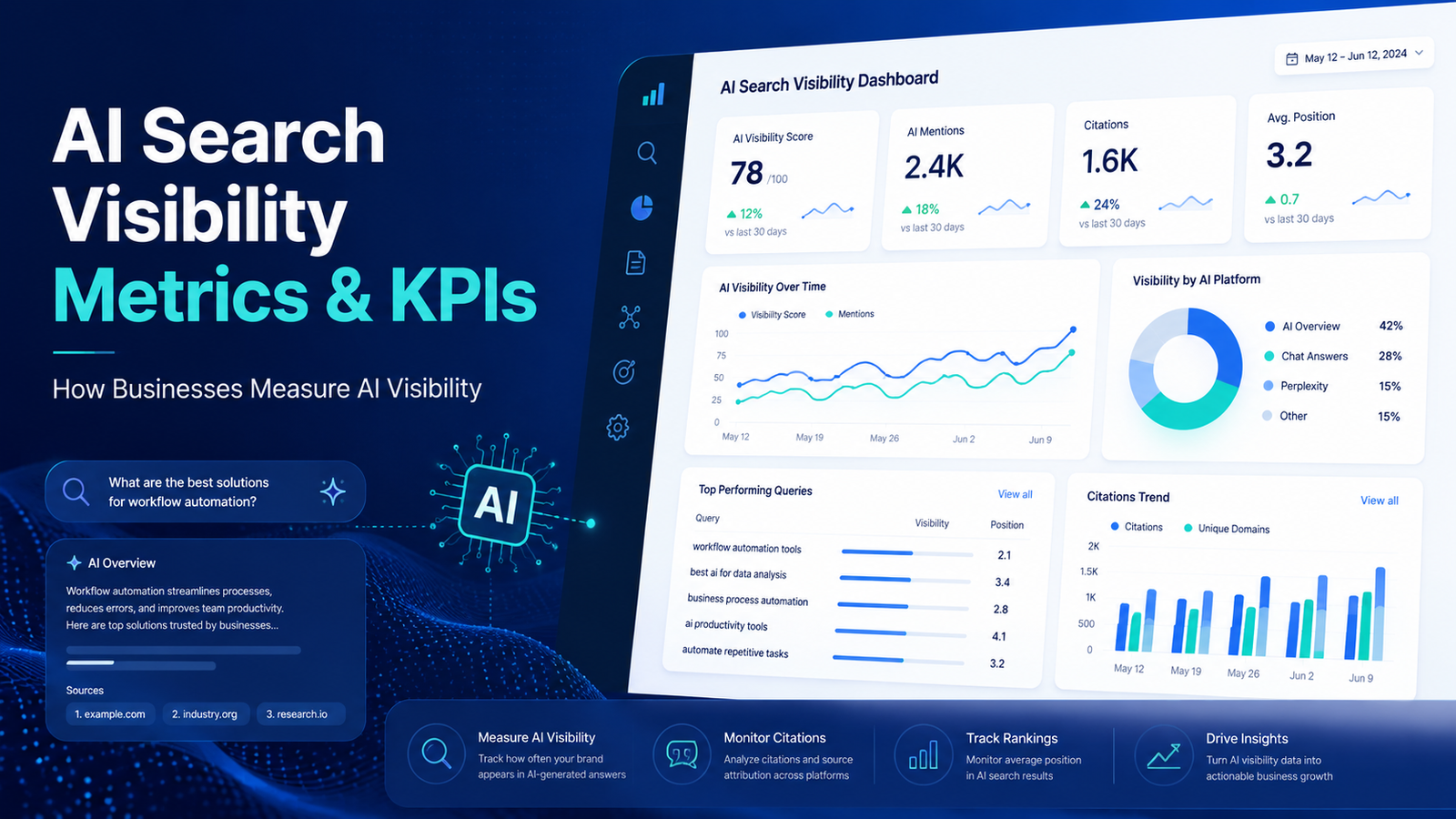
AI search visibility refers to how often, how accurately, and how favorably your brand appears inside AI-generated answers across platforms like Google AI Overviews, ChatGPT, Perplexity, and Gemini. AI search visibility metrics and KPIs help companies understand whether AI platforms can find, cite, and describe their brand correctly. Unlike traditional SEO rankings, AI search visibility metrics focus on mentions, citations, accuracy, and context inside AI responses.
It is different from traditional rankings. A high-ranking website may still be ignored by an AI system if the content is not structured clearly, lacks authoritative citations, or does not match the contextual understanding the AI has built about your industry.
Think of it this way: if someone asks ChatGPT to recommend a project management tool for a remote team, will your product appear? If someone asks Google’s AI Overview about the best CRM for small businesses, does your company get mentioned? These are AI visibility questions, and they are not answered by checking your Google Search Console data.
Why AI Search Visibility Metrics Matter
Most businesses have no idea how AI platforms describe them. Some are being described inaccurately. Others are not mentioned at all, even for topics where they have strong expertise. Tracking AI search visibility metrics and KPIs gives businesses a clearer view of how AI platforms understand their brand.
The companies that invest in understanding and improving their AI visibility now will have a significant advantage as AI search becomes the default discovery method for buyers, researchers, and decision-makers.
There are three core reasons to start measuring AI visibility today:
- AI answer engines are replacing the first page of search results for an increasing number of queries.
- Buyers use AI tools to research products and vendors before contacting a sales team.
- Competitors who appear in AI answers first will capture awareness and trust that never reaches your website.
Waiting until AI search is fully mainstream is like waiting to optimize for mobile until everyone already has a smartphone.
Key AI Search Visibility Metrics and KPIs
The best AI search visibility metrics and KPIs measure mentions, citations, answer accuracy, competitor visibility, and conversion impact. Here are the ten metrics that matter most when measuring how visible and well-represented your brand is inside AI-generated answers.
1. AI Mention Frequency
This measures how often your brand appears when relevant prompts are run across AI platforms. Run a set of industry-relevant questions and count how often your company name surfaces in the responses.
2. Brand Citation Rate
Some AI systems cite sources. Brand citation rate tracks what percentage of AI responses reference your website, publications, or content as a source. Higher citation rates signal authority.
3. Share of AI Voice
Borrowed from the marketing concept of share of voice, this metric compares how often your brand appears in AI answers relative to your competitors. If ten AI responses about your category mention Competitor A five times and your brand twice, your share of AI voice is roughly 20%.
4. Prompt Coverage
Define the prompts most relevant to your business, product questions, industry questions, use-case questions, comparison questions. Prompt coverage tracks what percentage of those prompts return a mention of your brand in any position.
5. Sentiment of AI Answers
When AI systems do mention your brand, what tone do they use? Are the descriptions positive, neutral, or negative? Sentiment scoring is important because AI-generated descriptions shape first impressions before a user ever reaches your website.
6. Accuracy of AI-Generated Answers
This is one of the most undertracked metrics. AI systems sometimes describe products incorrectly, cite outdated pricing, or confuse your brand with a competitor. Accuracy tracking involves reviewing AI answers for factual correctness and flagging errors that need to be corrected at the source.
7. Source Citation Quality
AI systems draw from public sources. The quality of those sources, whether they are respected publications, industry directories, or low-authority blogs, affects how authoritatively your brand is described. Tracking source quality helps you understand which external placements are influencing AI answers.
8. Topic Authority Coverage
Does AI associate your brand with the topics you actually specialize in? Topic authority coverage measures how many of your core subject areas the AI accurately connects to your brand. A cybersecurity company that only appears in AI answers about one product type but never about compliance or threat intelligence has low topic authority coverage.
9. Competitor Comparison Visibility
When users ask AI to compare vendors or recommend tools in your category, who gets mentioned? This metric tracks your presence in head-to-head and category comparison prompts, one of the highest-intent query types in AI search.
10. Conversion Impact from AI Search
Ultimately, AI visibility should tie back to business results. Use UTM parameters, referral traffic analysis, and attribution models to understand how much pipeline or revenue is influenced by AI search visibility. This metric builds the business case for ongoing investment.
Tracking AI search visibility metrics and KPIs helps businesses understand how often their brand appears in AI-generated answers.
AI Search Visibility Metrics and KPIs Table
The table below summarizes the key metrics, what they measure, why they matter, and how to improve each one.
| Metric | What It Measures | Why It Matters | How to Improve It |
| AI Mention Frequency | How often your brand appears in AI answers | Reveals baseline AI discovery rate | Publish consistent, well-structured content |
| Brand Citation Rate | % of AI responses citing your brand as a source | Measures credibility and reference value | Build authority; get cited on trusted sites |
| Share of AI Voice | Your brand vs. competitors in AI answers | Shows competitive positioning in AI search | Increase topical authority and coverage |
| Prompt Coverage | % of target prompts that return your brand | Identifies content and topic gaps | Create content targeting uncovered prompts |
| Sentiment of AI Answers | Whether AI describes your brand positively | Negative framing harms conversion rates | Correct misleading information at the source |
| Answer Accuracy | Whether AI facts about your brand are correct | Inaccurate answers damage trust and leads | Keep product pages, FAQs, and data updated |
| Source Citation Quality | Quality of sources AI uses to reference you | Better sources = more trusted AI descriptions | Earn mentions on authoritative platforms |
| Topic Authority Coverage | How many key topics AI associates with you | Broad authority expands AI visibility | Build topical clusters around core subjects |
| Competitor Comparison Visibility | How often AI mentions you vs. competitors | Competitive intelligence for positioning | Create explicit comparison and alternative pages |
| Conversion Impact | Traffic and leads originating from AI search | Quantifies AI visibility in business terms | Optimize landing pages for AI-referred users |
AI Governance and Business Context in Visibility Tracking
When AI systems generate answers about your company, they pull from whatever public information is available. If your website is inconsistent, your third-party listings are outdated, or your positioning is unclear, the AI builds an inaccurate picture, and then shares that picture with every person who asks.
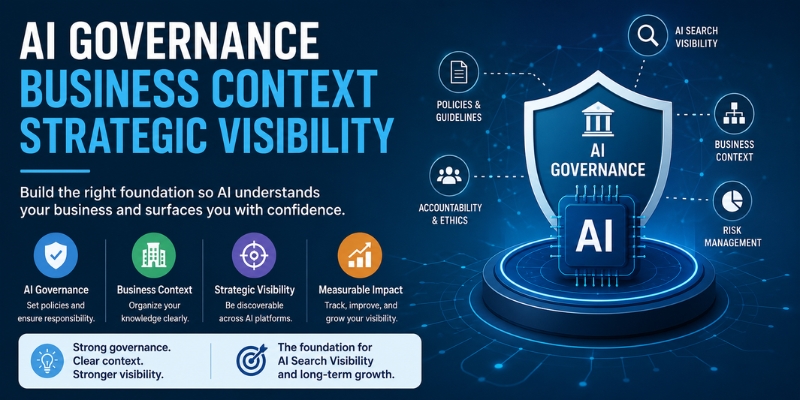
This is where AI governance business context strategic visibility becomes relevant. Businesses that treat AI visibility as a strategic priority need governance frameworks that define what information is accurate, where it is published, how it is maintained, and who is responsible for keeping it current.
Similarly, AI governance business context business-specific accuracy refers to ensuring that AI systems understand details specific to your business, your target market, your pricing model, your use cases, your certifications, your geographic coverage. Generic descriptions are not enough. AI systems need granular, well-structured information to represent your brand with precision.
Governance in this context means owning your narrative before AI systems create one for you.
What Is AI Business Context Refinement?
AI business context refinement is the process of deliberately shaping the public information available about your brand so that AI systems can understand and describe you more accurately.
It involves reviewing the content and data sources AI platforms are most likely to use your website, your knowledge base, third-party reviews, press coverage, directory listings, and social profiles, and improving them so the picture they collectively paint is accurate, complete, and aligned with your actual positioning.
Practical steps for AI business context refinement include:
- Rewriting product and service pages to clearly explain what you do, who you serve, and what outcomes you deliver.
- Publishing structured FAQ content that answers the exact questions your buyers ask AI tools.
- Creating comparison pages that position your brand clearly relative to alternatives.
- Standardizing business information: name, address, description, categories, across all directories and listings.
- Adding structured data markup (schema.org) so search engines and AI crawlers can parse your content more effectively.
- Publishing case studies and use-case documentation that give AI systems evidence of your real-world applications.
The goal is to reduce the information gap between what AI systems know about you and what is actually true.
The Role of AI Contextual Organizational Knowledge
AI contextual organizational knowledge refers to the collective body of public information that allows an AI system to build an accurate, detailed understanding of what a business does and how it operates.
AI systems are not omniscient. They work with what is publicly available and well-structured. A company that has never published detailed product documentation, customer success stories, leadership credentials, or policy information is essentially invisible to AI at a deep level. The AI may know the company exists, but it cannot describe it with confidence or specificity.
Building strong AI contextual organizational knowledge means ensuring that the following information is publicly documented, well-written, and consistently structured:
- Products and services, including features, limitations, and ideal use cases.
- Customer types and industries served.
- Pricing models or tiers (at least at a general level).
- Company policies: returns, support, SLAs, security practices.
- Leadership team credentials and areas of expertise.
- Awards, certifications, and third-party validations.
- Geographic coverage and delivery capabilities.
The more complete this knowledge base is in the public domain, the better AI systems can represent your brand accurately, and the less likely they are to fill information gaps with incorrect assumptions.
How Businesses Can Track AI Search Visibility
Tracking AI visibility is a manual and semi-automated process for most businesses right now. Dedicated tooling is emerging, but the most reliable method is structured prompt testing. Here is a practical framework:
- Define your target topics. Identify the questions, comparisons, and use cases your buyers are most likely to search in AI tools.
- Create a master list of prompts. Write 20 to 50 prompts covering product questions, category comparisons, problem-solution queries, and competitor comparisons.
- Test across AI platforms. Run each prompt in Google AI Overviews, ChatGPT, Perplexity, Gemini, and any other platforms relevant to your audience.
- Record all brand mentions and citations. Log whether your brand appeared, how it was described, and whether the AI cited any sources.
- Compare with competitors. Run the same prompts with competitor names as the focus and compare how often each brand appears.
- Flag inaccuracies. Identify any incorrect descriptions, outdated information, or misleading characterizations and trace them to the source content.
- Update content and repeat. Make improvements to your website, FAQs, and third-party listings, then re-run the prompts monthly to track progress.
This process does not require specialized tools to start. A spreadsheet, a consistent set of prompts, and disciplined testing every month will give you meaningful data.
Common Mistakes When Measuring AI Visibility
Businesses new to AI visibility tracking often fall into predictable traps. Here are the most common mistakes to avoid:
- Only tracking Google rankings. Traditional SEO dashboards do not capture AI Overview appearances or mentions in LLM-based platforms.
- Ignoring answer accuracy. Knowing that your brand appeared in an AI answer is not enough if the answer is factually wrong.
- Not checking competitor mentions. Visibility is relative. You need to know how often competitors appear in the same prompts.
- Using vague prompts. Generic queries produce generic results. Your prompts need to reflect the specific questions your buyers ask.
- Not improving source content. Monitoring without acting on findings is wasted effort. AI visibility improves when the underlying content improves.
- Ignoring governance and compliance. Some industries, finance, healthcare, legal, face real risk if AI systems describe their offerings inaccurately. Governance teams should be involved in AI visibility tracking.
How to Improve AI Search Visibility
Improving AI visibility metric and KPIs is an ongoing content and authority-building effort. The following tactics are proven to make AI systems recognize and describe your brand more accurately and more often:
- Publish clear, detailed product and service pages that explain your offering without marketing fluff.
- Create comparison content, both against competitors and against alternative approaches, so AI systems understand where you fit in the market.
- Add structured FAQ sections to key pages, written in the natural language your customers use when asking AI tools.
- Improve author bios and expertise signals. AI systems value human expertise, and well-documented credentials help establish authority.
- Use schema markup to add structured data for your organization, products, FAQs, and reviews.
- Earn mentions and citations on trusted third-party websites, industry publications, analyst reports, review platforms, and respected directories.
- Keep all business information consistent across your website, Google Business Profile, social profiles, and industry directories.
- Build topical authority by publishing comprehensive content on a focused set of subjects rather than scattered articles across many unrelated topics.
Future of AI Search Visibility Metrics
AI search visibility metrics and KPIs are moving from a niche concern to a mainstream business metric. As AI-generated answers become the primary way users discover products, services, and companies, visibility inside those answers will carry the same strategic weight as organic search rankings did in the previous decade.
Expect AI visibility KPIs to appear on marketing dashboards alongside traditional SEO metrics within the next one to two years. PR teams, brand managers, digital transformation leads, and SEO professionals will all need to collaborate on AI visibility strategy.
Platforms and tools designed specifically for AI visibility tracking are already emerging. Businesses that establish measurement baselines now will be better positioned to demonstrate ROI when executive teams start asking for AI search performance reports.
The fundamentals, however, will remain constant: accurate information, strong authority signals, clear business context, and consistent content governance will always matter, no matter which AI platform becomes dominant.
For companies building modern digital teams, understanding the role of a technology solutions professional can also help connect AI visibility, business strategy, and practical technology implementation.
Frequently Asked Questions
What are AI search visibility metrics?
AI search visibility metrics and KPIs are measurements that track how often, how accurately, and how favorably a brand appears inside AI-generated answers on platforms like ChatGPT, Google AI Overviews, Perplexity, and Gemini. They help businesses understand whether AI tools can find and correctly represent their brand.
How is AI visibility different from traditional SEO?
Traditional SEO focuses on ranking positions in keyword-based search results and tracking clicks to a website. AI visibility focuses on whether a brand appears in AI-generated responses, which may not include clickable links at all. A highly-ranked page may still be poorly represented in AI answers if the content is not structured for AI comprehension.
What KPIs should businesses track for AI search?
The most important AI search KPIs include AI mention frequency, brand citation rate, share of AI voice, prompt coverage, sentiment accuracy, source citation quality, topic authority coverage, competitor comparison visibility, and the conversion impact of AI-referred users.
Why does business context matter in AI visibility?
AI systems describe brands based on whatever public information is available to them. If that information is incomplete, inconsistent, or inaccurate, the AI will produce descriptions that do not reflect the actual business. Providing clear, well-structured public content, what is sometimes called AI contextual organizational knowledge, helps AI systems represent your brand correctly.
How can a company improve visibility in AI-generated answers?
Companies can improve AI visibility by publishing detailed product and service content, creating FAQ sections written in natural language, building topical authority through consistent content publishing, earning citations on authoritative third-party sites, using schema markup, and regularly auditing AI answers for accuracy and completeness.
Conclusion
AI search visibility metrics and KPIs are not optional extras for forward-thinking businesses, they are becoming a core part of how brands understand and manage their digital presence. By monitoring AI search visibility metrics regularly, businesses can improve how AI platforms find, cite, and describe them.
Tracking how AI platforms find, describe, and cite your brand gives you a clearer picture of your true market visibility. It reveals content gaps, governance risks, accuracy problems, and competitive blind spots that traditional analytics cannot surface.
Businesses that build AI visibility measurement into their strategy now, before AI answer engines become the dominant discovery channel, will have a meaningful head start on competitors who wait.
For more practical guides on AI visibility, digital transformation, and technology strategy, explore more resources on AT Hub Technology at athubtechnology.com.