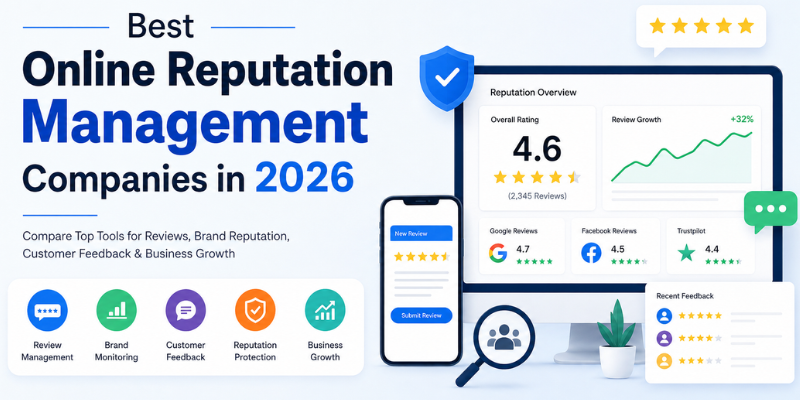
Your online reputation affects how customers find you, trust you, and choose you over a competitor. Whether you run a small local business, a growing hotel chain, a healthcare clinic, or a large enterprise brand, what people see when they search your name online matters more than ever.
This guide is for businesses, local brands, hotels, healthcare companies, SaaS startups, executives, agencies, and multi-location businesses that want to compare the best online reputation management companies and find the right fit for their needs.
The best online reputation management companies help businesses monitor reviews, collect customer feedback, improve public ratings, respond to negative feedback, and protect brand trust online. Some focus on review growth. Others handle full brand protection and search result cleanup. The right choice depends on your goals, budget, and business size.
Online reputation also connects with modern search visibility. Businesses are no longer only judged by traditional Google rankings. They are also judged by how they appear in AI answers, local search results, review platforms, and brand mentions. If you want to understand this wider trend, read this guide on AI Search Visibility Metrics and KPIs.
Table of Contents
Quick Comparison of the Best Online Reputation Management Companies
Use this table to compare platforms at a glance before diving into the full breakdown below.
| Company | Best For | Key Features | Pricing | Pros | Limitations |
|---|---|---|---|---|---|
| GetMoreReview | Small businesses | Review requests, private feedback routing, QR campaigns, dashboard | Free + paid plans | Easy to use, affordable, Google review growth | Not a full ORM agency |
| Birdeye | Multi-location brands | Review monitoring, messaging, surveys, social | Custom pricing | All-in-one platform, strong integrations | Can be expensive for small teams |
| Podium | Local businesses | Review requests via text, webchat, payments | Custom pricing | SMS-based review collection, fast setup | Pricing may not suit very small budgets |
| Reputation | Enterprise & multi-location | Review management, social monitoring, analytics | Custom pricing | Strong reporting, enterprise-grade | Setup requires onboarding support |
| ReviewTrackers | Agencies & brands | Review monitoring across 100+ sites, analytics | Contact sales | Deep analytics, multi-platform coverage | Less review generation focus |
| Trustpilot | eCommerce & SaaS | Verified reviews, widgets, brand trust signals | Free + paid plans | High consumer trust, good SEO value | Review removal limitations |
| Yext | Local SEO + listings | Business listings, review monitoring, search sync | Custom pricing | Strong local SEO, wide listing coverage | Complex for very small businesses |
| SOCi | Franchise & enterprise | Multi-location review management, social posting | Custom pricing | Built for franchise brands, AI-powered | Enterprise pricing only |
| Brand24 | Brand monitoring | Mentions, sentiment analysis, media monitoring | Starts from paid plans | Real-time alerts, easy setup | Not review-collection focused |
| Mention | PR & marketing teams | Brand mentions, social listening, competitor tracking | Starts from paid plans | Good for PR teams, multi-channel | Not a full ORM or review tool |
| NetReputation | ORM agency services | Search result suppression, brand cleanup, PR | Contact sales | Full-service ORM, personal support | Agency pricing, longer timelines |
| ReputationDefender | Executives & personal brands | Search result cleanup, personal brand protection | Contact sales | Trusted for personal ORM, long track record | Expensive for small businesses |
| WebiMax | SMBs needing agency help | ORM, SEO, social, PR under one roof | Contact sales | Multi-service digital agency, flexible | Pricing varies widely by scope |
| Thrive | Businesses needing ORM + SEO | ORM, content marketing, review management, SEO | Custom pricing | Full digital marketing + ORM combo | May be more than some businesses need |
| Vendasta | Agencies reselling ORM | White-label ORM tools, listings, reviews, social | Contact sales | Great for agencies, scalable | Not designed for direct business use |
Top Online Reputation Management Companies
1. GetMoreReview
Best for: Small businesses that want more Google reviews and better feedback management.
GetMoreReview is a review management software built specifically for small businesses. It helps you collect customer feedback, send automated review requests, route unhappy customers to private feedback forms, and grow your Google star rating from one simple dashboard. You can run QR code review campaigns, automate follow-ups, and see your review performance in real time. QR campaigns can be useful for restaurants, salons, clinics, hotels, and local shops because customers can scan a code and leave feedback quickly. For a wider QR tool comparison, you can also read this guide on Top 15 Dynamic QR Code Generators. If you want to Get More Reviews without hiring an expensive agency, GetMoreReview is a practical and affordable starting point.
Why businesses choose it: It is straightforward, beginner-friendly, and focused on one goal, helping small businesses get more positive Google reviews and manage customer feedback efficiently.
Limitation: It is not a full ORM agency. It does not handle search result cleanup or PR crisis management. But for most small businesses, it handles exactly what they need.
2. Birdeye
Best for: Multi-location businesses and brands that want an all-in-one platform.
Birdeye combines review management, customer messaging, surveys, social media tools, and reporting into one platform. It works well for businesses managing reviews across multiple locations. It integrates with hundreds of business tools and offers a strong dashboard for tracking performance across all locations.
Why businesses choose it: Wide integration support, strong analytics, and a feature set that covers reviews, messaging, and customer experience in one place.
Limitation: Pricing scales up for larger teams and multi-location setups, which may not suit very small businesses or solo operators.
3. Podium
Best for: Local businesses that want to collect reviews and communicate with customers via text.
Podium focuses on SMS-based customer communication. It lets you send review requests by text message, which typically generates higher response rates than email. It also includes webchat tools, payment collection, and team inbox features.
Why businesses choose it: Text-based review requests are simple and effective. Local businesses like auto dealers, dental practices, and retailers find Podium easy to adopt.
Limitation: Custom pricing means you need to contact sales to get a quote, and costs can add up for smaller budgets.
4. Reputation
Best for: Enterprise companies and large multi-location brands with complex review management needs.
Reputation (formerly Reputation.com) is a full-featured platform built for enterprise brands. It covers review management, social listening, business listings, and detailed analytics. It is widely used in healthcare, automotive, and hospitality.
Why businesses choose it: Deep reporting, strong multi-location management, and enterprise-grade workflows.
Limitation: Requires proper onboarding and is not the simplest tool for a solo business owner.
5. ReviewTrackers
Best for: Agencies and brands that want to monitor reviews across many platforms.
ReviewTrackers pulls in reviews from over 100 platforms and gives businesses a central place to monitor, respond, and analyze customer feedback. It is popular with marketing agencies managing multiple client accounts.
Why businesses choose it: Comprehensive platform coverage, strong analytics, and a clean interface for agencies.
Limitation: Less focus on review generation compared to platforms like GetMoreReview or Podium.
6. Trustpilot
Best for: eCommerce businesses and SaaS companies that need verified reviews and public trust signals.
Trustpilot is one of the most recognized consumer review platforms globally. Businesses can collect verified reviews, display them via website widgets, and use them to build SEO authority. It has both free and paid tiers.
Why businesses choose it: High public trust and strong SEO value from Trustpilot-verified review widgets.
Limitation: Businesses have limited ability to remove negative reviews, and Trustpilot operates as a public review platform, not a private ORM tool.
7. Yext
Best for: Businesses focused on local SEO and consistent business listings across the web.
Yext helps businesses manage their information across directories, maps, search engines, and voice search platforms. It also includes review monitoring and response tools. It is strong for businesses that want accurate listings plus review management in one place.
Why businesses choose it: Excellent for local SEO, wide directory coverage, and keeping business information consistent online.
Limitation: The platform can feel complex for very small businesses or solo operators who only need basic review collection.
8. SOCi
Best for: Franchise brands and enterprise businesses with many locations.
SOCi is built for multi-location brands and franchises. It includes AI-powered review management, social media posting, local listings, and response workflows. It is designed to help a central marketing team manage hundreds or thousands of locations efficiently.
Why businesses choose it: Specifically designed for franchise and enterprise-scale reputation management with AI-assisted features.
Limitation: Enterprise-level pricing makes it unsuitable for independent small businesses.
9. Brand24
Best for: Businesses and PR teams that want to monitor online brand mentions in real time.
Brand24 tracks mentions of your brand across social media, news sites, blogs, forums, and podcasts. It includes sentiment analysis, reach metrics, and alert systems so you know when people are talking about your brand.
Why businesses choose it: Good for proactive brand monitoring and catching reputation issues early before they escalate.
Limitation: It is a monitoring tool, not a review collection or response platform.
10. Mention
Best for: Marketing and PR teams that need multi-channel brand listening.
Mention is a social listening and brand monitoring tool. It tracks your brand across social platforms, news sites, and the web. Teams can set up alerts, track competitors, and monitor coverage over time.
Why businesses choose it: Good for marketing teams that need to stay on top of brand coverage and competitor mentions.
Limitation: It does not help businesses collect or respond to Google reviews directly.
11. NetReputation
Best for: Businesses and individuals who need professional ORM agency services.
NetReputation is a full-service online reputation management agency. They work on suppressing negative search results, removing unwanted content where legally possible, and rebuilding brand presence online. They serve individuals, businesses, and executives.
Why businesses choose it: Personal account management, full-service ORM approach, and experience handling complex reputation situations.
Limitation: Agency pricing and longer timelines. Not a self-service software tool.
12. ReputationDefender
Best for: Executives, professionals, and personal brands who need to clean up search results.
ReputationDefender (a Gen Digital company) specializes in personal online reputation management. It helps individuals push down negative search results, protect personal information online, and rebuild their digital presence.
Why businesses choose it: Trusted name in personal ORM with a long track record for executives and public figures.
Limitation: Costs are high, and results can take several months to appear in search rankings.
13. WebiMax
Best for: Small to mid-size businesses that want ORM combined with SEO and digital marketing.
WebiMax is a digital marketing agency that offers reputation management alongside SEO, social media, and PR services. Businesses that want a single agency for both marketing and ORM may find this convenient.
Why businesses choose it: Bundled services mean you can manage reputation and digital marketing from one agency relationship.
Limitation: Pricing varies widely by project scope, and results depend on the specific package and timeline.
14. Thrive
Best for: Businesses looking for ORM as part of a broader digital marketing strategy.
Thrive Internet Marketing Agency offers review management, content marketing, SEO, and ORM under one roof. It is a good option for businesses that want to grow their reputation while also improving organic search performance.
Why businesses choose it: Integrated approach to ORM and digital marketing with strong client support.
Limitation: May offer more services than a small business strictly needs for review management alone.
15. Vendasta
Best for: Digital marketing agencies that want to resell reputation management tools to their clients.
Vendasta is a white-label platform designed for agencies. It includes review management, business listings, social media tools, and ORM capabilities that agencies can resell under their own brand.
Why businesses choose it: Strong white-label offering for agencies that want to add ORM to their service menu without building tools from scratch.
Limitation: Not designed for direct business use. It is primarily a platform for agencies.
How We Chose These Online Reputation Management Companies
We evaluated each platform based on the following criteria:
- Review management: Can the tool help businesses monitor and respond to reviews?
- Google review growth: Does the tool actively help businesses get more Google reviews?
- Negative feedback handling: Does it route unhappy customers to private feedback before they post publicly?
- Multi-location support: Can it handle businesses with more than one location?
- Reporting and analytics: Does it provide clear data on reputation performance?
- Ease of use: Can a non-technical business owner use it without heavy training?
- Pricing: Is there transparent pricing or at least a reasonable starting point?
- Support: Is there good customer support available?
- Integrations: Does it connect with tools businesses already use?
- Small business fit: Is it accessible for businesses with limited budgets?
- Enterprise fit: Can it scale to large or multi-location operations?
We also considered whether each tool supports ethical review practices. Businesses should avoid fake reviews, paid undisclosed reviews, or review gating that violates platform rules. The FTC review guidance explains why transparency matters in customer reviews and endorsements.
Best Online Reputation Management Company by Use Case
Best for Small Businesses
Small businesses do not usually need a full ORM agency. What they need is a simple tool that helps them collect reviews, manage customer feedback, and grow their Google rating. Best Review Management Software for Small Businesses offers a useful comparison of tools built specifically for this. GetMoreReview stands out as a top pick, it is affordable, easy to set up, and focused entirely on helping small businesses build a stronger online reputation through Google reviews and customer feedback.
This is especially important for new businesses that are still building trust. For example, a new service business, local shop, or entertainment startup needs early customer feedback to prove credibility. If you are planning a new local business, this step-by-step guide on starting an Escape Room Business shows how trust, reviews, and local visibility support early growth.
Best for Google Reviews
If your main goal is growing Google reviews, look for tools that send automated review requests via text or email, support QR code campaigns, and route unhappy customers to private feedback. GetMoreReview, Podium, and Birdeye all perform well here.
Best for Hotels
Hotels need to monitor reviews across platforms like Google, TripAdvisor, Booking.com, and Expedia. Reputation, Birdeye, and ReviewTrackers offer multi-platform review monitoring and response workflows that suit hospitality businesses well.
Best for Healthcare
Healthcare businesses need tools that are sensitive to patient privacy regulations. Birdeye and Reputation both offer healthcare-specific workflows and integration with patient management systems. Always confirm HIPAA compliance with any vendor before signing up.
Best for Executives
Executives and personal brands with search result issues need specialized ORM agencies rather than software tools. ReputationDefender and NetReputation are the two most established names for personal brand and executive reputation management.
Best for Enterprise Brands
Large enterprises with many locations and complex reporting needs should look at SOCi, Reputation, Yext, or Birdeye at the enterprise tier. These platforms offer the scale, analytics, and integrations that large organizations require. Enterprise companies often need more than review collection. They may need a complete technology setup that connects customer feedback, reporting, local SEO, support teams, and analytics. This is why many companies work with technical roles such as a Technology Solutions Professional to connect business tools and improve workflows.
Best for Agencies
Agencies managing reputation for multiple clients should consider Vendasta for white-label reselling, ReviewTrackers for multi-client monitoring, or Birdeye for a full-featured client dashboard. Thrive and WebiMax work well if you want an agency partner rather than a self-service tool.
Best Free or Low-Cost Option
Trustpilot offers a free tier for businesses that want to start collecting and displaying reviews. For more hands-on review management, GetMoreReview and other paid tools offer affordable entry-level plans that are more practical for active review growth.
What Is an Online Reputation Management Company?
An online reputation management (ORM) company is a service or software platform that helps businesses control what people see when they search for them online. Businesses can also manage reviews directly through Google Business Profile. Google provides official guidance on how business owners can read, reply to, and manage reviews through Google Business Profile Help.
This includes:
- Monitoring reviews on Google, Yelp, TripAdvisor, and other platforms
- Responding to customer reviews on behalf of the business
- Collecting new positive reviews from satisfied customers
- Routing unhappy customers to private feedback channels
- Suppressing or pushing down negative search results (for full-service agencies)
- Protecting executive and personal brand reputations online
- Monitoring brand mentions across the web and social media
Some ORM companies are full-service agencies that handle everything from brand protection to PR crisis management. Others are software tools that focus specifically on review management and customer feedback. The right option depends on what kind of reputation problem you are trying to solve.
ORM Company vs Review Management Software
These two categories are often confused. Here is a clear comparison:
| Feature | ORM Company | Review Management Software |
|---|---|---|
| Primary focus | Brand protection, search results, PR, crisis management | Customer reviews, feedback collection, star ratings |
| Who uses it | Enterprises, executives, brands with reputation crises | Local businesses, restaurants, hotels, SMBs |
| Google review growth | Sometimes included, not always primary | Core feature |
| Search result cleanup | Yes, key service | Not typically offered |
| Pricing | Higher, often custom agency pricing | More affordable, subscription-based |
| Contract length | Often 6-12 months+ | Monthly or annual plans |
| Setup time | Longer onboarding | Often same-day setup |
| Best use case | Severe reputation damage, executive brand issues | Growing reviews, managing feedback, local SEO |
In short: if your main goal is getting more Google reviews and managing customer feedback, review management software is usually enough. If you are dealing with negative press, damaging search results, or a personal brand crisis, you may need a full ORM agency.
How Much Do Online Reputation Management Companies Cost?
Pricing varies significantly based on business size, goals, and whether you choose software or an agency. Use this table as a general guide:
| Business Type | Typical Need | Possible Monthly Cost | Best Option |
|---|---|---|---|
| Small local business | Get more Google reviews, basic feedback | $30 – $150/month | Review management software (e.g. GetMoreReview) |
| Restaurant or salon | Review requests, response tools, rating growth | $50 – $200/month | Podium, GetMoreReview, or Birdeye starter plan |
| Hotel | Multi-platform review monitoring, response workflows | $200 – $600/month | Reputation, Birdeye, or ReviewTrackers |
| Healthcare clinic | HIPAA-aware feedback tools, review monitoring | $150 – $500/month | Birdeye, Reputation, or Yext |
| Multi-location brand | Centralized review management, reporting | $500 – $2,000+/month | SOCi, Reputation, Yext, or Birdeye |
| Executive or personal brand | Search cleanup, personal brand protection | $1,000 – $5,000+/month | ReputationDefender, NetReputation |
| Enterprise company | Full ORM, PR, crisis management, analytics | Custom agency pricing | WebiMax, Thrive, NetReputation, or SOCi |
Note: These are rough estimates only. Always request a quote directly from the vendor. Pricing can vary based on the number of locations, features, and contract length.
Business Impact and Profit Factors
Investing in reputation management can have a measurable effect on business performance. Here is how each key factor translates into business value:
| Factor | How It Helps | Business Impact |
|---|---|---|
| More Google reviews | Builds trust with new customers searching online | Higher click-through rates and more foot traffic |
| Higher star rating | Signals quality to both customers and Google | Better local search rankings and conversion rates |
| Faster review response | Shows customers the business cares and listens | Improves public perception and reduces churn |
| Private feedback collection | Routes unhappy customers away from public reviews | Fewer negative public reviews, better internal data |
| Better local SEO trust | Google rewards businesses with active review signals | Higher rankings in Google Maps and local search |
| Customer retention | Addressing concerns keeps existing customers loyal | Lower cost than acquiring new customers |
| Brand confidence | Consistent positive reputation builds long-term trust | More referrals, repeat business, and brand value |
How to Choose the Best Online Reputation Management Company
Follow these steps to find the right solution for your business:
- Step 1: Define your main problem. Are you trying to get more reviews, respond to existing reviews, clean up search results, or protect your personal brand? Your goal determines which type of solution you need.
- Step 2: Check your current reviews. Look at your Google, Yelp, or industry-specific ratings. If you have fewer than 50 reviews or a rating below 4.0, a review management tool may be all you need.
- Step 3: Decide if you need software or an agency. Review management software handles day-to-day review growth. An ORM agency handles deeper brand protection and crisis management. Most small businesses start with software.
- Step 4: Compare features. Look for review request tools, response management, private feedback routing, reporting dashboards, and integration with platforms you already use.
- Step 5: Check pricing and contracts. Avoid locking into long agency contracts without seeing results first. Many software tools offer monthly billing, which gives you more flexibility.
- Step 6: Start with one location or one campaign. Test the tool on your main location or one review channel before rolling it out across your entire business.
- Step 7: Track review growth and customer feedback. Set a baseline before you start, then measure your review count, average rating, and feedback volume month over month.
Which Online Reputation Management Company Should You Choose?
There is no single answer that fits every business. Here is a practical guide based on your situation:
- Small businesses should start with review management software. Tools like GetMoreReview are affordable, simple to use, and focused on helping small businesses grow their Google reputation without large agency retainers.
- Multi-location brands may need enterprise platforms like SOCi, Reputation, or Birdeye to manage reviews and feedback at scale across all their locations.
- Executives or brands with serious reputation issues, such as damaging news articles or negative search results, may need full ORM agencies like ReputationDefender or NetReputation.
- Hotels and healthcare businesses should choose tools with multi-platform review monitoring, response workflows, and industry-specific features.
- Agencies reselling ORM services should consider Vendasta or white-label platforms that let them manage multiple clients efficiently.
When comparing the best online reputation management companies, the key questions are always: What problem are you solving? What is your budget? And do you need a software tool or a full-service agency?
Frequently Asked Questions
What is the best online reputation management company?
The best company depends on your needs. For small businesses, GetMoreReview is a strong choice for growing Google reviews. For enterprises, Birdeye or Reputation offer more advanced features. For executives with search result issues, ReputationDefender or NetReputation are better fits.
What are the best online reputation management companies in 2026?
Top options in 2026 include GetMoreReview, Birdeye, Podium, Reputation, ReviewTrackers, Yext, SOCi, NetReputation, and ReputationDefender. Each serves a different business type and budget range. Compare based on your goals, location count, and industry.
How much does online reputation management cost?
Costs range from around $30 per month for basic review management software to $5,000 or more per month for full-service ORM agency work. Small businesses often spend $50 to $200 per month. Enterprise brands and executives typically pay custom pricing based on project scope.
What is the difference between online reputation management and review management?
Review management focuses on collecting, monitoring, and responding to customer reviews. Online reputation management (ORM) covers a broader set of activities, including managing search results, brand mentions, PR, and crisis response. Review management is one part of ORM.
Can online reputation management companies remove bad Google reviews?
In most cases, no. ORM companies cannot simply delete negative Google reviews. Google only removes reviews that violate its rules, such as spam, fake content, conflicts of interest, or offensive content. You can check the official Google review policies to understand what may qualify for removal.
What is the best online reputation management company for small businesses?
GetMoreReview is one of the best options for small businesses. It is affordable, easy to set up, and focuses specifically on helping small businesses grow their Google reviews and manage customer feedback without expensive agency fees.
What is the best online reputation management company for hotels?
Hotels benefit most from platforms that monitor multiple review sites like Google, TripAdvisor, and Booking.com in one place. Reputation, Birdeye, and ReviewTrackers are strong choices for hospitality businesses that need multi-platform monitoring and structured response workflows.
What is the best online reputation management company for executives?
ReputationDefender and NetReputation are the most established agencies for executive and personal brand reputation management. They specialize in pushing down negative search results and rebuilding positive online presence for professionals and public figures.
Which company offers the best reputation management online?
There is no single best company for all situations. GetMoreReview works best for small businesses focused on Google reviews. Birdeye is strong for multi-location brands. ReputationDefender is best for personal brand and executive ORM. The right choice depends on your specific business type and reputation goals.
Are there free online reputation management companies?
Trustpilot offers a free tier for basic review collection. Google Business Profile itself is free and allows businesses to monitor and respond to Google reviews at no cost. For more active review management, such as automated review requests and private feedback routing, most tools require a paid plan.
Conclusion
Choosing between the best online reputation management companies comes down to four things: your business size, your budget, your review goals, and whether you need software or full-service agency support.
Small businesses with limited budgets can often start with review management software. Tools like GetMoreReview make it easy to send review requests, collect private feedback, and grow a Google star rating without committing to an expensive agency contract.
Multi-location brands, hotels, and healthcare businesses need more robust platforms with multi-site monitoring, response workflows, and detailed reporting. Enterprise companies and executives dealing with serious reputation challenges may need a full ORM agency that handles brand protection, search cleanup, and strategic PR.
Start by defining your main problem. Then compare features, pricing, and contract terms. If you are a small business owner just getting started, review management software is usually the most practical and affordable first step.
The best time to start managing your online reputation is before a problem happens, not after.