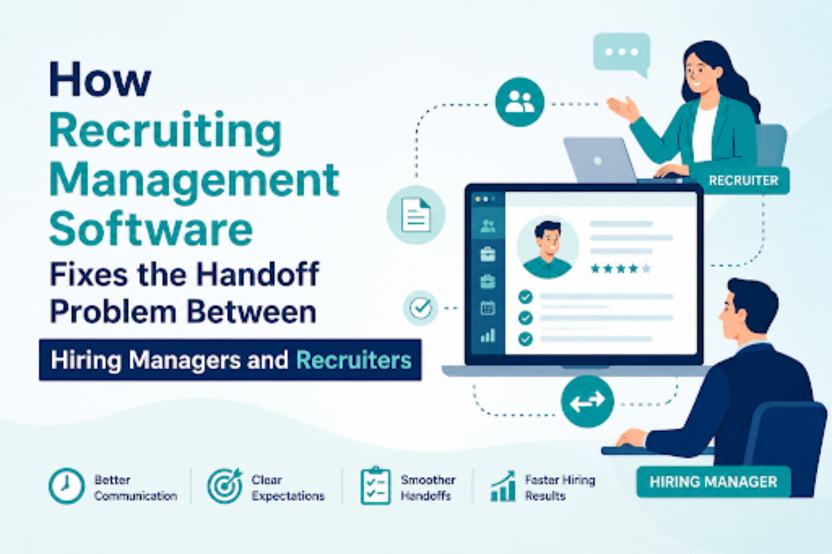
A scenario that happens all the time and rarely gets discussed directly is when a recruiter finds a great candidate, does the first screen, and then hands that person off to the hiring manager for the next round. Then there’s silence. The hiring manager assumes the recruiter is arranging the interview. The recruiter assumes the hiring manager reached out. Three days later the candidate takes another offer somewhere else and no one is entirely clear who was responsible for keeping the process moving.
That is not a people problem. It’s a systems problem. This is one of the most common (and most fixable) failures in hiring. Recruiting management software is largely designed to fill this gap.
Why the Handoff Breaks in the First Place
Employers and hiring managers usually have different information. The recruiter has the full candidate pipeline – who’s applied, who’s been screened, who’s a good fit. The hiring manager often only sees what’s forwarded to them, when it’s forwarded and how it’s communicated. Without a shared system, it’s like a game of telephone: an email here, a Slack message there, a detail about a candidate that’s mentioned once and then lost.
Instead, recruiting systems are based on shared pipelines that give both sides the same view on where every candidate really stands. This solves the problem at its root, instead of relying on someone remembering to update someone else.
Pipeline Visibility Removes the Guesswork
Recruiting software with pipeline management means a hiring manager doesn’t need to ask “where are we in this role” — they can just look. Every candidate sits in a defined stage, visible to everyone involved, updated the moment something changes rather than whenever someone gets around to sending an update email.
This matters most exactly at the handoff point. When a recruiter moves a candidate from “screened” to “manager review,” that move itself becomes the notification. Nobody has to remember to separately tell anyone anything.
Calendar Coordination: Where Handoffs Actually Die
If there is one area where candidates get lost between the recruiter and hiring manager, it’s scheduling. The manager is waiting for the recruiter’s reply about availability. The recruiter says the manager is checking in to arrange it. Days go by. Meanwhile, the candidate wonders if they’re still in the running.
Recruiting software with calendar management closes this gap directly — interview scheduling gets built into the same system as the pipeline, syncing with actual calendar availability instead of running through a separate email thread that’s easy for either party to assume the other is handling.
Communication History Prevents the “Wait, Did We Already Tell Them That?” Problem
Another failure point: the hiring manager contacts a candidate not knowing that the recruiter already did, or worse, provides slightly different information. Communication management in recruiting software means every message and note is attached to the candidate’s record and visible to recruiter and hiring manager alike. There’s one shared history, not two separate (and sometimes conflicting) ones.
That sounds like a small thing, until it happens to a candidate that notices the disconnect and starts to question just how organized the company really is.
Where This Gets More Complex: Agencies and Multi-Client Handoffs
The handoff problem multiplies for recruiting agencies. Recruiting agency management software has to manage not just the recruiter-to-hiring-manager handoff, but the handoff between an agency recruiter and a client’s internal hiring team — often for multiple clients and multiple roles simultaneously. Project management software for recruiting firms frequently gets paired with recruiting tools for exactly this reason: agencies are essentially coordinating handoffs across several parallel relationships, not just one internal team.
Structured Workflows Make the Process Repeatable
Recruiting software with workflow management takes this a step further by defining not just where a candidate is, but what’s supposed to happen next, and whose responsibility it is. Instead of a handoff being an informal “hey, can you take a look at this one,” workflow structure makes the next step and the next owner explicit, every time, for every role — not just for the roles where someone happened to be paying close attention.
Enterprise-Level Coordination
At the larger end, platforms like Cornerstone OnDemand (often searched as CSOD recruiting management software) integrate recruiting into broader HR and talent management ecosystems, which can help large organizations manage handoffs not just between recruiters and hiring managers, but across recruiting, learning and performance systems as a whole. That level of integration tends to be more important in larger, multi-department organizations than in smaller teams where a more straightforward pipeline and calendar setup typically solves the actual problem.
Where This Overlaps With Applicant Tracking Systems
It’s worth being direct about the overlap here: much of what fixes the handoff problem — pipeline stages, shared visibility, structured next steps — is also core functionality in a standard applicant tracking system. An ATS applicant tracking system and recruiting management software aren’t always cleanly separate categories; a lot of applicant tracking system software includes workflow and handoff features built in, and a lot of recruiting management software includes full applicant tracking as one component.
For a small business evaluating options, this means the practical question isn’t “ATS or recruiting management software” so much as “does this specific system solve the handoff problem for how our team actually works.” An applicant tracking system for small business use, even without every enterprise feature, can solve the recruiter-to-manager handoff just as effectively as a broader recruiting management platform, if pipeline visibility and scheduling are genuinely built in well.
Connecting the Handoff to Onboarding
The same coordination problem often persists even after the hire. Onboarding software with recruiting management integration means the transition from “candidate accepted the offer” to “new hire’s first day is organized” doesn’t require reentering the same information into a separate system, or hoping someone remembers to loop in the right people before day one.
The Bottom Line
The recruiter-to-hiring-manager handoff fails for a predictable reason: information that only one person has, communicated through channels that don’t create a shared, visible record. Recruiting management software fixes this not through anything flashy, but through the unglamorous basics — shared pipeline visibility, synced calendars, unified communication history, and workflows that make the next step explicit rather than assumed. Get those right, and strong candidates stop slipping through the exact gap where a lot of good hires quietly get lost.
FAQs
Why does the hiring manager/recruiter handoff break down so often?
Usually because each side only has partial information, and updates happen through informal channels like email or Slack that don’t create a shared, visible record either person can check independently.
Is this handoff problem specific to large companies?
No — it happens at small companies too, often because there’s no dedicated recruiter and the “handoff” is really just one person forgetting to update another between other responsibilities.
Do applicant tracking systems solve the handoff problem, or only recruiting management software?
Both can, depending on the specific system. Pipeline visibility and workflow structure — the features that actually fix handoffs — appear in many applicant tracking system software options and recruiting management platforms alike.
What’s the single feature that helps most with handoffs?
Calendar and scheduling coordination tends to matter most in practice, since scheduling delays are where candidates are most likely to be lost or left waiting during a handoff.
Do recruiting agencies face a different version of this problem?
Yes. Agencies work with their own recruiters and each client’s internal hiring team and often work across multiple clients at once, which is why recruiting agency management software requires better multi-party coordination features than a standard in-house set-up.