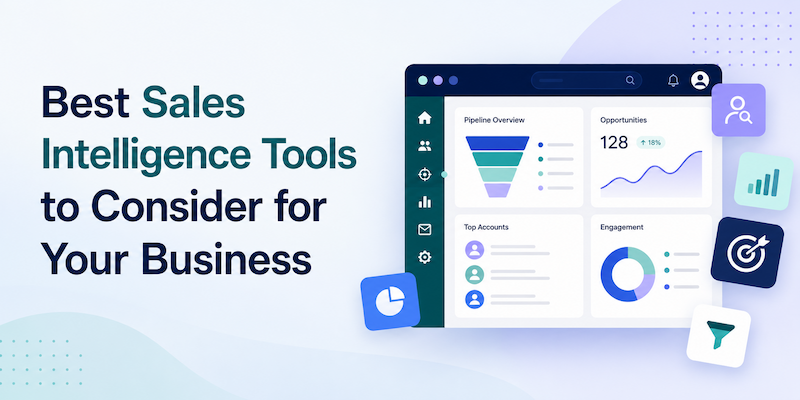
Choosing a B2B sales intelligence platform is no longer as simple as buying the database with the most contacts.
Modern sales teams need to answer four different questions:
- Can we identify the right companies?
- Can we find accurate contact information for the right decision-makers?
- Can we tell which accounts are worth contacting now?
- Can we move that information into our CRM and outbound workflow without creating another manual process?
That distinction matters because tools marketed as “sales intelligence platforms” now solve very different problems.
Apollo combines contact data with prospecting and outbound workflows. Cognism emphasizes verified mobile data and compliance-first prospecting. Clay orchestrates enrichment across many external data providers rather than behaving like a traditional single-source database. 6sense focuses much more heavily on buying intent and account prioritization. LinkedIn Sales Navigator approaches prospecting through LinkedIn’s professional graph.
So there is no single best B2B contact-data platform for every sales team.
The better question is:
Which sales intelligence tool best matches the way your team actually sells?
This guide compares the leading options by contact-data model, prospecting workflow, intent capabilities, integrations, pricing transparency and ideal use case.
Sales intelligence works best when it is connected to a broader demand-generation strategy rather than used only for building contact lists. Our guide to demand generation and digital marketing explains how marketing, CRM, buyer intent, and sales teams can work together to create a stronger B2B pipeline.
Table of Contents
Best B2B Sales Intelligence Tools at a Glance
| Platform | Best for | Contact data | Intent/signals | Public pricing |
|---|---|---|---|---|
| Apollo | Best overall value for SMB and mid-market outbound | Yes | Yes | Free; paid from $49/user/month billed annually |
| Cognism | EMEA prospecting and phone-verified mobile data | Yes | Yes on Pro | Custom |
| ZoomInfo | Enterprise sales intelligence and data depth | Yes | Yes | Custom |
| UpLead | Teams prioritizing verified contact data and transparent pricing | Yes | Buyer intent on Professional | From $99/month |
| Lusha | Fast self-service prospecting and contact lookup | Yes | Yes | Free plan; paid plans available |
| Clay | Multi-provider enrichment and custom GTM workflows | Through multiple providers | Yes | Free; Launch from $185/month monthly |
| 6sense | Enterprise intent, account prioritization and ABM | Yes | Strong | Custom |
| SalesIntel | Contact data, enrichment and teams that dislike restrictive export limits | Yes | Yes | Custom |
| LinkedIn Sales Navigator | Relationship-led B2B prospecting | LinkedIn profiles rather than a traditional contact database | Buyer/activity signals | Core from $119.99/month |
Pricing and product capabilities were checked against current vendor documentation in August 2026 and can change. Apollo currently lists a free tier plus Basic at $49, Professional at $79 and Organization at $119 per seat per month when billed annually. UpLead currently lists Essentials at $99 monthly and Plus at $199 monthly, with lower effective prices on annual billing. LinkedIn lists Sales Navigator Core from $119.99 per month and Advanced from $159.99 per month.
Note: Sales intelligence teams should also make sure their outbound workflows comply with applicable email-marketing rules. In the U.S., the FTC’s CAN-SPAM compliance guide explains requirements for commercial email, including B2B outreach, sender identification and opt-out handling.
How AT Hub Evaluated These Sales Intelligence Platforms
This is a research-based comparison rather than a claim that every platform was tested against the same private dataset.
Where hands-on access was available, we also reviewed the platform interface and prospecting workflow; screenshots in this guide are included to show the experience we observed. We reviewed current product documentation, pricing information and publicly documented capabilities and evaluated each platform around six questions.
1. Contact-data utility
Does the platform provide usable business emails, direct dials or mobile numbers rather than simply company names and generic firmographic information?
2. Prospecting depth
Can a sales representative narrow a large market into a realistic ICP using company, role, seniority, geography, technology or related filters?
3. Data freshness and verification
Does the vendor explain how contact information is verified, refreshed or maintained?
4. Buyer context
Does the platform go beyond static contact information by providing intent, hiring, funding, job-change, website or other account signals?
5. Workflow fit
Can the data move into CRM, sales-engagement and enrichment workflows without repeated CSV exports and manual cleanup?
6. Cost predictability
Can buyers understand what they will pay and what consumes credits before committing to the platform?
We deliberately do not rank platforms by database-size marketing claims alone.
A database containing hundreds of millions of contacts does not help if the 2,000 decision-makers inside your ICP are outdated or unreachable.
1. Apollo | Best Overall for Data + Outbound in One Platform
Apollo is our strongest general recommendation for small and mid-sized B2B teams that want contact data and outbound execution without assembling several separate products.
Apollo combines contact and account data, prospecting filters, enrichment, buying-intent functionality and outbound sequences inside the same platform.
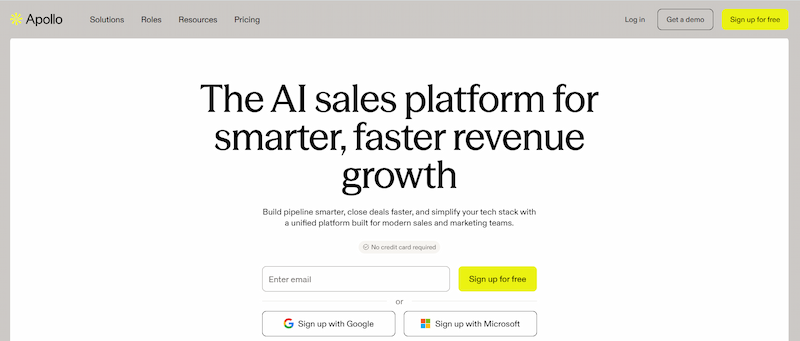
Its pricing is also unusually visible for this category.
As of August 2026, Apollo lists:
- Free: $0
- Basic: $49 per user/month billed annually
- Professional: $79 per user/month billed annually
- Organization: $119 per user/month billed annually, with a three-seat minimum
Apollo says credits can be used to access emails, phone numbers and enriched data. The current pricing documentation lists verified email access at one credit and phone-number access at eight credits.
Why Apollo stands out
The main advantage is consolidation.
A smaller B2B sales team may otherwise need:
- a contact database,
- an email finder,
- enrichment software,
- a sequencing platform,
- buying-intent data,
- and workflow automation.
Apollo covers a meaningful portion of those jobs under one subscription.
Its current plans include contact and account data, CRM enrichment and outbound capabilities, with additional filters, signals and intent functionality available as teams move into paid tiers.
Best for
- Startups
- SMB sales teams
- SDR teams
- Founder-led outbound
- Companies replacing several separate prospecting tools
Potential limitation
An all-in-one platform will not automatically have the best contact coverage for every industry and geography.
Before moving your entire outbound operation to Apollo—or any provider—validate it against your own ICP.
AT Hub recommendation: Export or review a controlled sample of at least 100 target contacts and measure valid-email rate, usable phone coverage and job-title accuracy before evaluating annual cost.
2. Cognism | Best for EMEA and Phone-Verified B2B Mobile Data
Cognism deserves serious consideration when phone prospecting is important, particularly for teams operating across the UK and Europe. Its positioning is different from a platform competing primarily on raw database size.
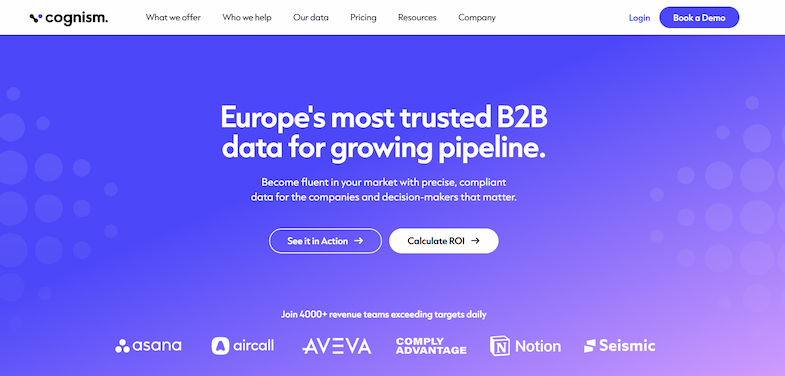
Cognism emphasizes verified B2B contact data, mobile-number quality and compliance-focused prospecting.
The company calls its premium phone-verified contacts Diamond Data. Cognism says these numbers go through additional phone verification, and its current platform documentation also highlights DNC-list cross-referencing and GDPR/CCPA-focused prospecting.
Cognism currently offers Standard and Pro prospecting packages, with five seats included according to its pricing page. Pro adds capabilities including higher-quality mobile data, on-demand verification and intent data. Pricing requires contacting the company.
Why Cognism stands out
Many B2B data products can find an email.
Finding the correct mobile number for a specific senior buyer is a harder problem.
That makes Cognism particularly interesting for sales organizations where calls are a major part of outbound activity.
The platform also provides:
- emails and mobile numbers,
- company and contact data,
- firmographic filters,
- technographic filters,
- job-change information,
- funding and M&A signals,
- AI company research,
- CRM enrichment,
- and intent functionality on higher-tier packages.
Best for
- EMEA sales teams
- Phone-heavy outbound
- Enterprise SDR organizations
- Teams where compliance requirements heavily influence data-provider selection
Potential limitation
Pricing is not self-service.
Smaller teams should therefore compare the total contract against lower-cost platforms using an identical test sample rather than comparing feature lists alone.
3. ZoomInfo | Best for Enterprise Sales Intelligence Depth
ZoomInfo remains one of the category-defining sales-intelligence platforms and appears repeatedly across current 2026 comparisons as an enterprise-oriented option for contact data, company intelligence and buying signals.
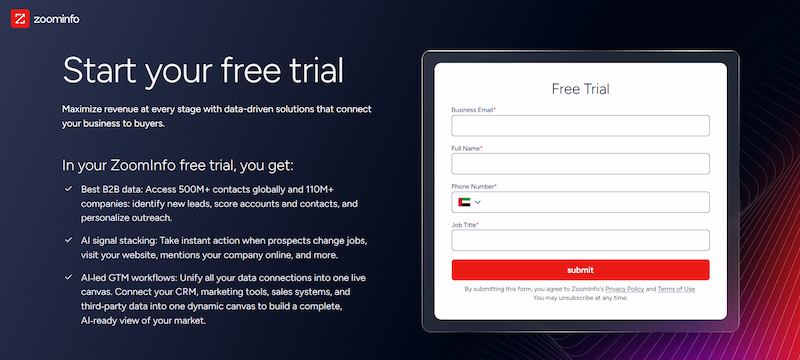
Where a small business may primarily need verified contacts, larger sales organizations often need considerably more:
- account hierarchies,
- organizational intelligence,
- contact data,
- intent,
- workflow integration,
- territory planning,
- enrichment,
- and large-scale RevOps support.
That is where ZoomInfo is generally positioned.
Best for
- Enterprise sales teams
- Large addressable markets
- ABM programs
- Organizations with mature SalesOps/RevOps teams
- Companies that can justify enterprise contracts
Potential limitation
Public pricing transparency is limited compared with platforms such as Apollo or UpLead.
For an SMB, more data and more functionality do not necessarily produce better economics.
The correct comparison should be:
qualified opportunities created per dollar spent
rather than:
number of contacts in the database
4. UpLead | Best for Transparent Contact-Data Buying
UpLead is attractive for teams that want a relatively straightforward contact-data product without immediately entering a large enterprise contract.
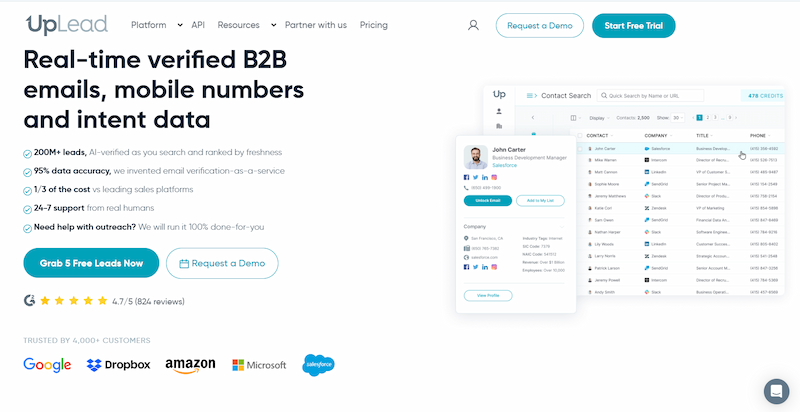
Its public pricing currently includes:
- 7-day free trial with five credits
- Essentials at $99/month
- Plus at $199/month
- Professional with custom annual pricing
On annual billing, UpLead currently shows lower effective monthly prices.
One credit unlocks one contact for download or CRM export and provides access to the contact’s email and available mobile direct dial.
UpLead also publicly states that it verifies email addresses and lists CRM integrations covering Salesforce, HubSpot, Zoho, Pipedrive, Microsoft Dynamics and a range of sales-engagement products.
The Plus plan expands into areas such as:
- data enrichment,
- technographics,
- advanced filters,
- suppression lists,
- and email-pattern intelligence.
Professional adds buyer-intent functionality and additional organizational features.
Best for
- Small sales teams
- Consultants
- Agencies
- Businesses wanting clear monthly pricing
- Teams primarily purchasing verified contacts
Potential limitation
UpLead is less of an all-in-one sales-engagement environment than Apollo and less of an enterprise intent platform than 6sense.
That is not necessarily a weakness.
If your actual problem is:
“We need better contacts,”
paying for an enormous intent and ABM stack may be unnecessary.
5. Lusha | Best for Fast Self-Service Prospecting
Lusha has evolved beyond its earlier identity as mainly a contact-lookup browser extension. The current product combines verified contact and company data with enrichment, buyer signals, workflows, prospecting and integrations.
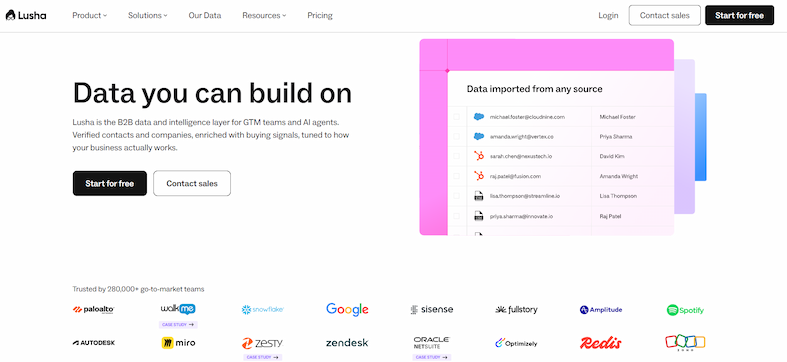
Lusha currently offers a free plan with up to 40 credits per month. Its pricing documentation says a verified email reveal consumes one credit while a phone-number reveal consumes ten credits.
The company says its platform includes buying and account signals alongside traditional B2B contact data. Current signal documentation includes events such as:
- job changes,
- promotions,
- hiring surges,
- headcount changes,
- website-traffic changes,
- IT-spend changes,
- and other account events.
Best for
- Individual SDRs
- Small outbound teams
- Browser-based prospecting
- Teams wanting to start with a free tier
- Businesses needing contact data plus straightforward signals
Potential limitation
Credit economics matter.
A phone number costs substantially more credits than an email under Lusha’s current model, so teams running high-volume calling campaigns should model their expected consumption before comparing subscription prices.
6. Clay | Best for Multi-Provider Enrichment and GTM Automation
Clay should not be evaluated exactly like Apollo, Cognism or UpLead.
It increasingly behaves as a data-orchestration and GTM workflow layer rather than one traditional contact database.
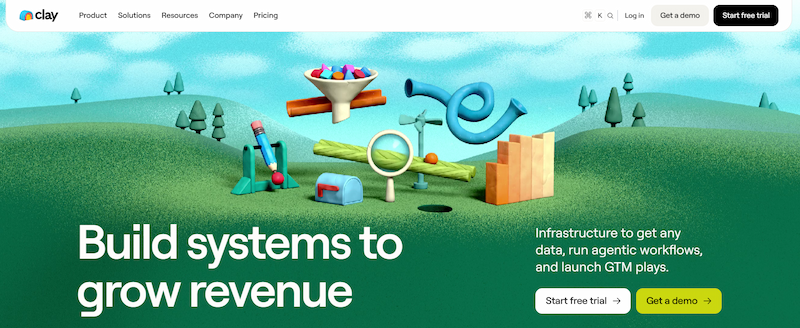
Clay can connect to more than 150 data providers and supports multi-provider waterfall enrichment. This allows a workflow to try different data sources when attempting to find or enrich a contact rather than relying entirely on a single database.
That distinction can be extremely important for advanced RevOps and growth teams.
Clay’s current pricing structure separates platform Actions from Data Credits.
The company currently offers:
- a free plan,
- Launch for smaller prospecting workflows,
- Growth for CRM-based workflows and larger campaigns,
- and custom Enterprise pricing.
Its documentation lists Launch from $185/month on monthly pricing, with lower effective pricing available through annual billing. Growth starts higher and adds capabilities including CRM auto-sync, webhook automation and web-intent signals.
Best for
- GTM engineers
- RevOps teams
- Sophisticated enrichment workflows
- Agencies running different data providers
- Teams building customized outbound systems
- Organizations that already have data-provider subscriptions
Potential limitation
Clay can be overkill if your entire requirement is:
“Give me 500 accurate emails every month.”
Its real strength appears when a business wants to combine several data sources, signals and automations into one repeatable GTM workflow.
7. 6sense | Best for Intent and Enterprise Account Prioritization
6sense is strongest when the sales problem is not simply finding contacts.
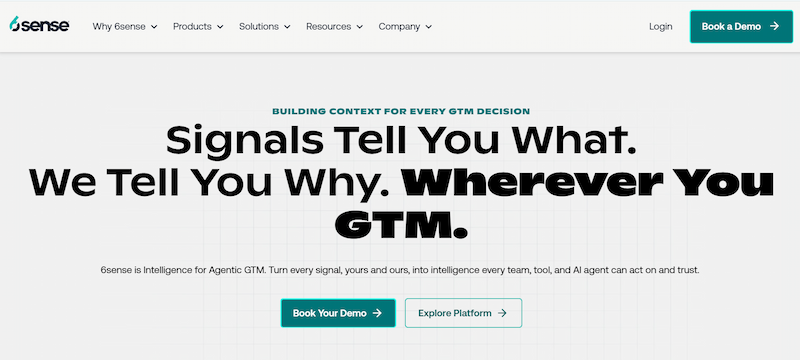
The problem it is designed to solve is:
Which accounts are actually showing signs that they may buy?
Its Sales Intelligence product combines buyer and account context with predictive models, contact information and intent signals.
6sense says its platform surfaces accounts that are more likely to buy, identifies members of buying groups and provides sellers with contextual information about what buyers may be researching.
Its current product materials also describe company and people search, verified contact data, CRM enrichment and intent signals.
Best for
- Enterprise B2B
- Account-based marketing
- Long sales cycles
- Large named-account territories
- Teams with established CRM and RevOps processes
- Organizations prioritizing buying intent over mass list building
Potential limitation
A five-person outbound team probably does not need the same intelligence stack as a global enterprise running account-based marketing.
6sense makes more sense when deciding when and where to deploy sales resources is as important as finding the contact itself.
8. SalesIntel | Best for Teams That Want Fewer Export Restrictions
SalesIntel takes an interesting approach to contact-data economics. Its current pricing page advertises unlimited users, unlimited export credits and unlimited enrichment credits in its core offering, while pricing itself remains quote-based.
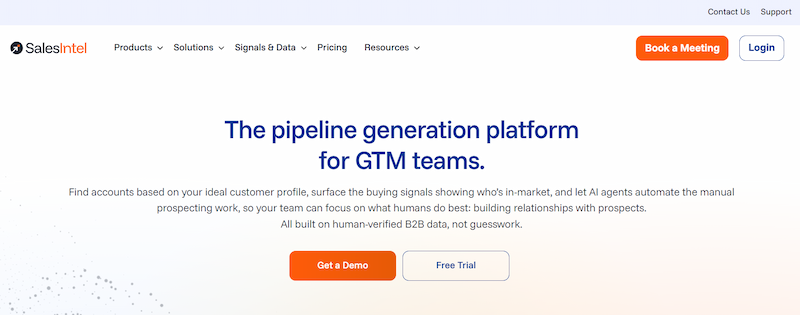
The platform includes:
- business emails,
- mobile phone numbers,
- company firmographics,
- technographics,
- company and industry news,
- basic intent,
- contact enrichment,
- account enrichment,
- inbound lead enrichment,
- and integrations including Salesforce, HubSpot, Marketo and Salesloft.
Best for
- Teams with high enrichment volume
- Multi-user revenue organizations
- Companies frustrated by restrictive export-credit models
- Sales and marketing teams sharing the same data infrastructure
Potential limitation
Because pricing is not public, “unlimited” should not automatically be interpreted as inexpensive.
Calculate total annual contract cost against the number of records your team realistically consumes.
9. LinkedIn Sales Navigator | Best for Relationship-Led Prospecting
Sales Navigator belongs in this comparison even though it is not a conventional B2B contact database. Its advantage is access to LinkedIn’s professional network and the relationship context around prospects.
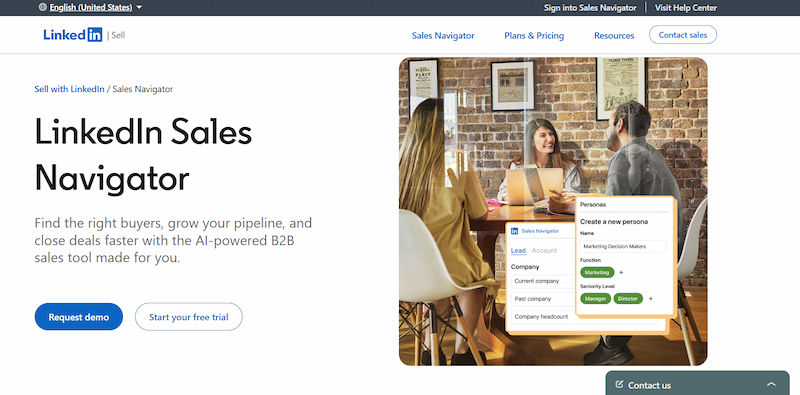
For many complex B2B sales motions, knowing:
- where someone currently works,
- their role,
- career history,
- shared relationships,
- recent changes,
- and which accounts match specific criteria
can be as important as possessing an email address.
LinkedIn currently lists Sales Navigator Core from $119.99 per month per license and Advanced from $159.99 per month per license. Advanced Plus uses custom pricing.
LinkedIn positions Core primarily for individual sellers, Advanced for sales teams requiring more collaboration and account research, and Advanced Plus for organizations requiring deeper CRM integration.
Best for
- Enterprise prospecting
- Consultants
- Relationship-driven selling
- Account research
- High-value B2B sales
- Teams already doing prospect discovery on LinkedIn
Potential limitation
Sales Navigator does not completely replace a contact-data provider for teams needing verified external emails and phone numbers at scale.
A common architecture is therefore:
Sales Navigator for discovery and account context
Apollo, Cognism, Lusha, UpLead or another provider for contact data
CRM/sales-engagement software for execution
Which B2B Sales Intelligence Tool Should You Choose?
Start with your sales motion rather than the longest feature list.
Choose Apollo if:
You are an SMB or mid-market team that wants prospecting data and outbound execution in one relatively affordable platform.
Choose Cognism if:
Phone numbers, EMEA coverage and compliance-focused prospecting are central requirements.
Choose ZoomInfo if:
You operate a larger enterprise revenue organization and need deeper account intelligence, contact data and intent capabilities.
Choose UpLead if:
You primarily want verified B2B contacts with understandable public pricing.
Choose Lusha if:
Your SDRs want fast contact discovery, browser-based prospecting and a low-friction starting point.
Choose Clay if:
You want to combine several enrichment providers and automate custom GTM workflows.
Choose 6sense if:
Your main challenge is prioritizing in-market accounts rather than simply generating larger contact lists.
Choose SalesIntel if:
Your team consumes large volumes of contact and enrichment data and wants an alternative to restrictive per-user export limits.
Choose LinkedIn Sales Navigator if:
Your selling process relies heavily on professional relationships, account research and identifying the right people inside complex organizations.
AT Hub 100-Contact Validation Framework
Do not choose a B2B data provider based entirely on vendor database-size claims. Before signing a large annual contract, create a representative sample from your actual target market.
For example: 100 contacts
across:
- 25 enterprise accounts
- 25 mid-market accounts
- 25 small businesses
- 25 difficult or niche accounts
Then evaluate every shortlisted provider against exactly the same sample.
Track:
| Metric | What to measure |
|---|---|
| Email coverage | How many target people have an email? |
| Email validity | How many emails pass verification? |
| Mobile coverage | How many have usable direct/mobile numbers? |
| Job accuracy | Does the person still hold the stated role? |
| ICP precision | Can the platform reliably find similar buyers? |
| Signal usefulness | Are intent/events actionable or mostly noise? |
| CRM workflow | How many manual steps are required? |
| Cost per usable contact | Subscription + credits ÷ usable contacts |
| Cost per meeting | Platform cost ÷ meetings generated |
| Pipeline contribution | Qualified pipeline associated with sourced prospects |
The final metric matters most.
A platform costing $10,000 that contributes $500,000 in qualified pipeline may be cheaper than a $1,000 tool that produces poorly matched contacts and no meetings.
Contact Data vs Sales Intelligence: Know What You Are Buying
These terms increasingly overlap, but buyers should understand the difference.
B2B contact database
Primarily tells you:
Who is this person and how can I reach them?
Typical data:
- name
- title
- company
- phone
- industry
- company size
Sales intelligence platform
Adds context such as:
Should I contact this person or account now, and why?
Potential signals include:
- hiring
- funding
- job changes
- technology usage
- website activity
- topic research
- intent
- company growth
- engagement
GTM data-orchestration platform
Tools such as Clay introduce another layer:
Which providers should we query, what should happen to the resulting data and where should it go next?
This distinction explains why comparing Clay directly with a traditional contact database based only on database size makes little sense.
Frequently Asked Questions
What is the best sales intelligence tool for B2B contact data?
For smaller and mid-sized outbound teams, Apollo offers one of the strongest combinations of contact data, prospecting, enrichment and outbound functionality at transparent pricing.
Cognism is particularly compelling when phone-verified mobile data and EMEA prospecting matter. ZoomInfo is better suited to many enterprise requirements, while UpLead and Lusha provide more straightforward approaches to contact discovery.
The best platform still depends on your ICP and should be validated against your own target-contact sample.
What is the best B2B sales intelligence tool for outbound prospecting?
Apollo is a strong all-in-one option because contact discovery and outbound sequences can live in the same environment.
Teams with more sophisticated enrichment requirements may prefer Clay combined with one or more data providers, while phone-heavy outbound teams should consider Cognism.
What is the difference between Apollo and ZoomInfo?
Apollo is generally easier for smaller teams to adopt because it offers public self-service pricing and combines prospecting with outbound execution.
ZoomInfo is generally positioned further toward enterprise sales intelligence and broader organizational data requirements.
The right choice depends more on team size, data requirements and sales motion than on which product has the longest feature list.
Is LinkedIn Sales Navigator a B2B contact database?
Not in the traditional sense.
Sales Navigator is primarily a prospecting and sales-research environment based on LinkedIn’s professional network. Many teams combine it with another contact-data provider to obtain verified emails or direct phone numbers.
What should I look for in B2B contact data?
Prioritize:
- accuracy within your specific ICP,
- verified email coverage,
- usable mobile/direct-dial coverage,
- current job information,
- geographic coverage,
- compliance requirements,
- integration with your sales stack,
- predictable credit costs.
Do not buy solely on the headline number of contacts in a vendor’s database.
Are sales intelligence tools worth paying for?
They can be when the platform reduces prospecting time or improves your team’s ability to reach qualified decision-makers.
The best way to evaluate ROI is not database size or number of exported contacts.
Measure:
cost per valid contact → cost per conversation → cost per meeting → pipeline generated.
That exposes whether the platform is actually improving sales productivity.
Final Recommendation
For most smaller B2B teams starting from scratch, Apollo is the easiest platform on this list to shortlist first because it combines B2B contact data, prospecting, enrichment and outbound capabilities with public pricing.
For EMEA and phone-led outbound, add Cognism to the evaluation.
For an enterprise sales organization, compare ZoomInfo and 6sense depending on whether the priority is broad sales intelligence or deeper account-intent prioritization.
For data enrichment and custom GTM automation, evaluate Clay as an orchestration layer rather than treating it as another traditional database.
And regardless of the vendor:
Do not ask which company has the biggest database. Ask which company can identify and accurately reach the buyers inside your ICP at an acceptable cost.
That is the sales-intelligence metric that actually matters.