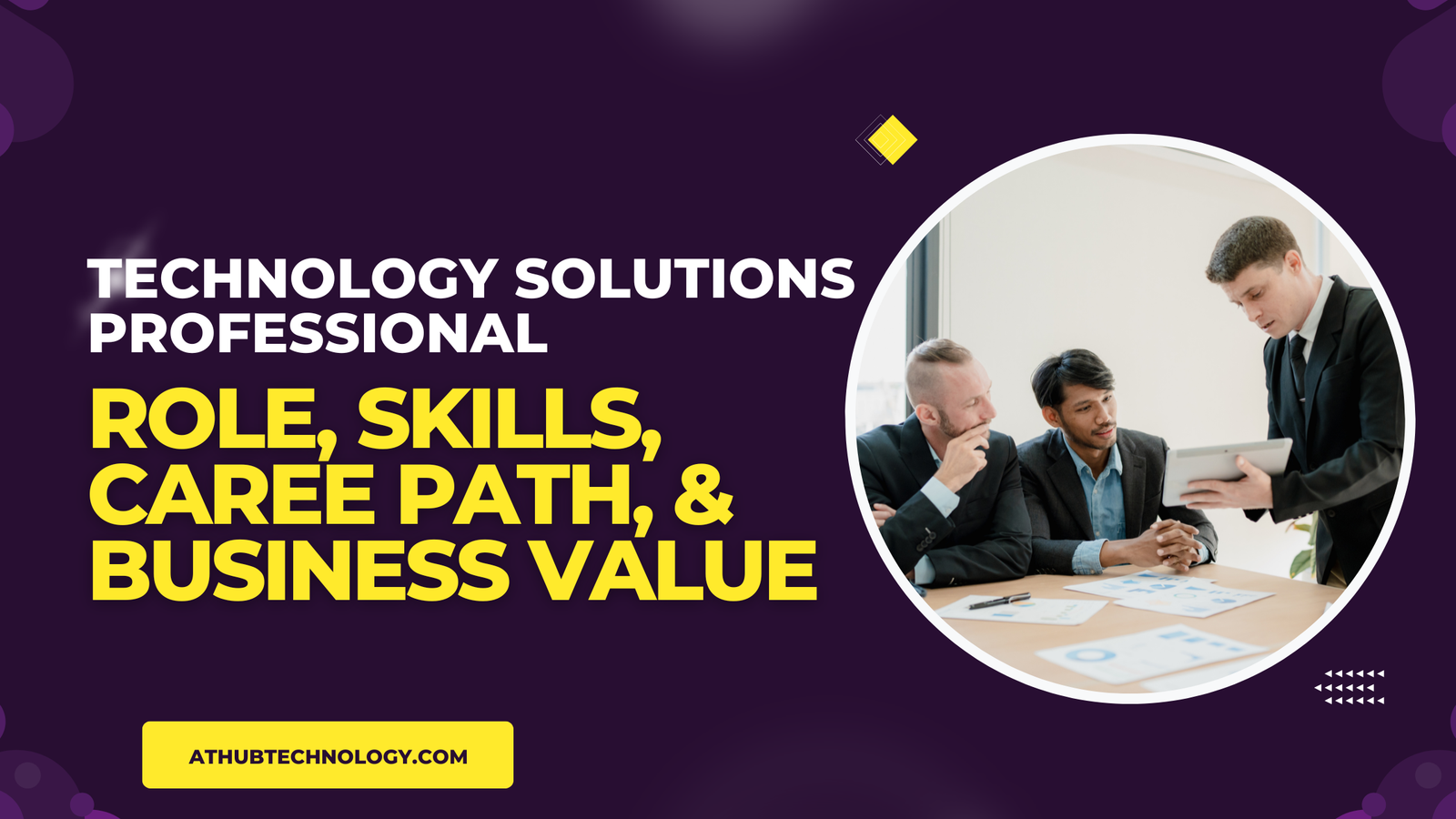
A technology solutions professional helps businesses identify technology problems, choose the right tools, and implement solutions that match their structure, budget, and goals. Most businesses don’t struggle with identifying their technology problems. They struggle with knowing how to fix them in a way that makes sense for their structure, budget, and goals. That’s precisely where a technology solutions professional comes in.
These specialists sit at the intersection of business strategy and technical execution. They’re not purely IT support staff, and they’re not abstract consultants who hand over reports and disappear. They understand what a company needs, evaluate available technologies, design a fitting approach, and see that it’s properly implemented.
Whether you’re considering this as a career or looking to hire one for your organization, this guide covers everything worth knowing.
Table of Contents
What Is a Technology Solutions Professional?
A technology solutions professional is someone who analyzes business challenges and designs technology-driven strategies to address them. The role blends technical knowledge with communication ability and business understanding.
Unlike a traditional IT technician who focuses on maintaining systems, or a software developer who writes code, a technology solutions professional works across multiple functions. They assess what a business is trying to achieve, identify where current systems are falling short, and recommend or build solutions that close that gap.
The job title varies across companies. You might see it listed as technology solutions specialist, IT solutions consultant, business technology advisor, or enterprise solutions professional. Regardless of the title, the core function is the same: translate business needs into technology outcomes.
What Does a Technology Solutions Professional Do?
On any given week, the work can vary considerably. A technology solutions professional might spend Monday reviewing a client’s current software infrastructure, Tuesday presenting a proposed migration plan to stakeholders, Wednesday coordinating with vendors, and Thursday troubleshooting an issue that surfaced during deployment.
The work isn’t confined to a back office. Strong communication is just as critical as technical competence. Most professionals in this role spend significant time translating complex technical concepts into plain language for executives and department heads who need to make informed decisions.
Businesses often rely on trusted technology resources such as Microsoft Learn and Google Cloud documentation to understand modern digital solutions, cloud platforms, and enterprise technology practices.
Common areas of focus include:
- Evaluating current technology stacks and identifying gaps or inefficiencies
- Designing solution architectures that align with business goals
- Leading or supporting software and hardware implementation projects
- Coordinating between IT teams, vendors, and non-technical stakeholders
- Monitoring systems post-implementation and adjusting as needed
- Providing training or documentation to help teams adopt new tools
Key Responsibilities of a Technology Solutions Professional
The specific duties depend on the industry and company size, but several responsibilities appear consistently across roles:
1. Requirements Gathering
Working directly with department heads and executives to understand what they need technology to accomplish. This often means asking the right questions to uncover problems the client hasn’t clearly articulated yet.
2. Solution Design
Evaluating available platforms, tools, and architectures. Whether it’s recommending a CRM upgrade, a cloud migration, or a new data pipeline, the professional must match the right tool to the actual need.
3. Project Coordination
Acting as the bridge between technical teams and business stakeholders. This includes timelines, budget tracking, vendor management, and keeping everyone aligned.
4. Implementation Oversight
Ensuring that systems are deployed correctly, securely, and with minimal disruption to daily operations. This may involve hands-on work or directing a team of engineers and developers.
5. Post-Deployment Support
Many solutions need adjustment after launch. Technology solutions professionals remain involved to troubleshoot issues, refine workflows, and confirm that the intended business outcomes are being achieved.
Skills Required to Become a Technology Solutions Professional
This is a role that rewards breadth. You don’t need to be the deepest expert in any single area, but you do need competent, working knowledge across several domains:
- Technical literacy: Comfortable with networking concepts, software systems, databases, and infrastructure. You don’t necessarily write code every day, but you need to understand how things work.
- Cloud platforms: Familiarity with AWS, Microsoft Azure, or Google Cloud is increasingly essential. Most enterprise solutions now involve cloud services at some level.
- Cybersecurity fundamentals: Understanding data protection, access controls, compliance requirements, and basic threat awareness. Security is never someone else’s problem in this role.
- Business analysis: The ability to assess a business process, identify inefficiencies, and frame technical recommendations in terms of business impact.
- Project management: Whether formally certified or practically experienced, you need to manage timelines, dependencies, risks, and stakeholder expectations.
- Communication: Probably the most underestimated skill. Presenting a complex migration plan to a CFO contacts a completely different approach than discussing it with an infrastructure engineer.
- Data understanding: Basic familiarity with analytics, reporting tools, and how data flows through an organization helps professionals make better solution recommendations.
Technology Solutions Professional vs IT Consultant
People often use these two titles interchangeably, but they represent meaningfully different roles in most organizations:
| Aspect | Technology Solutions Professional | IT Consultant |
|---|---|---|
| Primary Focus | End-to-end solution design and implementation | Advisory, strategy, and recommendations |
| Engagement Style | Ongoing, embedded in projects | Often short-term or project-based |
| Technical Involvement | Directly involved in deployment and oversight | Primarily strategic and evaluative |
| Client Interaction | Continuous, collaborative | Structured, deliverable-focused |
| Typical Output | Working technology systems | Reports, frameworks, or roadmaps |
| Industry Setting | Corporate, in-house, or vendor-side | Often external consultancy firms |
That said, the lines blur often. Many technology consultants take on implementation responsibilities, and solutions professionals may provide advisory-level guidance. Context and company structure determine how these roles actually function.
Industries That Hire Technology Solutions Professionals
The demand for this kind of expertise cuts across nearly every sector. Some of the most active areas include:
| Industry | Common Use Cases |
|---|---|
| SaaS & Software | Platform integrations, customer onboarding tools, API architecture |
| Healthcare | Electronic health records, compliance systems, patient data security |
| Finance & Banking | Core banking modernization, fraud detection platforms, regulatory tech |
| Education | Learning management systems, campus infrastructure, digital transformation |
| Retail & E-commerce | Inventory systems, POS integration, personalization platforms |
| Manufacturing | IoT integration, supply chain tech, predictive maintenance systems |
| Logistics & Transport | Fleet tracking, warehouse management, route optimization software |
| Government | Public service portals, data security, legacy system modernization |
Career Path and Job Opportunities
This field offers a clear progression for those willing to develop both their technical depth and communication skills.
1. Entry-Level (0–2 Years)
Roles like junior IT analyst, technology support specialist, or associate solutions consultant. The focus is learning internal systems, supporting implementations, and understanding how businesses use technology.
2. Mid-Level (3–6 Years)
Titles such as technology solutions specialist, systems analyst, or IT solutions engineer. Professionals at this stage lead portions of projects, manage vendor relationships, and begin to own client interactions.
3. Senior-Level (7+ Years)
Senior technology solutions professional, solutions architect, or director of technology solutions. These roles involve strategic planning, executive engagement, team leadership, and ownership of large-scale transformation projects.
There are also lateral paths worth noting. Some professionals move into product management, enterprise architecture, or IT leadership (CTO, CIO tracks) depending on their interests.
Salary Expectations
Compensation in this field varies considerably, and it’s worth understanding what drives those differences before looking at ranges.
Location plays a significant role. Professionals working in major technology hubs like San Francisco, New York, London, or Dubai typically command higher compensation than those in smaller markets. Remote work has partially equalized this, but geography still matters in many hiring decisions.
Experience level is the other major factor. Entry-level roles naturally pay less than senior positions, but the jump from mid to senior level can be substantial, especially when leadership responsibilities are involved.
Company size and industry also affect pay. Large enterprises and well-funded technology companies tend to offer more competitive packages than smaller firms. Professionals with certifications in cloud platforms, cybersecurity, or project management often see salary premiums as a direct result.
In general terms, mid-level technology solutions professionals in developed markets tend to earn solid, above-average salaries relative to broader IT roles. Senior professionals with specialized expertise and proven business impact can earn significantly more. Checking platforms like LinkedIn Salary, Glassdoor, or Levels.fyi provides up-to-date ranges relevant to your specific location and industry.
How Businesses Benefit from Technology Solutions Professionals
Organizations that invest in this role consistently report advantages that go beyond simply having working systems:
- Cost savings: A professional who designs the right solution from the start prevents expensive rework, redundant software licenses, and failed deployments.
- Operational efficiency: Automating manual processes and integrating disconnected systems frees staff to focus on higher-value work.
- Improved security posture: With cybersecurity built into every solution, companies reduce their exposure to breaches and compliance failures.
- Better customer experience: Technology that works well internally usually translates to smoother experiences for customers, whether through faster service, fewer errors, or better self-service options.
- Digital transformation enablement: Many organizations know they need to modernize but don’t know where to start. A skilled technology solutions professional provides both the roadmap and the execution.
- Scalable infrastructure: Solutions designed with growth in mind avoid the common trap of systems that work fine at current scale but break under expansion.
How to Become a Technology Solutions Professional
There’s no single prescribed path, but the following sequence works for most people entering this field:
- Build IT fundamentals. Start with a solid grounding in networking, operating systems, databases, and software concepts. A degree in computer science or information systems helps, but self-taught routes through structured online programs also work well.
- Learn cloud and software tools. Get hands-on with platforms like AWS, Azure, or Google Cloud. Understand how enterprise software is deployed and integrated. Build real experience, even in lab or personal project environments.
- Develop communication skills. Practice explaining technical topics to non-technical audiences. This is a learnable skill, not an innate talent. Writing clear documentation, presenting findings, and handling difficult stakeholder conversations all improve with practice.
- Get relevant certifications. Credentials like AWS Solutions Architect, Google Professional Cloud Architect, Microsoft Certified: Azure Solutions Architect, CompTIA Project+, or PMP add credibility and signal structured knowledge to employers.
- Build project experience. Contribute to technology projects, even in supporting roles. Understanding how projects run, go wrong, and recover is some of the most valuable experience you can have.
- Apply for relevant roles. Target positions with titles like IT analyst, solutions consultant, systems analyst, or technology associate. Use each role to grow your scope, then pursue more senior positions as your experience accumulates.
Future of Technology Solutions Professionals
The role is evolving, and the professionals who adapt will remain highly valuable.
Artificial intelligence is changing what’s possible. Technology solutions professionals who understand how to integrate AI tools into business processes, and can evaluate when AI genuinely helps versus when it adds unnecessary complexity, will stand out. This doesn’t mean every professional needs to build machine learning models. It means understanding AI well enough to make informed recommendations.
Cloud infrastructure will continue to dominate enterprise architecture. Multi-cloud environments are increasingly common, and navigating them requires both technical fluency and the ability to evaluate trade-offs at the business level.
Cybersecurity is not a separate discipline anymore. Every solution a technology professional designs must account for data privacy, access control, and regulatory compliance. Professionals who treat security as an integral part of solution design, rather than an afterthought, will be more effective and more sought after.
Finally, data literacy is becoming non-negotiable. Businesses increasingly expect their technology decisions to be grounded in data. Professionals who can read analytics, build dashboards, and connect data insights to business strategy will have a meaningful edge over those who cannot.
Frequently Asked Questions
What is a technology solutions professional?
A technology solutions professional is someone who analyzes a company’s business challenges and designs or implements technology-based solutions to address them. The role combines technical knowledge with business understanding and strong communication skills.
Is technology solutions professional a good career?
Yes. The role is in steady demand across nearly every industry, offers clear career progression from entry to senior and leadership levels, and pays well relative to other IT careers. As businesses continue to invest in digital transformation, the need for professionals who can translate strategy into working technology is only growing.
What skills are most important for this role?
Technical literacy, cloud platform knowledge, business analysis, project management, and communication are the most consistently valuable. Cybersecurity awareness and basic data literacy are increasingly expected as well. Strong communicators who can bridge the gap between technical teams and business stakeholders tend to advance fastest.
Is coding required to work as a technology solutions professional?
Not typically, though it helps. The focus is more on architecture, evaluation, and coordination than on writing code. That said, understanding how software is built, how APIs work, and how to read technical documentation makes professionals significantly more effective. Some roles in smaller companies do expect hands-on scripting or configuration work.
What is the difference between a technology solutions professional and an IT consultant?
An IT consultant typically operates in an advisory capacity, providing recommendations, strategies, or frameworks, often on a short-term engagement basis. A technology solutions professional usually has a more hands-on, ongoing role that includes design, implementation, and post-deployment support. In practice, the roles overlap considerably depending on the organization.
Which industries hire technology solutions professionals?
Virtually every industry with significant technology infrastructure, including SaaS, healthcare, finance, education, retail, manufacturing, logistics, and government. The specific focus areas differ by sector, but the core need for someone who can connect business goals to technology outcomes exists across all of them.
Conclusion
A technology solutions professional is not a glorified help desk technician or a detached advisor who never gets hands dirty. The role demands a rare combination: enough technical depth to design credible solutions, enough business understanding to make them relevant, and enough communication skill to bring stakeholders along.
For professionals, it represents a career that rewards curiosity and adaptability. The field changes constantly, which means the people who thrive are those who genuinely enjoy learning and can translate new technology capabilities into practical business value.
For businesses, hiring or developing this kind of talent is one of the more impactful investments available. Not because technology alone solves problems, but because technology in the right hands, guided by the right expertise, consistently does.
For more technology guides and digital innovation updates, visit AT Hub Technology.