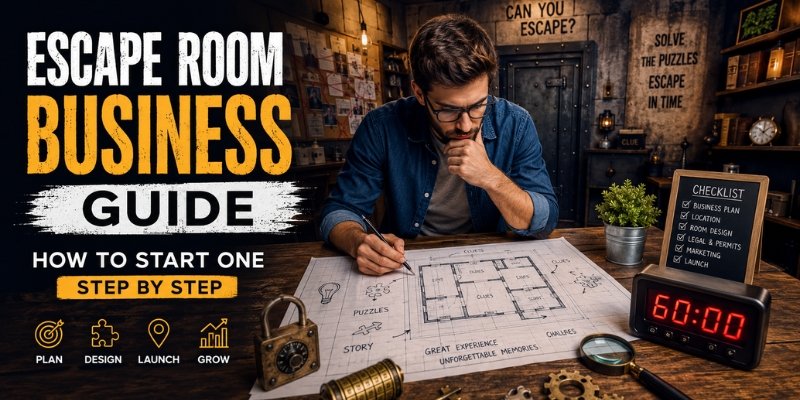
If you enjoy games, storytelling, and creating fun experiences for people, an escape room business might be the right move. It is one of the fastest-growing entertainment business ideas, and it works in small towns, large cities, and even at events.
This guide covers the escape room business, how to start one from scratch, including what it costs, how to plan your first room, what legal steps you may need to take, and how to attract your first customers.
An escape room is a live puzzle-based experience. Customers book a time slot, enter a themed room, solve clues and challenges, and try to complete the mission before time runs out. It is part game, part theatre, and part team challenge.
Whether you want to open a full venue, start with one room, or test a mobile concept, this guide will walk you through every step.
Table of Contents
What Is an Escape Room Business?
An escape room business sells timed, live puzzle experiences to paying customers. A group of people, usually two to eight players, enters a themed room and works together to solve puzzles, find hidden clues, unlock codes, and complete a mission before the clock hits zero.
The business owner creates the experience, manages the bookings, operates the rooms, and resets everything after each group leaves.
Popular escape room themes include:
- Mystery room (a detective-style whodunnit)
- Horror room (spooky, scary, or thriller atmosphere)
- Bank heist room (crack the vault before the alarm goes off)
- Science lab or mad scientist room
- Pirate treasure hunt room
- Detective agency or crime scene room
- Corporate team-building escape room
- Family-friendly adventure or school-themed room
Most escape rooms charge per group or per person. Sessions typically run 60 minutes, and venues run multiple groups per day. That is how the revenue adds up.
Is an Escape Room Business Profitable?
An escape room business can be profitable, but it depends on several factors. Location, rent, number of rooms, pricing, room quality, customer volume, reviews, and marketing all play a role in how much money a venue makes.
Some escape room venues earn a comfortable income from just one or two rooms. Others run six or more rooms and scale into a larger business. What matters most is good planning and consistent bookings.
| Factor | Impact on Profit |
| Location | High foot traffic can significantly increase daily bookings |
| Number of rooms | More rooms allow more sessions per day, which increases revenue |
| Game quality | A fun, well-designed experience gets better reviews and referrals |
| Marketing | Local SEO, Google reviews, TikTok, and partnerships drive bookings |
| Staff cost | Wages are a recurring monthly expense that affects net profit |
| Rent | Usually the largest fixed cost — choose the location carefully |
| Pricing strategy | Competitive pricing with peak and off-peak rates helps fill slots |
| Repeat customers | Birthday groups, corporate teams, and families often return |
Profitability is not guaranteed, but with a solid plan, a good location, and strong customer reviews, an escape room business can do well within its first one to two years.
How to Start an Escape Room Business Step by Step
Starting an escape room takes planning. Here is a clear, practical breakdown of every major step.
1. Research the Local Market
Before spending any money, spend time researching. Search Google Maps for escape rooms in your area. Look at how many exist, where they are located, how they are priced, and what customers say in reviews.
Pay attention to weak spots. If people complain that puzzles are too hard, that rooms are poorly maintained, or that customer service is bad, those are opportunities for you to do better.
Think about your target audience too. Are you near a university? Families with kids? Corporate offices? Tourist areas? Your location and theme choices should match who is actually nearby and looking for something to do.
For industry research, you can also review escape room market data and operator trends before finalizing your business plan. Room Escape Artist publishes a detailed U.S. Escape Room Industry Report, while broader market research firms such as Allied Market Research also publish escape room market outlooks.
2. Choose Your Escape Room Business Model
Not all escape room businesses look the same. Pick a model that fits your budget, your skills, and your goals.
- Independent escape room: You own and run everything yourself.
- Escape room franchise: You pay for a proven brand, system, and support. Costs are usually higher.
- Mobile escape room: You bring the experience to schools, events, or offices using a trailer or portable setup.
- Pop-up escape room: Temporary location at malls, festivals, or events.
- Corporate team-building escape room: Focused on business clients. Often commands higher prices.
- One-room small startup: The simplest way to start. One room, one theme, low overhead.
- Seasonal or event-based escape room: Runs during Halloween, Christmas, or special events.
For beginners, a one-room model is often the best starting point. It keeps costs low and lets you learn the business without overextending.
3. Create an Escape Room Business Plan
A business plan does not have to be complicated. It is just a clear document that answers the key questions about your business before you spend money. It helps you avoid costly mistakes.
Your escape room business plan should include:
- Business name and concept
- Target customers (families, students, corporate teams, tourists)
- Location plan and backup options
- Startup budget and where the money comes from
- Room themes you plan to offer
- Pricing structure per session or per person
- Marketing plan (how you will get customers)
- Booking system (online or in-person)
- Staffing plan (how many people you need and when)
- Monthly operating expenses
- Break-even estimate (how many bookings you need to cover costs)
- Growth plan (when and how you might add more rooms)
Writing this out forces you to think through problems before they become expensive surprises. Many new owners skip this and regret it later.
4. Estimate Escape Room Startup Costs
Startup costs vary a lot. They depend on your city, the size of the space, how complex the room design is, whether you build puzzles yourself or hire designers, and what technology you use. Here is a general breakdown:
| Cost Item | Estimated Range (USD) |
| Rent deposit (first + last month) | $2,000 – $10,000+ |
| Room design, set building, and decor | $3,000 – $25,000+ per room |
| Puzzle equipment and technology | $1,000 – $10,000+ |
| Website and online booking system | $300 – $3,000 |
| Insurance and licenses | Varies by city and state |
| Marketing and launch budget | $500 – $5,000 |
| Staff wages and training | Varies based on team size |
| Emergency fund | 3–6 months of operating expenses |
These are estimates. Your actual costs may be lower or higher. Some owners start small by building puzzles themselves, using second-hand props, and keeping the design simple. Others invest more for a higher-quality experience from day one.
Never spend your entire budget on the room. Keep money in reserve for month two and three while you are still building a customer base.
5. Pick the Right Location
Location matters more than most new owners realise. A cheaper property in a hard-to-find spot can hurt your business even if the room itself is excellent.
Look for locations with:
- Good foot traffic or easy online discoverability
- Parking for customers (especially for groups)
- Nearby restaurants, malls, or entertainment areas
- Proximity to universities, offices, or tourist attractions
- Safe neighbourhood and good lighting
- Reasonable rent for the square footage you need
- Easy access from main roads or public transport
A slightly higher rent in a visible, accessible area will usually pay for itself in more bookings. A hard-to-find location with cheap rent can cost you in lost customers.
6. Design Your First Escape Room Game
The game is your product. A well-designed room keeps customers happy, generates strong reviews, and fills your booking calendar through word-of-mouth.
When designing your first room, think through:
- Theme and storyline: what is the player trying to do and why?
- Puzzle flow: how do clues connect from start to finish?
- Difficulty level: not too easy, not frustratingly hard
- Room timing: usually 60 minutes, with a hint system for stuck players
- Safety exits: always required, always clearly marked
- Reset process: how quickly can staff reset the room between groups?
- Staff instructions: what do your team members say and when?
Before opening to the public, test the room with friends, family, or a small paid test group. Ask them what was confusing, what was fun, and what felt broken. Fix those things before launch.
The first room does not have to be perfect. It needs to be fun, safe, and easy to run consistently.
7. Handle Legal, Safety, and Insurance Requirements
Legal requirements for an escape room business vary depending on your city, state, and country. There is no single universal checklist, so you need to confirm what applies in your specific location.
Common areas to check include:
- Business registration and local business license
- Zoning approval (commercial entertainment use)
- Fire safety inspection and exit requirements
- Occupancy limits per room
- Liability insurance (very important for a physical activity business)
- Building safety and accessibility rules
- Lease terms from your landlord
- Health and safety rules for enclosed spaces
Note: This article does not provide legal advice. Requirements change and vary widely. Always confirm the rules that apply to your specific business with local authorities, a licensed business attorney, or a qualified professional before signing a lease or opening to the public.
8. Set Up a Website and Online Booking System
Customers expect to book online. If they cannot find you online or cannot book easily, most will choose a competitor that makes it simple.
Your website and online setup should include:
- A clean, mobile-friendly website
- Online booking calendar with available time slots
- Payment options (credit card, PayPal, or similar)
- Clear pricing page with what is included
- FAQ page to answer common questions
- Google Business Profile with your address, hours, and phone number
- Digital waiver or liability form
- Customer review section or Google review link
- Contact page
- Social media links (Instagram, TikTok, Facebook)
Local SEO is also important. Use your city name and keywords in your website content so that people searching for escape rooms near them can find you in Google results.
9. Market the Escape Room Before Launch
Start marketing before the doors open. Building awareness early means you will have bookings lined up on day one instead of waiting weeks for your first customer.
Effective marketing ideas for escape room businesses include:
- Set up and verify your Google Business Profile
- Post TikTok and Instagram Reels showing room teasers (without spoiling puzzles)
- Partner with local restaurants and hotels for referral deals
- Create a birthday party package and promote it to parent groups
- Offer a corporate team-building package and pitch to local offices
- Use student discounts to attract university groups
- Join local Facebook groups and community pages
- List your business on local event and entertainment directories
- Offer a referral discount for customers who bring a friend
QR codes can also play a useful role in marketing an escape room. Owners can use them to:
- Print QR code flyers for coffee shops, hotels, and gyms
- Link QR codes directly to an online booking page
- Use QR codes on waiver forms so customers can sign from their phone
- Create QR code links for Google Review requests after a session
- Offer QR code discount coupons at local events
- Even use QR codes as clues inside the rooms themselves
QR codes are a simple, low-cost way to connect physical marketing materials with your online booking system. Tools like IMQRScan allow you to create dynamic QR codes that can be updated without reprinting the flyer.
10. Launch With a Soft Opening
A soft opening means opening to a limited group before your full public launch. Invite friends, family, or a small group of discounted first-time customers.
During the soft opening, you should:
- Collect honest feedback on puzzles, timing, and room experience
- Fix anything confusing or frustrating before more customers arrive
- Improve the room reset process so it stays on schedule
- Train staff on how to give hints, handle problems, and manage groups
- Ask early customers to leave a Google review if they enjoyed it
Reviews from a soft opening can make your first week of full public bookings much easier. People trust businesses with reviews. A few positive early reviews go a long way.
Can You Start an Escape Room Business in One Day?
A complete escape room business cannot realistically be launched in a single day. There are too many steps involved: location, room design, permits, insurance, website, booking system, staff, and testing all take time.
However, you can absolutely start the planning process in one day. In a single focused day, you could:
- Research competitors on Google Maps
- Choose a potential theme for your first room
- Draft a rough startup budget
- Create a list of steps you need to complete over the coming weeks
- Test a simple puzzle concept on paper
Day one is about starting, not finishing. The business builds from there.
Can One Person Start an Escape Room Business?
Yes, one person can start an escape room business. A single-room concept is manageable solo, especially in the early stages.
However, running an escape room involves more than just owning it. Even a one-person operation will likely need occasional help with construction, puzzle design, room resets, customer check-ins, safety monitoring, cleaning, and marketing.
Many solo founders start by handling everything themselves and bring in part-time help as bookings grow. Some hire family members or friends at the beginning to keep costs low. As revenue increases, staffing becomes easier to afford.
How Much Does It Cost to Start an Escape Room Business?
There is no single answer because costs depend on where you are, how big the space is, how complex the room design is, and how much work you do yourself versus hiring professionals.
A minimal one-room setup in a smaller city could potentially start at a lower investment. A professional multi-room venue in a major city with high-end technology, custom set design, and hired staff will cost significantly more.
The biggest cost drivers are usually:
- Rent and lease deposit
- Room design, props, and set building
- Puzzle technology and electronics
- Insurance and permits
- Website and booking system
- Marketing for the launch
Plan a realistic budget, add a buffer for unexpected expenses, and do not drain all your funds before opening. You will need working capital for the first few months while bookings build up.
Common Mistakes to Avoid When Starting an Escape Room Business
Many new escape room businesses struggle or close early, not because the idea was bad, but because of avoidable mistakes. Here are the most common ones:
- Choosing a poor or hard-to-find location to save on rent
- Making the puzzles too difficult or confusing for average players
- Skipping safety checks, fire exits, or insurance
- Spending the entire budget on room design before testing the concept
- Not setting up online booking before launch
- Doing little or no marketing before or after opening
- Ignoring customer reviews or failing to ask for them
- Slow room reset times that delay the next group and frustrate customers
- No clear business plan, just building a room and hoping customers show up
- Poor customer service, being rude or unhelpful during or after the game
Most of these mistakes are avoidable with planning. If you address them before opening, you give yourself a much better chance of building a sustainable business.
Escape Room Business Ideas for Beginners
If you are still deciding on your concept, here are some beginner-friendly escape room business ideas that work well for first-time owners:
- Detective mystery room: A classic whodunnit format. Popular with a wide age range.
- Beginner-friendly family room: Simpler puzzles that work for parents and young children.
- Corporate team-building room: Target local offices. Often booked for groups of 10 or more.
- Horror-lite room: Atmospheric and spooky, but not graphic. Suitable for teens and young adults.
- School or history-themed room: Educational and fun. Good for school group bookings.
- Mobile escape room for events: A pop-up trailer or portable setup for weddings, festivals, or fairs.
- Birthday party escape room: Add a cake table, photo wall, and party atmosphere for an easy upsell.
- Pop-up escape room at malls or festivals: A low-commitment way to test your concept before signing a long lease.
Start with one theme, perfect it, and expand later. Trying to build too many rooms at once is one of the most common and costly mistakes new owners make.
If this is your first business, it can also help to speak with someone who has experience in startups, finance, or local business operations. SCORE.org provides free mentoring and startup resources for small business owners, which can be useful before investing heavily in an escape room location.
How to Start an Escape Room Business in California, Texas, or New Jersey
Starting an escape room in any US state follows the same general process, but the specific local rules can vary significantly by city and county.
In California, Texas, New Jersey, or any other state, owners typically need to look into:
- City or county business registration and license
- Zoning approval for entertainment use in the chosen property
- Fire safety inspection of escape rooms with locked doors or enclosed spaces often face strict fire code checks
- Occupancy limits per room set by the local fire marshal
- Liability insurance for a physical, interactive business
- Building accessibility requirements
- Lease and landlord approval for operating a commercial entertainment business
California: Rules can be strict in cities like Los Angeles or San Francisco. California has strong consumer protection and fire safety laws. Check with your city’s planning and fire departments before signing a lease.
Texas: Texas generally has a more straightforward business registration process, but fire safety rules and occupancy rules still vary by city. Houston, Dallas, and Austin may all have different requirements.
New Jersey: NJ requires standard business registration through the state. Local permits, zoning, and fire safety inspections will vary by municipality.
Important: This is general information, not legal advice. Always confirm requirements with local city or county offices, a licensed attorney, or a small business advisor before opening. Rules change, and enforcement varies.
Before choosing a location or signing a lease, create a simple business plan that covers your startup budget, target customers, pricing, monthly expenses, and marketing strategy.
The U.S. Small Business Administration offers helpful guidance on writing a business plan and preparing the basic steps needed to start a small business.
Final Thoughts
If you are researching an escape room business and how to start one, the smartest first move is to keep things simple. Do your market research, write a basic business plan, set a realistic budget, and design one strong room concept before scaling.
Start small. Test your experience with real people. Ask for feedback. Fix what does not work. Then grow from there.
Escape rooms succeed when the experience is genuinely fun, the booking process is easy, and the customer service is memorable. Get those three things right, and word-of-mouth will do a lot of the marketing for you.
For more small business guides and startup ideas, browse the Business section at https://athubtechnology.com/business/.
Frequently Asked Questions
How do you start an escape room business?
To start an escape room business, research the local market, choose a theme, create a business plan, estimate startup costs, secure a location, design the room, meet safety requirements, set up online booking, and launch with local marketing.
Can you start an escape room business in one day?
A complete escape room cannot be launched in one day. However, you can start the planning process in a single day by choosing a concept, researching competitors, estimating costs, and drafting a simple test idea.
Can one person start an escape room business?
Yes. A one-room concept is manageable for a solo founder, especially at the beginning. But help will likely be needed for construction, puzzle design, safety, marketing, cleaning, and customer support.
How much does it cost to start an escape room business?
Costs vary widely based on rent, city, room design, props, technology, staff, permits, and marketing. A minimal single-room setup may start lower, while a full multi-room venue in a major city can cost much more. Always budget a reserve for the first few months.
Is an escape room business good for beginners?
It can be a good fit for beginners who understand customer experience, games, storytelling, and local marketing. Starting small with one room and testing before scaling reduces the financial risk significantly.
How do you start an escape room business in California?
Owners in California should check city licensing, fire safety rules, occupancy limits, liability insurance, building accessibility requirements, and local zoning before opening. Requirements vary by city, so confirm with local authorities.
How do you start an escape room business in Texas?
In Texas, owners should research local city permits, business registration, fire safety inspections, building safety, and customer liability insurance requirements. Rules can differ between Houston, Dallas, Austin, and other cities.
How do you start an escape room business in New Jersey?
Starting an escape room in New Jersey requires state business registration and local permits covering zoning, fire safety, and property requirements. Check with your specific municipality before signing a lease.