Quick Answer
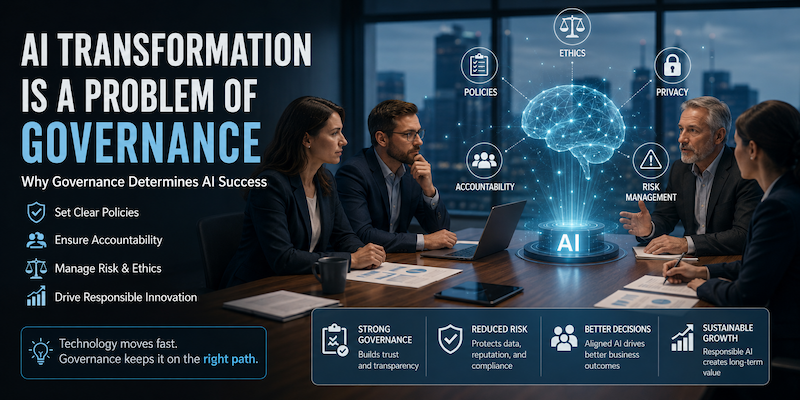
AI transformation is a problem of governance because technology alone cannot decide who owns an AI system, which data it may use, how much risk is acceptable, or who must act when it fails.
A company may have advanced models and skilled engineers, yet still fail to gain value from AI. Successful AI transformation needs clear ownership, approved data, human oversight, risk controls, performance measures, and rules that support fast but responsible decisions.
Artificial intelligence can write reports, predict demand, answer customer questions, detect fraud, and automate complex work. Yet many organizations still struggle to move from AI experiments to lasting business value.
The main barrier is often not the model.
It is not always the cloud platform, the software vendor, or the size of the data science team.
In many cases, AI transformation is a problem of governance.
Governance determines who can approve an AI use case. It defines which data the system may access. It sets limits on automated decisions. It assigns responsibility when the system produces a harmful, unfair, insecure, or inaccurate result.
Without these decisions, AI projects remain stuck in testing. Other projects go live without enough control and expose the organization to legal, financial, security, and reputation risks.
The World Economic Forum reported in 2026 that the central AI challenge has moved beyond proving whether the technology works. Organizations must now change their workflows, decision structures, operating models, and ways of working to gain sustained value from AI.
This guide explains why AI transformation is a governance challenge, which risks leaders must address, and how to create a practical governance model that supports innovation instead of blocking it.
Key Takeaways
- AI transformation fails when accountability is unclear.
- Governance connects AI projects to business goals.
- Strong governance controls data, security, ethics, quality, and compliance.
- Business leaders must own AI outcomes, not only technology teams.
- Human review should match the impact of each AI decision.
- Governance should be based on risk, not one fixed process for every project.
- The best model allows safe AI projects to move faster.
Table of Contents
What Does “AI Transformation Is a Problem of Governance” Mean?
Definition
AI transformation governance is the system of decision rights, policies, responsibilities, controls, and review processes used to select, build, operate, measure, and retire AI systems.
The statement AI transformation is a problem of governance does not mean technology is unimportant.
Technology remains essential. An organization still needs reliable data platforms, secure systems, suitable AI models, skilled teams, testing tools, and integration capabilities.
However, technology cannot answer every important business question.
For example:
- Should an AI system be allowed to reject a loan?
- Who approves employee data for model training?
- Can customer conversations be sent to an external AI provider?
- Who verifies AI-generated financial information?
- What level of model error is acceptable?
- When must a human review an automated decision?
- Who informs customers when AI is being used?
- Who has authority to stop the system?
These are governance decisions.
An AI model can generate an answer. It cannot decide whether the organization should trust that answer.
That difference explains why AI transformation is a problem of governance rather than only a technical implementation project.
The OECD AI Principles state that organizations should support transparency, traceability, responsible disclosure, and accountability throughout the AI lifecycle. They also make clear that AI actors remain responsible for the proper functioning of systems based on their roles and context.
AI Projects and AI Transformation Are Not the Same
An AI project solves a defined problem.
AI transformation changes how the organization works.
A project may create a chatbot for one department. A transformation may change customer support, employee roles, approval paths, service measures, knowledge management, and customer communication across the company.
This difference matters.
| AI Project | AI Transformation |
|---|---|
| Focuses on one use case | Changes many connected workflows |
| Often owned by one team | Requires shared enterprise ownership |
| Has a limited user group | Affects employees, customers, and partners |
| Measures model accuracy | Measures business value and operating impact |
| May end after deployment | Requires ongoing monitoring and improvement |
| Uses project-level controls | Needs organization-wide governance |
| Solves a local problem | Changes decision rights and accountability |
A company can run many successful pilots without completing an AI transformation.
Pilots may appear successful because they work in a limited setting. Problems often appear during scale. More users access the system. More sensitive data enters prompts. AI outputs affect customers. Costs increase. Different teams create duplicate tools. No one knows which version is approved.
At that point, AI transformation is a problem of governance.
Why AI Transformation Is a Problem of Governance
AI changes more than software.
It changes:
- How decisions are made
- Who completes each task
- What evidence people trust
- Which data flows between departments
- How employees interact with customers
- How errors are detected
- How performance is measured
- Who carries responsibility for an outcome
Traditional software normally follows rules written by people.
AI systems can produce variable results. A generative AI assistant may answer the same question differently on separate occasions. A prediction model may lose accuracy when customer behavior changes. An AI agent may complete several actions before a human checks its work.
This creates new forms of uncertainty.
The National Institute of Standards and Technology, or NIST, organizes AI risk management around four functions: Govern, Map, Measure, and Manage. The framework treats governance as a continuous part of the AI lifecycle rather than a final compliance review.
Good governance gives the organization a structured way to manage that uncertainty.
It does not promise zero risk.
It ensures that risks are identified, assigned, measured, controlled, and reviewed by the right people.
1. Unclear Ownership Creates Uncontrolled AI
The first reason AI transformation is a problem of governance is unclear ownership.
Many AI projects begin inside innovation teams, IT departments, marketing units, or individual business functions. A small team selects a tool, uploads data, and builds a useful solution.
The pilot works.
Then the difficult questions begin.
Who owns the AI system after launch?
Is it the technology team that built it? Is it the business department that uses it? Is it the data team because the model depends on enterprise information? Is it the legal team because the system creates compliance risk?
When ownership is unclear, important work is missed.
No one may take responsibility for:
- Updating instructions
- Reviewing poor outputs
- Monitoring costs
- Checking data quality
- Approving new users
- Responding to incidents
- Tracking vendor changes
- Measuring business value
- Retiring an outdated system
Definition: AI System Owner
An AI system owner is the business leader accountable for the system’s purpose, outcomes, controls, performance, users, and continued operation.
The business owner does not need to understand every technical detail.
However, the owner must answer for the result.
A customer service director should own the outcome of a customer service AI assistant. The security, data, legal, and technology teams support the owner, but they should not replace business accountability.
Best Practice
Assign one named business owner before an AI use case receives development funding or access to production data.
A practical ownership model should include:
| Role | Main Responsibility |
|---|---|
| Executive sponsor | Connects AI work to business strategy |
| Business owner | Owns the outcome, value, and operating risk |
| Product owner | Manages requirements and user needs |
| Data owner | Approves data access and quality rules |
| Technical owner | Manages architecture, integration, and reliability |
| Risk or compliance owner | Reviews regulatory and control requirements |
| Security owner | Reviews access, threats, and data protection |
| Model owner | Monitors model quality and behavior |
| Human reviewer | Checks high-impact outputs and exceptions |
Clear ownership does not slow AI.
It prevents repeated meetings, delayed approvals, and unmanaged systems.
2. Poor Data Governance Produces Poor AI Decisions
The second reason AI transformation is a problem of governance is data.
AI systems depend on data, documents, prompts, instructions, examples, and business rules. A powerful model cannot repair every weakness in these inputs.
If customer records are incomplete, the AI may make weak recommendations.
If policy documents conflict, the AI may provide inconsistent guidance.
If old product information remains in the knowledge base, the AI may answer with expired prices or services.
If employees upload confidential information to an unapproved platform, the organization may lose control over sensitive data.
Definition: AI Data Governance
AI data governance defines which data an AI system may use, who owns it, how quality is measured, and how privacy, access, retention, and lineage are controlled.
Data governance for AI should answer:
- What data does the system use?
- Who owns each source?
- Is the data approved for this purpose?
- Does it contain personal or confidential information?
- How often is it updated?
- Can users trace an output back to a source?
- How long is prompt and response data retained?
- Can the provider use the data to train its models?
- How are incorrect records fixed?
- What happens when access rights change?
Organizations often treat all data as one governance problem. A more useful method is to prioritize important data by business domain and use case. Data that affects customer eligibility, safety, finance, employment, or legal rights requires stronger control than low-impact public information. This domain-focused approach also helps governance work produce visible business value.
Key Takeaway
AI does not remove the need for data governance. It makes data ownership, quality, lineage, access, and purpose more important.
Best Practice
Create an approved AI data register with these fields:
- Data source
- Data owner
- Business purpose
- Sensitivity level
- Legal basis
- Quality status
- Approved AI uses
- Restricted uses
- Retention period
- Geographic storage requirements
- Last review date
This register helps teams make fast and consistent decisions.
3. AI Risk Is Different for Every Use Case
Not every AI system creates the same level of risk.
A tool that summarizes public news has a different risk level from an AI system that recommends medical treatment.
A tool that drafts an internal email has a different impact from a system that approves an insurance claim.
When companies use one approval process for every AI project, two problems appear.
Low-risk projects face too much delay.
High-risk projects receive too little control.
This is another reason AI transformation is a problem of governance.
Organizations need a risk-based model.
AI Risk Classification Table
| Risk Level | Example | Suggested Controls |
|---|---|---|
| Low | Rewriting non-sensitive internal text | Basic usage policy and user review |
| Moderate | Summarizing internal documents | Approved data sources, access control, testing |
| High | Customer recommendations or financial forecasts | Formal validation, monitoring, human approval |
| Very high | Employment, healthcare, credit, safety, or legal decisions | Executive approval, legal review, detailed audit trail, strict human oversight |
The risk assessment should consider more than the AI model.
It should examine:
- The business decision
- People affected
- Data sensitivity
- Financial impact
- Legal impact
- Security exposure
- Ability to reverse the decision
- Need for explanation
- Scale of use
- Level of human control
- Dependence on third-party providers
NIST describes AI risk management as a voluntary, cross-sector approach that helps organizations include trustworthiness considerations in the design, development, deployment, use, and evaluation of AI systems.
Best Practice
Apply stronger controls as the possible harm, scale, autonomy, and difficulty of reversing a decision increase.
This model allows governance to support innovation.
A low-risk writing assistant may receive fast approval. A system that affects customer rights should receive deeper review.
That is not unfair delay.
It is proportionate control.
4. Human Oversight Is Often Poorly Defined
Many organizations say a human will remain “in the loop.”
That phrase sounds safe, but it is often too vague.
Which human?
At what point?
What information will the person review?
Can the reviewer reject the AI output?
Does the reviewer have enough time and skill?
Will the system record the reviewer’s decision?
A person who clicks “approve” without checking the result does not provide meaningful oversight.
Human Oversight Models
| Model | How It Works | Suitable Use |
|---|---|---|
| Human in the loop | A person approves before the system acts | High-impact decisions |
| Human on the loop | The system acts while a person monitors | Moderate-risk automation |
| Human over the loop | People set limits and review trends | Large-scale, lower-risk systems |
| Human out of the loop | The system acts without direct review | Only clearly defined low-risk tasks |
The correct model depends on the impact of an error.
For high-impact systems, the reviewer should have:
- Clear authority to stop or reverse the decision
- Access to the source information
- Training on common AI errors
- Enough time to perform a real review
- A simple way to report concerns
- Protection from pressure to approve every output
- A record of the final decision
Real Example: Customer Refund Assistant
Imagine an online retailer introduces an AI assistant to review refund requests.
The first version only summarizes the customer’s message. An employee decides whether to approve the refund.
The risk is moderate.
Later, the company allows the AI to approve refunds below $100 automatically. The system uses order history, customer behavior, product type, and fraud indicators.
The risk has changed.
The company now needs rules for:
- Maximum refund value
- Fraud alerts
- Repeat claims
- Protected customer information
- Exceptions
- Manual escalation
- Appeal rights
- Monitoring false approvals and false rejections
The model may be technically similar, but its decision authority has changed.
This example shows why AI transformation is a problem of governance. The main question is no longer whether the model can analyze a refund request. The main question is what authority the organization should give it.
5. AI Policies Fail When They Are Too General
Many organizations publish an AI policy that says employees should use AI responsibly.
That is not enough.
Employees need practical rules for real situations.
They need to know:
- Which tools are approved
- Which data may be entered
- When AI-generated content needs review
- How to disclose AI use
- Which activities are prohibited
- How to report a problem
- Whether AI output can be used in customer communication
- Whether generated code needs security testing
- Whether meeting recordings may be processed
- Whether confidential contracts may be summarized
A useful AI policy should be clear enough for daily use.
Weak Policy Versus Practical Governance
| Weak Rule | Practical Rule |
|---|---|
| Use AI responsibly | Use only tools listed in the approved AI catalogue |
| Protect private data | Do not enter customer, employee, financial, or confidential data without approved controls |
| Check AI output | Verify facts, figures, citations, names, and decisions before use |
| Avoid harmful content | Report biased, unsafe, or inappropriate output through the AI incident process |
| Follow the law | Complete legal and compliance review for high-impact use cases |
| Keep humans involved | Define the required human review for each risk level |
Best Practice Box
Write separate guidance for employees, developers, business owners, reviewers, procurement teams, and executives. Each group makes different AI decisions.
The policy should also explain that AI output may be incorrect even when it sounds confident.
This is especially important for generative AI.
Users may trust a fluent answer because it appears professional. Governance should require evidence, source checking, or human review when accuracy matters.
6. Vendor Governance Becomes Business Governance
Many organizations do not build their own foundation models.
They buy AI features from software vendors, cloud providers, business applications, and small technology companies.
This may reduce development time, but it does not remove accountability.
A vendor may change:
- Its model
- Data retention terms
- Hosting region
- Subprocessors
- Security controls
- Pricing
- Usage limits
- Safety filters
- Training practices
- Product features
The organization still owns the business outcome.
Questions to Ask an AI Vendor
- Which model powers the service?
- Where is customer data processed and stored?
- Is customer data used for model training?
- How long are prompts and responses retained?
- Which subprocessors receive the data?
- Can the service support role-based access?
- Are actions and outputs logged?
- Can data be deleted?
- How are security incidents reported?
- How often does the provider change the model?
- Can customers test major updates before release?
- What happens when the contract ends?
- Can the company export its data and history?
- Which service levels are guaranteed?
- How does the provider test harmful or inaccurate behavior?
Key Takeaway
Outsourcing the AI platform does not outsource responsibility for customer impact, legal compliance, security, or business performance.
Procurement teams should not review AI tools as ordinary software subscriptions.
They need support from security, data, legal, technology, risk, and the business owner.
Vendor governance also needs continuous review.
A tool that was safe when purchased may change after a major model update.
7. Organizations Measure Activity Instead of Value
AI teams often report:
- Number of pilots
- Number of users
- Number of prompts
- Number of tools purchased
- Number of employees trained
- Number of automation ideas collected
These measures show activity.
They do not prove transformation.
A company may have thousands of AI users and still gain little financial or operational value.
Strong governance connects each AI initiative to a measurable business result.
Useful AI Transformation Measures
| Measurement Area | Example Metrics |
|---|---|
| Adoption | Active users, repeat use, completed tasks |
| Quality | Accuracy, acceptance rate, correction rate |
| Efficiency | Time saved, cycle-time reduction, cost per task |
| Customer impact | Resolution time, satisfaction, complaint rate |
| Employee impact | Workload, job quality, training completion |
| Risk | Incidents, policy breaches, harmful outputs |
| Financial value | Revenue gained, cost reduced, loss prevented |
| Reliability | Availability, latency, failed actions |
| Data quality | Missing records, stale sources, conflicting information |
| Governance | Review completion, owner assignment, control effectiveness |
McKinsey’s 2026 AI measurement framework connects adoption, operational performance, organizational capability, financial results, and enterprise impact. It also emphasizes clarity about who owns each measure.
Best Practice
Approve an AI use case only when the team can explain the current baseline, expected result, measurement method, owner, and review date.
For example, “use AI in customer service” is not a measurable goal.
A stronger goal is:
Reduce average customer email handling time from 12 minutes to 8 minutes while maintaining a quality score above 90% and keeping incorrect policy advice below 1%.
This makes the expected value and risk visible.
Governance Should Enable AI, Not Block It
Governance is often described as red tape.
That happens when every decision goes through one central committee, regardless of risk.
A better model gives teams clear boundaries and reusable controls.
The World Economic Forum argues that effective governance should start with the outcomes an organization wants to protect, such as integrity, accountability, transparency, and resilience. It should then apply the minimum mechanisms needed to protect those outcomes.
This means a governance team should not review every prompt.
It should create a system that helps teams make safe decisions without constant escalation.
Centralized, Decentralized, and Federated Governance
| Model | Strength | Weakness |
|---|---|---|
| Centralized | Consistent control | Can create bottlenecks |
| Decentralized | Fast local decisions | May create inconsistent standards |
| Federated | Shared standards with local ownership | Requires clear roles and coordination |
A federated model often works well for large organizations.
A central team provides:
- Enterprise policies
- Risk classification
- Approved technology patterns
- Vendor standards
- Training
- Monitoring requirements
- Common templates
- Incident rules
Business teams provide:
- Use-case ownership
- Domain expertise
- Process design
- User adoption
- Outcome measurement
- Day-to-day control
This approach explains why AI transformation is a problem of governance across both central and local teams.
A Practical AI Governance Operating Model
An AI governance model should be easy to understand.
It should not begin with a 100-page policy.
Start with the decisions that teams make during the AI lifecycle.
1. Discover
The team identifies a business problem.
Questions include:
- What problem are we solving?
- Who experiences the problem?
- What is the current cost?
- Why is AI suitable?
- Could a simpler rule or software feature solve it?
2. Assess
The team reviews value, data, risk, and feasibility.
Questions include:
- What data is required?
- Who owns the data?
- Who may be affected?
- What could go wrong?
- Is a human review needed?
- What laws or policies apply?
3. Approve
The correct authority approves the use case based on risk.
Low-risk use cases may follow a fast path.
High-risk use cases may require legal, security, risk, and executive approval.
4. Build or Buy
The team develops the solution or selects a vendor.
Required controls may include:
- Secure architecture
- Access management
- Data filtering
- Prompt protection
- Output validation
- Audit logging
- Vendor terms
- Model testing
5. Test
Testing should cover more than accuracy.
The team should test:
- Normal cases
- Edge cases
- Harmful prompts
- Sensitive data
- Bias risks
- Security attacks
- Incorrect source information
- High-volume use
- Model failure
- Human escalation
6. Deploy
Deployment should include:
- Named owner
- Approved users
- Monitoring dashboard
- User training
- Support process
- Incident response
- Rollback plan
- Communication plan
7. Monitor
AI behavior can change because the model, data, users, or business environment changes.
Monitoring should review:
- Output quality
- User behavior
- Data quality
- Cost
- Complaints
- Incidents
- Model changes
- Business value
8. Retire
AI systems should not remain active forever.
Retirement planning should cover:
- Data deletion
- Access removal
- Contract closure
- Process replacement
- Record retention
- User communication
- Lessons learned
How to Build AI Governance in 10 Steps
Step 1: Create an AI Inventory
List every approved and unapproved AI system currently used.
Record the owner, purpose, users, provider, data sources, risk level, and current status.
Step 2: Define AI Principles
Choose a small set of principles such as:
- Human accountability
- Fairness
- Privacy
- Security
- Transparency
- Reliability
- Business value
The OECD AI Principles provide a useful external reference for trustworthy AI, accountability, traceability, transparency, robustness, security, and safety.
Step 3: Assign Decision Rights
State who can approve:
- AI tools
- Data access
- High-risk use cases
- Production deployment
- Model changes
- Exceptions
- System shutdowns
Step 4: Classify AI Risk
Use clear levels such as low, moderate, high, and prohibited.
Connect each level to required controls.
Step 5: Create an Approved Tool Catalogue
Employees should know which AI products they may use and for what purpose.
Include approved data types and restrictions.
Step 6: Create Reusable Controls
Provide templates for:
- Risk assessments
- Data reviews
- Vendor reviews
- Human oversight
- Testing
- Monitoring
- Incident reports
Step 7: Train People by Role
Executives, employees, developers, data owners, and reviewers need different training.
General AI awareness is not enough.
Step 8: Start With Important Use Cases
Do not attempt to govern every possible AI idea at once.
Prioritize use cases with clear value, available data, and visible ownership.
Step 9: Monitor Value and Risk Together
A system should not remain active because it is safe but useless.
It should also not remain active because it is valuable but uncontrolled.
Step 10: Improve Governance Through Evidence
Review incidents, user feedback, delays, false alarms, and control failures.
Remove controls that add no value. Strengthen controls where real risks appear.
Common AI Governance Mistakes
Creating a Committee Without Decision Authority
A committee that only discusses AI cannot govern it.
Members need clear authority, deadlines, and escalation paths.
Making IT Responsible for Every Outcome
Technology teams should own technical delivery.
Business leaders must own business decisions and results.
Applying One Process to Every Use Case
A text summarizer and a healthcare decision system should not follow the same approval path.
Ignoring Unapproved AI Use
Employees may use public AI tools even when the company has no formal program.
Governance should make safe tools easier to access than unsafe ones.
Reviewing Only Before Launch
AI risks continue after deployment.
Models, data, vendors, and user behavior change.
Focusing Only on Compliance
Compliance is important, but governance must also support value, adoption, quality, and operating performance.
Treating AI as a Separate Business Strategy
AI should support customer, employee, operational, and financial goals.
It should not become a collection of disconnected experiments.
AI Governance Versus AI Management
These terms are related but different.
| AI Governance | AI Management |
|---|---|
| Defines who has authority | Executes approved decisions |
| Sets policies and limits | Operates within those limits |
| Assigns accountability | Completes daily tasks |
| Approves risk levels | Monitors system performance |
| Defines acceptable outcomes | Delivers and improves outcomes |
| Reviews major exceptions | Handles routine issues |
Governance defines the rules of the game.
Management plays the game.
Both are needed.
How AI Governance Supports AI Search Visibility
AI governance also affects public information and digital visibility.
Companies increasingly want their content to appear in Google AI Overviews, ChatGPT, Gemini, Claude, Perplexity, and Microsoft Copilot.
However, AI search visibility needs accurate, structured, and trusted content.
Organizations should govern:
- Who may publish official claims
- Which sources support those claims
- How content is updated
- How entities are named
- Which pages represent the official answer
- How duplicate information is managed
- How structured data is implemented
- How AI citations and brand mentions are monitored
For a deeper view of these measures, see the internal guide on AI search visibility metrics and KPIs.
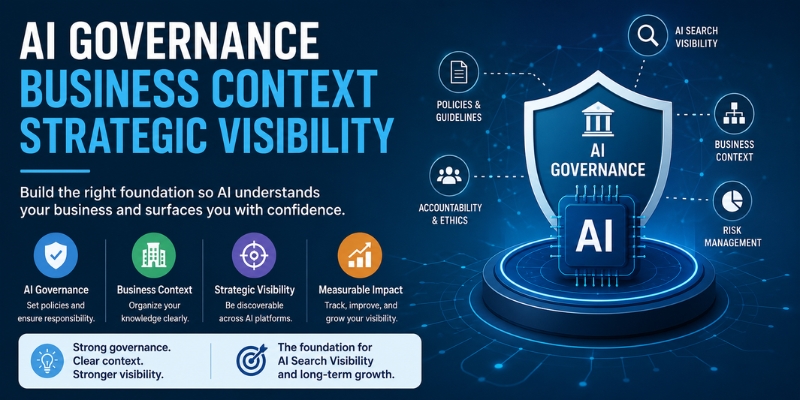
You may also connect governance to broader business context through AI governance, business context, and strategic visibility.
These internal resources support a wider view of AI transformation. Governance covers both internal AI systems and the quality of information that external AI platforms discover about the organization.
Real-World AI Transformation Example
Consider a regional manufacturing company.
The company wants to use AI to predict equipment failures.
The first pilot uses sensor data from one factory. A data science team builds an accurate prediction model.
The model is technically successful.
However, the company cannot scale it because:
- Factory names are inconsistent.
- Equipment records have missing IDs.
- Maintenance teams use different failure codes.
- No one owns sensor data quality.
- Engineers do not trust the prediction.
- The system does not explain why it issued an alert.
- There is no process for false alarms.
- Operations and technology teams have different success measures.
- No one has authority to change the maintenance schedule.
The problem is not only the model.
The company needs governance.
It assigns the operations director as the business owner. Plant managers own local adoption. The data team creates common equipment IDs. Engineers define acceptable alert accuracy. Maintenance teams record whether each alert was correct. The security team controls sensor access. Finance measures avoided downtime.
The model now becomes part of the operating process.
This is AI transformation.
The technology creates the prediction. Governance turns the prediction into a trusted business decision.
Best Practices for Responsible AI Transformation
Best Practice 1: Begin with a business decision, not an AI tool.
Best Practice 2: Assign a named owner for value, risk, data, and technical operation.
Best Practice 3: Use stronger controls for systems with greater impact or autonomy.
Best Practice 4: Make approved AI tools easy for employees to find and use.
Best Practice 5: Record data sources, model versions, owners, approvals, and major changes.
Best Practice 6: Test real business scenarios, not only model benchmarks.
Best Practice 7: Give human reviewers authority, information, training, and time.
Best Practice 8: Monitor business value and risk after launch.
Best Practice 9: Review vendor changes throughout the contract.
Best Practice 10: Retire AI systems that no longer provide safe, reliable value.
Final Answer: Is AI Transformation Really a Governance Problem?
Yes.
AI transformation is a problem of governance because organizations must decide how AI fits into their goals, workflows, data, responsibilities, controls, and human decisions.
A model can automate a task.
It cannot assign accountability.
A platform can process data.
It cannot decide whether that use is fair, legal, or suitable.
An AI agent can take action.
It cannot define the level of authority the organization should give it.
Governance provides these answers.
The goal is not to prevent every mistake. That would stop useful innovation.
The goal is to create clear ownership, proportionate controls, reliable evidence, and fast escalation when something goes wrong.
Organizations that treat AI as only a technology purchase may create many pilots.
Organizations that treat AI as an operating and governance change have a better chance of creating lasting value.
Frequently Asked Questions
Why is AI transformation a governance issue?
AI transformation changes decisions, roles, data access, and accountability. Governance defines who controls these changes and how organizations manage value, risk, and human oversight.
What is the main purpose of AI governance?
AI governance helps organizations use AI safely and effectively by setting ownership, approval rules, data controls, risk limits, monitoring requirements, and accountability.
Does AI governance slow innovation?
Poor governance can slow innovation. Risk-based governance speeds up safe projects by providing clear tools, approval paths, responsibilities, and reusable controls.
Who should own an AI system?
A business leader should own the outcome. Technology, data, security, legal, and risk teams should support the owner with specialist controls.
What is a high-risk AI system?
A high-risk system can significantly affect safety, employment, finance, healthcare, legal rights, privacy, or customer access to important products and services.
How often should AI systems be reviewed?
Review frequency should match risk. High-impact systems may need continuous monitoring and frequent formal reviews, while low-risk tools may need periodic checks.
What data controls does AI need?
AI needs approved sources, named owners, quality checks, access controls, retention rules, privacy protection, lineage, usage restrictions, and processes for correcting errors.
What is human-in-the-loop AI?
Human-in-the-loop AI requires a person to review or approve an output before the system completes a decision or takes an important action.
Can a company outsource AI accountability?
No. A vendor may provide the technology, but the company remains responsible for business decisions, customer impact, security, privacy, and regulatory obligations.
What should an AI inventory contain?
An AI inventory should record each system’s purpose, owner, users, provider, model, data sources, risk level, controls, status, and latest review date.
How do companies measure AI transformation success?
They should measure adoption, quality, time saved, customer impact, employee impact, financial value, system reliability, incidents, and control effectiveness.
What is federated AI governance?
Federated governance combines shared enterprise standards with local business ownership, allowing departments to move quickly while following common risk and data rules.
How should AI incidents be handled?
Organizations should provide a clear reporting channel, stop harmful activity, preserve evidence, assess impact, notify responsible leaders, fix controls, and document lessons.
Can small businesses use AI governance?
Yes. Small businesses can begin with an approved tool list, basic data rules, named owners, human review, vendor checks, and a simple incident process.
What is the difference between AI ethics and governance?
AI ethics defines principles such as fairness and transparency. Governance turns those principles into responsibilities, approval rules, controls, evidence, and measurable actions.
Why does data quality matter in AI?
AI systems learn, retrieve, and reason from available information. Missing, outdated, biased, or conflicting data can produce inaccurate and harmful outputs.
Should every AI output be reviewed by a human?
No. Human review should match the risk. High-impact decisions need stronger review, while low-risk and reversible tasks may use automated monitoring.
What is an AI governance committee?
It is a cross-functional group that sets standards, reviews significant risks, resolves ownership issues, approves exceptions, and monitors enterprise AI performance.
When should an AI system be retired?
Retire it when it loses business value, becomes unreliable, creates unacceptable risk, depends on unsupported technology, or no longer meets legal requirements.
Where can organizations find an AI governance framework?
The NIST AI Risk Management Framework offers practical guidance through its Govern, Map, Measure, and Manage functions.