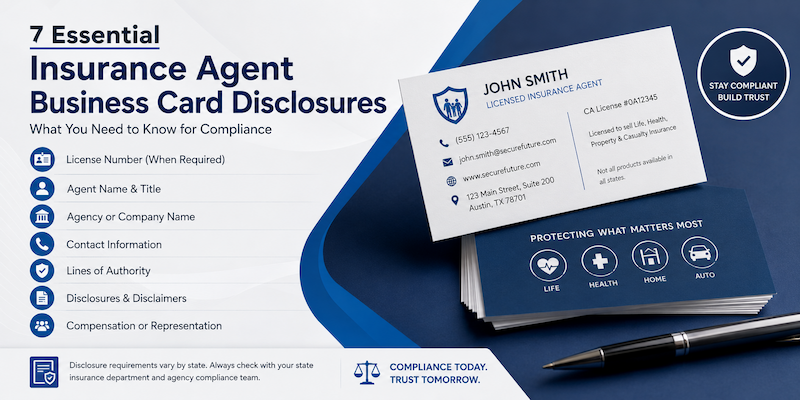
If you are asking what are typical insurance agent disclosures for business card use, the answer depends partly on where the insurance agent is licensed.
A typical insurance agent business card identifies the agent, gives accurate contact information, states the agent’s professional role, and may show an insurance license number when required by state law. It should also use the correct agency or business name and avoid claims that could mislead a customer.
The important point is that there is no single disclosure format that works in every U.S. state.
For example, California requires many insurance licensees to display their license number on business cards. New York has historically taken a different approach and does not generally require an insurance agent’s license number to appear on the business card under its insurance laws.
That difference is why insurance agents should treat a business card as a form of regulated marketing, not simply a networking tool.
Quick Answer
Typical insurance agent business card disclosures may include the agent’s legal or approved professional name, title, agency name, contact details, license number where required, and accurate information about the agent’s insurance role. Requirements vary by state and license type.
This guide explains what usually belongs on the card, what may be legally required, what should be avoided, and how agents can build a simple compliance checklist before printing thousands of cards.
Table of Contents
What Is an Insurance Agent Business Card Disclosure?
Definition
An insurance agent business card disclosure is information placed on a business card to accurately identify the agent, licensing status, business relationship, or other facts required by applicable insurance and advertising rules.
Some disclosures are required by law.
Others are included because they reduce confusion.
For example, consider these two descriptions:
John Smith
Financial Expert
and:
John Smith
Licensed Insurance Agent
CA License #1234567
The second description gives a consumer much more information about John’s actual professional role.
That distinction matters because insurance is a regulated industry.
Customers may make important financial decisions based on what an agent says or advertises. Regulators therefore care about how insurance professionals identify themselves.
What Are Typical Insurance Agent Disclosures for Business Card Designs?
The most common information falls into seven areas.
| Information | Common on Cards? | Potential Compliance Importance |
|---|---|---|
| Agent name | Yes | High |
| Professional title | Yes | High |
| Agency/company name | Yes | High |
| Phone/email | Yes | Medium |
| Insurance license number | Depends on state | High |
| Website/address | Often | Medium |
| Product or service description | Optional | High if used |
The presence of a particular item does not automatically mean the card complies with every law.
The wording must also be accurate.
Here are the seven areas in more detail.
1. Agent’s Name
The agent’s name is the most basic element.
It should match the name the agent is legally or professionally authorized to use.
A card might say:
Maria Johnson
rather than using an unrelated business identity that makes it difficult for customers to determine who is actually providing the insurance service.
Agents operating under an approved trade name or DBA should also check state requirements.
California, for example, has specific rules regarding approved fictitious business names. The California Department of Insurance states that when a committed DBA is approved, that approved name must be used when conducting insurance business, including on business cards and advertising.
Best Practice
Use the same professional name across your insurance license, business card, website, email signature, proposals, and other customer-facing materials whenever applicable.
Consistency makes verification easier.
2. Professional Title
The title should tell customers what the person actually does.
Common examples include:
- Licensed Insurance Agent
- Insurance Broker
- Life Insurance Agent
- Property and Casualty Agent
- Independent Insurance Agent
- Insurance Producer
The correct terminology can depend on the person’s license and state.
Avoid titles that exaggerate authority.
For example, someone who sells insurance should be careful about presenting themselves as an “investment adviser,” “financial planner,” or another regulated professional unless they are legally entitled to use that title.
A business card has very little space, but that does not make accuracy less important.
Good example
David Miller
Licensed Insurance Agent
Potentially confusing example
David Miller
Senior Wealth Authority
The second title does not clearly tell the customer what David is licensed to do.
3. Insurance License Number
This is one of the most important answers when someone asks what are typical insurance agent disclosures for business card compliance.
Some jurisdictions require the insurance license number.
Others may not.
California example
California provides a clear example.
The California Department of Insurance states that licensed insurance agents and brokers must display their license number on business cards and marketing materials concerning insurance products.
California Insurance Code Section 1725.5 covers business cards, written insurance price quotations, and certain print advertisements. The department has also explained that the number does not necessarily have to be preprinted. It can be affixed, typed, printed, or added legibly in another permitted way.
California later expanded license-number requirements to certain emails involving licensed activities, effective January 1, 2023.
A California card could therefore look like this:
Sarah Williams
Licensed Insurance Agent
CA License #0A12345
555-555-0198
sarah@example.com
New York example
New York demonstrates why agents should not assume every state follows the same rule.
The New York Department of Financial Services issued an opinion stating that New York insurance laws and regulations did not require agents to print their license number on business cards or advertising materials.
So the question is not simply:
“Should insurance agents put a license number on business cards?”
The better question is:
“Does my state, license type, agency, or insurer require it?”
Key Takeaway
License-number requirements are jurisdiction-specific. Never copy another agent’s business card and assume its disclosure format satisfies your state’s requirements.
4. Agency or Business Name
The card normally identifies the business the agent represents.
For example:
Robert Carter
Licensed Insurance Agent
ABC Insurance Services
This helps customers understand who they are dealing with.
However, the business name must also be accurate.
An independent agent should not design a card that makes it appear they are an insurance carrier if they are not.
Similarly, an agent should not imply a relationship with a well-known insurer that does not exist.
Business naming can itself be regulated.
For example, California rules address insurance business names that could mislead consumers. The state’s guidance explains that certain insurance producer names must clearly indicate the nature of the insurance business.
That is another reason to use the officially approved agency or DBA name.
5. Contact Information
Most business cards contain straightforward contact information.
Typical information includes:
Phone number
Use a number customers can actually use to reach the agent or agency.
Email address
A professional business email is generally preferable to an unrelated personal address.
Website
The website should accurately represent the agent or agency.
Office address
This may be useful when customers visit an office, although whether it is necessary depends on the business and applicable rules.
QR code
Some agents now use a QR code to connect the printed card with a digital profile, appointment page, contact form, or website.
If you are exploring how QR technology can support business marketing, AT HUB Technology’s guide to the top dynamic QR code generator options explains how dynamic QR destinations work.
A QR code should supplement required information rather than being used to hide mandatory disclosures.
If a license number must appear on the physical card, putting it only on a QR landing page may not satisfy the requirement.
6. Products and Services Offered
Insurance agents sometimes use the back of a card to list services.
For example:
Life Insurance
Health Insurance
Home Insurance
Auto Insurance
Business Insurance
This can be useful marketing.
But it introduces another compliance issue.
Only advertise services you are authorized to provide.
If an agent is licensed for one insurance line but advertises another service, customers could misunderstand the agent’s authority.
A safe approach is to keep product descriptions factual.
Instead of:
“We handle every insurance need.”
consider:
“Life and Health Insurance Services.”
Specific language is usually clearer than broad claims.
7. Relationship or Representation Information
Depending on the situation, consumers may need to understand whom the insurance professional represents.
Is the person:
- an agent of an insurer?
- an independent agent?
- a broker?
- part of an insurance agency?
- licensed to sell specific insurance products?
Not every one of these facts belongs on every business card.
Some disclosures occur later during the insurance sales process.
That distinction matters.
A business card is not expected to contain every disclosure that an insurance producer might eventually need to give a customer.
For example, New York’s producer disclosure rules can require certain disclosures to purchasers concerning the producer’s role and compensation. Those obligations are broader than simply printing information on a business card.
Are All Insurance Disclosures Required on the Business Card?
No.
This is a common misunderstanding.
Insurance agents can face disclosure requirements at several points in the customer relationship.
These may include:
| Stage | Possible Information |
|---|---|
| Business card | Identity, title, license number where required |
| Advertisement | Licensing and advertising disclosures |
| Initial customer discussion | Role and representation |
| Quote | Pricing and product information |
| Application | Product-specific disclosures |
| Sale | Required policy notices |
| Compensation discussion | Compensation disclosure where applicable |
A disclosure required during a sale does not automatically have to appear on a two-inch business card.
Likewise, something required on a business card cannot necessarily be moved to a later sales document.
Always distinguish between business card requirements and general insurance producer disclosure requirements.
Real Example: California Insurance Agent
Consider a fictional California agent named Olivia Chen.
Olivia sells property and casualty insurance.
She wants to order 2,000 cards.
Her first design says:
Olivia Chen
Insurance Solutions Specialist
555-555-0182
olivia@example.com
The design looks professional.
But Olivia checks California’s rules before sending it to print.
California requires covered licensees to display their insurance license number on business cards.
She therefore revises the card.
Front
Olivia Chen
Licensed Insurance Agent
CA License #0123456
ABC Insurance Services
555-555-0182
olivia@example.com
example.com
Back
Property Insurance
Auto Insurance
Business Insurance
QR Code: Schedule a Consultation
This version gives customers clearer information about who Olivia is.
It also includes the license identifier required for covered California licensees.
The example is fictional, but the compliance principle is real.
What Should an Insurance Agent Avoid Putting on a Business Card?
Knowing what not to print can be just as important as knowing what to include.
Misleading titles
Do not claim credentials or professional status you do not hold.
Unauthorized insurance products
Do not advertise products outside your authority.
Unsupported guarantees
Statements such as:
“Guaranteed lowest insurance rates”
can create advertising problems if they cannot be supported.
Misleading company relationships
Do not make an independent agency appear to be part of a carrier or government agency when it is not.
Outdated license information
A license number is not useful if other information falsely suggests the agent holds an active authority that has expired.
Unapproved business names
If a state requires approval for an insurance business or trade name, use the approved version.
Tiny mandatory disclosures
Do not intentionally make required information practically unreadable just to preserve the design.
How to Create a Compliant Insurance Agent Business Card
A simple review process can prevent expensive reprints.
Step 1: Identify Every State Where You Operate
Start with your licensing jurisdictions.
Requirements can differ significantly.
A California agent should not automatically copy a New York agent’s disclosure format.
Step 2: Confirm Your License Type
Determine exactly what license you hold.
Examples can include:
- Life
- Health
- Property
- Casualty
- Personal lines
- Surplus lines
- Limited lines
The California Department of Insurance, for example, maintains different requirements and classifications for numerous producer types.
Your title and advertised services should match your authority.
Step 3: Check the State Insurance Regulator
Use the official state regulator as your primary source.
For California, agents can use the California Department of Insurance.
For New York, use the New York Department of Financial Services.
Avoid relying only on another agent’s card, a printing template, or an old online forum.
Rules can change.
Step 4: Review Agency and Carrier Rules
Legal minimums are not always the only requirements.
An insurance agency may maintain branding or compliance standards covering:
- job titles
- company logos
- phone numbers
- email addresses
- license numbers
- carrier names
- disclaimers
- QR codes
- social media handles
A carrier appointment agreement may also affect how its name or branding can be presented.
Step 5: Build the Card Around Mandatory Information
Do not finish the design first and squeeze disclosures into whatever space remains.
Start with required information.
Then design around it.
For example:
NAME
AUTHORIZED TITLE
LICENSE NUMBER
AGENCY
PHONE
WEBSITE
Optional elements can come afterward.
Step 6: Check Every Marketing Claim
Read each statement as if you were a customer.
Would it give the wrong impression?
For example:
“Complete financial protection guaranteed.”
That is broad and potentially misleading.
A clearer statement could be:
“Life and Health Insurance Services.”
Simple language usually works better.
This same principle applies to broader business promotion. AT HUB Technology’s article about the best ways to support local businesses discusses the value of clear, trust-based business relationships.
Step 7: Get Compliance Approval Before Printing
If you work for an agency or insurer with a compliance department, submit the design before ordering cards.
This matters when ordering large quantities.
Finding an error in a PDF costs almost nothing.
Finding the same error after printing 10,000 cards can be expensive.
Best Practice
Create one approved master business-card template. Agents can change permitted fields such as name and contact details without rebuilding the compliance structure each time.
Insurance Agent Business Card Compliance Checklist
Before printing, check these items:
- Correct legal or approved professional name
- Accurate insurance title
- Correct agency name
- Approved DBA where applicable
- Current phone number
- Professional email address
- Correct website
- License number if required
- Correct license number
- Accurate insurance services
- No misleading professional titles
- No unsupported guarantees
- No false insurer relationships
- Required information is readable
- QR destination is correct
- Agency compliance approval obtained
- State-specific requirements checked
Save the approved design.
Also record the approval date.
This gives the agency a simple compliance trail.
Business Card vs Digital Business Card Disclosures
Insurance networking is increasingly digital.
Agents now share:
- physical cards
- digital contact cards
- email signatures
- LinkedIn profiles
- QR profiles
- online appointment pages
- social profiles
Do not assume the same rules apply to every medium.
California is a useful example.
Its law historically required covered license numbers on certain printed materials, including business cards. California later added requirements for license numbers in emails involving licensed activities.
That shows how regulations can evolve as communication changes.
| Channel | Compliance Review Needed? |
|---|---|
| Printed business card | Yes |
| Digital business card | Yes |
| Email signature | Yes |
| Website | Yes |
| QR landing page | Yes |
| LinkedIn profile | Yes |
| Printed brochure | Yes |
The exact rule may differ by channel.
Should You Put a QR Code on an Insurance Business Card?
A QR code can be useful if it has a clear purpose.
It might open:
Agent profile
Customers can learn more about the agent.
Appointment page
Prospects can schedule a call.
Contact card
Users can save the agent’s information.
Insurance agency website
Customers can view available services.
License verification page
In some situations, linking customers to official verification resources can improve transparency.
However, a QR code is not a replacement for information legally required to appear directly on the card.
It is an additional communication tool.
Why State Rules Matter So Much
Insurance regulation in the United States is heavily state-based.
That means a statement such as:
“Every insurance agent must put their license number on their business card.”
is too broad.
California provides strong evidence of a license-number requirement for covered insurance professionals.
New York’s published legal opinion says its insurance law and regulations did not require agents to place the license number on business cards or advertising materials.
Two agents can therefore have different compliance requirements while both operate legally.
Key Takeaway
When researching what are typical insurance agent disclosures for business card use, separate common industry practice from actual legal requirements.
Do Independent Insurance Agents Need Different Disclosures?
Possibly.
An independent agent may represent several insurers rather than working exclusively with one carrier.
The card should not create a false impression about that relationship.
For example, placing a major insurer’s logo prominently on an independent agent’s card could make consumers believe the agent is employed by that insurer.
Brand usage may also be governed by carrier agreements.
Independent agencies should review:
- State insurance advertising rules.
- Agency licensing requirements.
- Carrier branding agreements.
- Approved business names.
- Agent licensing information.
The goal is simple.
Customers should understand who they are dealing with.
Do Life Insurance Agents Need Special Business Card Disclosures?
Requirements depend on jurisdiction.
Life insurance agents should verify the rules associated with their specific license.
They should also be cautious about titles that imply investment, tax, accounting, or legal expertise.
A person may hold several professional licenses.
But an insurance license alone does not automatically authorize every type of financial service.
For example:
Licensed Life Insurance Agent
is specific.
Investment and Tax Expert
makes much broader claims.
If the agent truly holds additional qualifications, those credentials may be appropriate. If not, the title could confuse consumers.
Do Medicare Insurance Agents Need Disclosures?
Medicare marketing introduces additional rules beyond ordinary insurance business-card considerations.
Agents working with Medicare products may be subject to federal marketing requirements as well as state insurance rules, carrier requirements, and approved marketing processes.
That means a generic insurance card template may not be sufficient.
Agents should verify current Medicare marketing guidance and carrier compliance rules before distributing marketing material.
The same principle applies to other specialized insurance markets.
Should the Insurance Company’s Name Be on the Card?
Usually, the business relationship should be clear, but the answer depends on how the agent operates.
A captive agent may use approved carrier branding.
An independent agent may primarily use the agency’s own identity.
A broker may have another approved format.
The important thing is not to create a false relationship.
If the customer sees the card and reasonably believes the person is an employee of Company X when that is not true, the design needs another review.
How Large Should the License Number Be?
Where a license number is mandatory, it should be readable and satisfy applicable formatting requirements.
Do not treat compliance information like hidden legal text.
California describes the license number as something that must be prominently printed on covered materials. Its commercial insurance guidance likewise explains that licensees must prominently print the number on business cards, written price quotations, and relevant print advertisements.
A practical card might use:
CA License #0123456
Place it near the agent’s title or contact details.
There is rarely a design benefit in hiding important information at the bottom in microscopic text.
What If an Agent Is Licensed in Multiple States?
This can become more complicated.
Suppose an agent operates in:
California
Arizona
Nevada
Texas
The agent needs to determine which disclosure requirements apply to the card and how the card will be distributed.
Possible approaches include listing applicable license information, using regional card versions, or following a company-approved multi-state format.
The right solution depends on the relevant state laws and business model.
This is a good example of when professional compliance review becomes valuable.
Why Business Card Compliance Helps Build Trust
Compliance may sound like paperwork.
But much of it serves a simple purpose.
Customers should know who is offering them insurance.
A transparent card makes it easier to identify:
- the agent
- the agency
- the agent’s role
- how to contact the business
- licensing information where applicable
Consumers can then verify the professional.
For example, California specifically tells consumers they can use an agent’s name or license number to check licensing history.
That creates accountability.
And accountability can improve trust.
Common Mistakes Insurance Agencies Make
Copying competitors
Another agency may operate under different rules.
Using an old template
Insurance regulations and agency policies change.
Forgetting license numbers
This is especially important in jurisdictions such as California.
Using the wrong DBA
The marketing name should match approved naming requirements where applicable.
Listing services too broadly
Do not advertise authority the agent does not have.
Treating digital cards differently
Digital marketing still requires compliance review.
Printing too early
Get final compliance approval before ordering thousands of copies.
These mistakes are usually preventable.
A Simple Business Card Template
Here is a basic starting structure:
FRONT
Jane Example
Licensed Insurance Agent
State License #XXXXXXX
Example Insurance Services
Phone: (555) 555-0100
Email: jane@example.com
Website: example.com
BACK
Life Insurance
Health Insurance
Business Insurance
[QR Code]
Schedule a Consultation
This is only an example.
It is not a universal legally compliant template.
The required wording must be checked against the laws applying to the agent.
Final Answer: What Are Typical Insurance Agent Disclosures for Business Card Use?
So, what are typical insurance agent disclosures for business card designs?
Most cards should clearly identify the agent, professional role, agency, and contact information. A license number should be included whenever required by the relevant jurisdiction. Any product descriptions, titles, company relationships, or credentials should also be accurate and not misleading.
California is a strong example of why state-specific research matters because covered insurance licensees must place their license number on business cards. New York’s published guidance demonstrates that the same specific requirement is not universal.
The safest workflow is therefore:
Check your license → check your state’s insurance regulator → check agency rules → create the card → obtain compliance approval → print.
Do not rely solely on an online template.
A business card is small, but in a regulated industry, the information printed on it matters.
Frequently Asked Questions
What disclosures should an insurance agent put on a business card?
A card commonly includes the agent’s name, professional title, agency, contact information, and insurance license number when required by state law.
Does an insurance license number have to be on a business card?
It depends on the jurisdiction. California requires license numbers for covered licensees, while New York has published different guidance regarding business cards.
Does California require insurance license numbers on business cards?
Yes. California requires covered insurance licensees to display their license numbers on business cards and certain other insurance marketing materials.
Does New York require an insurance license number on business cards?
New York DFS has published an opinion stating its insurance laws and regulations do not generally require agents’ license numbers on business cards.
Can an insurance agent use a QR code on a business card?
Yes. A QR code can link to an agent profile, website, appointment page, or contact information, subject to applicable marketing and compliance requirements.
Can a QR code replace a required license number?
Do not assume so. If state law requires information directly on a business card, placing it only behind a QR code may be insufficient.
Should an insurance agent list every product they sell?
No. Agents can list relevant services, but every product description should accurately reflect what they are licensed and authorized to offer.
Can an insurance agent call themselves a financial advisor?
Only when legally authorized and appropriate. Insurance agents should avoid professional titles that falsely imply licenses, qualifications, or services they do not hold.
Should an independent agent list insurance carriers on the card?
Only when permitted and accurate. Carrier names and logos may be subject to branding agreements, appointment status, advertising rules, and agency compliance policies.
Should a business card show the agency’s legal name?
Usually the authorized agency or approved business name should be used. Agents operating under a DBA should verify applicable state naming requirements.
Do insurance business card requirements differ by state?
Yes. Insurance is largely regulated at state level, so licensing, advertising, naming, and disclosure requirements can vary significantly between jurisdictions.
Should an agent include an office address?
An office address is common but not universally required on every card. Agents should check state rules and their agency’s internal compliance standards.
Are email signatures subject to the same rules?
Not necessarily. Different rules can apply. California, for example, requires specified licensees to include license numbers in certain emails involving licensed activities.
Can an insurance agent make guarantees on a business card?
Agents should avoid unsupported guarantees or claims. Statements about prices, coverage, savings, returns, or availability should be truthful and capable of substantiation.
Who should review an insurance agent business card?
Agents should check their state insurance regulator’s rules and, where applicable, submit the final design to their agency, carrier, or compliance department before printing.