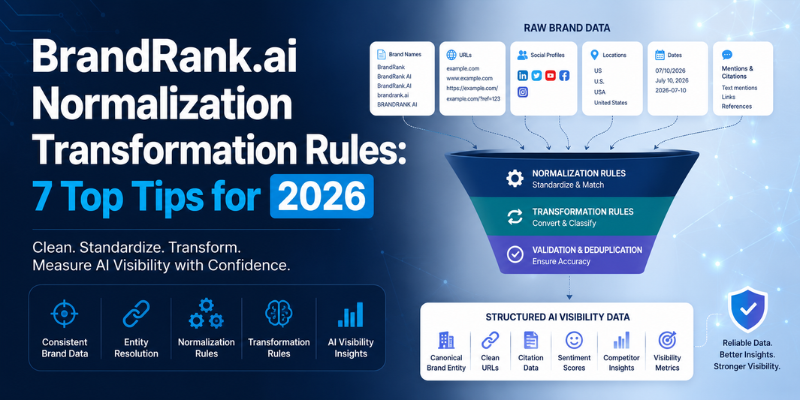
Quick Answer: BrandRank.ai normalization transformation rules are methods used to clean, standardize, match, and organize brand information before it is measured across AI-generated answers. These methods can standardize brand names, website URLs, product names, locations, citations, sources, sentiment, and competitor data. The goal is to create one clear record for each brand and produce more reliable AI visibility reports.
BrandRank.ai normalization transformation rules have become a popular topic as more businesses track how their brands appear in AI-generated answers.
Customers now use ChatGPT, Gemini, Claude, Perplexity, Microsoft Copilot, and Google AI features to research companies. They ask these tools to compare products, suggest services, explain pricing, and recommend trusted brands.
A business may appear in one answer but not another. It may also appear under an old name, with an outdated price, or with the wrong product details. This is where brand data normalization becomes useful.
BrandRank.ai normalization transformation rules help explain how scattered brand information can be cleaned and converted into a format that is easier to measure.
Normalization makes different versions of the same information consistent. Transformation turns raw text into useful fields, such as:
- Brand mentioned
- Citation found
- Sentiment
- Topic
- Competitor present
- Source type
- Recommendation strength
This guide explains the process in simple terms. It also provides examples, tables, best practices, and a seven-step plan that businesses can follow.
Independent Guide: This article is an independent educational resource. AT Hub Technology is not affiliated with BrandRank.AI. The examples explain common brand data and AI visibility practices. They do not claim to reveal BrandRank.AI’s private software, code, algorithms, or internal rules.
BrandRank.AI publicly explains that it tests important prompts, reviews AI-generated answers, examines citations, and helps brands find gaps in authority and visibility. However, its public pages do not currently present a technical framework with the exact name “BrandRank.ai normalization transformation rules.” This guide therefore treats the term as a practical industry framework.
Table of Contents
What Are BrandRank.ai Normalization Transformation Rules?
Definition: BrandRank.ai normalization transformation rules are processes used to turn inconsistent brand information and unstructured AI answers into clean, consistent, and measurable data.
A company may appear online in many different ways.
For example:
- BrandRank
- BrandRank AI
- BrandRank.AI
- brandrank.ai
- Brand Rank AI
A person can often tell that these names refer to the same brand.
A software system may not always know this.
A normalization rule can map all these versions to one official entity:
Canonical brand name: BrandRank.AI
A transformation rule can then process a raw AI answer.
For example, an AI tool may say:
“BrandRank.AI helps companies understand how their brands appear in AI-generated search answers.”
A transformation process can convert that sentence into these fields:
| Field | Value |
|---|---|
| Canonical brand | BrandRank.AI |
| Brand mentioned | Yes |
| Citation found | No |
| Sentiment | Positive |
| Topic | AI search visibility |
| Product category | Brand monitoring software |
This structured record is easier to analyze than a full paragraph.
A business can compare it with answers from other AI platforms. It can also track changes over time.
BrandRank.ai normalization transformation rules can therefore support:
- AI visibility tracking
- Brand monitoring
- Citation analysis
- Competitor research
- Reputation management
- Entity SEO
- Answer Engine Optimization
- Generative Engine Optimization
- Content governance
- Data quality
Key Takeaway: Normalization identifies the correct entity. Transformation converts raw information into fields that can be reviewed and measured.
What Does BrandRank.AI Do?
BrandRank.AI is focused on AI search visibility.
AI search visibility describes whether a brand appears in answers generated by AI platforms and how that brand is represented.
BrandRank.AI says it tests priority prompts across AI platforms, analyzes the generated answers, and reviews the sources those answers cite. It also helps brands identify gaps in authority, content, visibility, and trust.
For example, a company may want to know:
- Does ChatGPT mention our brand?
- Does Gemini recommend our product?
- Does Perplexity cite our website?
- Which competitors appear before us?
- Are AI tools showing our correct pricing?
- Which sources shape answers about our company?
- Is the sentiment positive, neutral, or negative?
The answers may differ by platform.
BrandRank.AI has also discussed how different AI engines can use different signals when forming views about brand authority. The same prompt can return different companies, sources, and recommendations across platforms.
This creates a data challenge.
A tracking platform must collect answers from several tools. It must then identify brands, competitors, products, citations, sources, topics, and claims.This type of analysis can be useful for companies providing Generative AI Development Services, as they also require accurate and consistent data to generate reliable AI responses.
BrandRank.ai normalization transformation rules describe the type of process needed to make this information consistent.
Without clean data, a report may count the same brand twice. It may mix a company with one of its products. It may also treat a simple mention as a trusted citation.
Are BrandRank.ai Normalization Transformation Rules Official?
There is an important difference between an official product feature and an educational interpretation.
BrandRank.AI publicly discusses:
- Prompt testing
- AI-generated answer analysis
- Brand visibility
- Source citations
- Competitive benchmarking
- Content gaps
- Brand authority
- Reputation risks
- Answer share
However, its public website does not currently provide a named technical rulebook called BrandRank.ai normalization transformation rules.
This does not make the topic useless.
The phrase can still describe an important process.
Any system that measures AI answers needs consistent rules for:
- Identifying brands.
- Matching aliases.
- Cleaning URLs.
- Removing duplicate records.
- Classifying sentiment.
- Detecting citations.
- Grouping prompt intent.
- Comparing competitors.
- Tracking claims.
- Preparing reports.
This guide uses common data normalization, entity resolution, and AI visibility practices to explain those tasks.
It does not suggest that the examples are BrandRank.AI’s private internal rules.
Best Practice: When writing about a company’s technology, separate confirmed public information from your own practical examples. This helps protect accuracy and reader trust.
Normalization Versus Transformation
Normalization and transformation are related, but they are not the same.
What Is Normalization?
Normalization makes different versions of the same information consistent.
Examples include:
- Changing “United States,” “USA,” and “U.S.” into one country value
- Mapping “BrandRank AI” and “BrandRank.AI” to one brand
- Removing tracking codes from URLs
- Using one date format
- Connecting a former product name with its current name
What Is Transformation?
Transformation converts raw information into another format.
Examples include:
- Turning a paragraph into a sentiment label
- Converting a citation into a source record
- Classifying a prompt as informational or commercial
- Turning a recommendation into a strength score
- Converting an AI answer into a list of claims
Comparison Table
| Process | Main purpose | Simple example |
|---|---|---|
| Normalization | Makes values consistent | BrandRank AI becomes BrandRank.AI |
| Transformation | Converts raw data into useful fields | A paragraph becomes positive sentiment |
| Validation | Checks whether data follows a rule | A URL must be valid |
| Deduplication | Removes repeated records | One repeated citation is counted once |
| Enrichment | Adds useful context | A domain is marked as a news source |
| Entity resolution | Decides whether records describe the same thing | A short product name is linked to its official product |
Normalization asks:
Do these values refer to the same entity?
Transformation asks:
How should this information be stored and measured?
BrandRank.ai normalization transformation rules can include both tasks.
Why Brand Data Consistency Matters
A brand exists across many online sources.
These may include:
- The official company website
- Product pages
- News articles
- Social media profiles
- Review platforms
- Business directories
- App stores
- Forum discussions
- Research reports
- Videos
- Partner websites
- Press releases
- Customer reviews
These sources may not show the same information.
One page may use an old logo.
Another may show a former company name.
A directory may list an old address.
A review site may describe a product that has changed.
AI systems use public information to create answers. When sources disagree, the generated answer may also be unclear or outdated.
BrandRank.ai normalization transformation rules help a business find and measure these differences.
A clean process can answer questions such as:
- How often is the brand mentioned?
- Which name does each AI platform use?
- Are the citations from official or third-party sources?
- Which products are linked to the company?
- What claims appear most often?
- Which facts are outdated?
- Which competitors appear in the same answers?
- How has sentiment changed?
- Which prompts fail to return the brand?
Clean data does not guarantee that an AI tool will recommend a company.
It does make the results easier to understand.
Key Takeaway: Consistent brand data improves measurement. It does not give a business direct control over AI-generated answers.
Common BrandRank.ai Normalization Transformation Rules
The following rules show how a practical brand normalization system may work.
These are industry examples rather than confirmed BrandRank.AI internal methods.
1. Brand Name Normalization
A brand name may use different punctuation, spacing, or capitalization.
For example:
- BrandRank
- Brand Rank
- BrandRank AI
- BrandRank.AI
- BRANDRANK.AI
A normalization process may map all verified versions to:
BrandRank.AI
However, a similar name should not be merged without checks.
Useful checks include:
- Official domain
- Company description
- Industry
- Country
- Product names
- Social profiles
- Logo
- Legal entity
Two unrelated businesses can have similar names.
A good rule checks context before merging them.
2. Website and URL Normalization
The same website can appear in many forms:
http://example.comhttps://example.comhttps://www.example.comhttps://example.com/https://example.com/?utm_source=newsletter
A URL normalization rule may:
- Use HTTPS
- Remove tracking parameters
- Remove an unnecessary trailing slash
- Lowercase the hostname
- Follow permanent redirects
- Keep meaningful page paths
- Store the root domain separately
This prevents one source from being counted several times.
3. Product Name Normalization
A product may have:
- An official name
- A short name
- A former name
- A regional name
- A common nickname
- A version number
For example:
- SmartReview
- Smart Review
- SmartReview Platform
- Smart ReviewRouting Tool
These names may refer to one product.
They may also refer to separate tools.
The product record should include:
| Product field | Example |
|---|---|
| Official name | SmartReview |
| Short name | Smart Review |
| Parent company | Example Company |
| Product category | Review management |
| Main URL | Official product page |
| Previous name | Old product name |
| Current status | Active |
BrandRank.ai normalization transformation rules should use verified product data instead of assumptions.
4. Location Normalization
Locations may also have different names.
Examples include:
- US
- U.S.
- USA
- United States
- United States of America
A normalization rule can map these versions to one country record.
The same process can be used for:
- Cities
- States
- Provinces
- Postal codes
- Regions
- Branches
- Store locations
- Country websites
Location normalization is important for local businesses, banks, clinics, universities, franchises, and global companies.
A local branch should be connected to its parent brand. It should not always be treated as the same exact entity.
5. Source Name Normalization
A source may appear by:
- Publication name
- Domain name
- Page title
- Social account
- Short label
For example:
- Google Search Central
- developers.google.com
- Google Developers
- Search Central documentation
A source normalization process can connect these records while keeping the exact cited URL.
This helps analysts count sources accurately.
It also supports source type classification.
Common source types include:
- Official website
- News publication
- Government website
- Research source
- Review platform
- Forum
- Social network
- Business directory
- Partner website
- Competitor website
6. Social Profile Normalization
A company may have official profiles on:
- X
- YouTube
- TikTok
- GitHub
A system should confirm which profiles are official.
Useful checks include:
- Is the profile linked from the official website?
- Does the profile link back to the main domain?
- Does the name match the brand?
- Does the profile use the current logo?
- Is the account active?
- Does it belong to the parent brand or a local branch?
A false profile match can damage the rest of the data.
7. Date and Time Normalization
AI answer tests may run in different time zones.
For example:
- July 10, 2026, 1:00 PM GST
- July 10, 2026, 9:00 AM UTC
- 2026-07-10T09:00:00Z
These values may describe the same moment.
A date normalization rule should store:
- Original date
- Original time
- Original time zone
- Standard date and time
- Reporting period
This makes daily, weekly, and monthly comparisons more reliable.
8. Language Normalization
A global brand may use different names in different languages.
A system should record:
- Language
- Country
- Translated name
- Official regional name
- Regional domain
- Parent company
- Legal entity
It should not merge every translated term without checking the relationship.
One regional business may belong to the same group but offer different products.
9. Historical Brand Name Normalization
Companies often rebrand.
Old articles and reviews may continue to use the former name.
A historical record should include:
- Former company name
- Current company name
- Date of the change
- Former domain
- Current domain
- Merger or acquisition details
- Products affected
This helps a business tell the difference between outdated information and valid historical information.
10. Duplicate Record Removal
The same answer may be saved twice.
The same citation may also appear several times in one response.
A deduplication rule may compare:
- Prompt
- Platform
- Test date
- Model
- Response text
- Citation URL
- Brand entity
- Response identifier
Weak deduplication can inflate reports.
Very strict deduplication can remove valid records.
The rule should be tested and reviewed.
Best Practice: Keep both the original value and the normalized value. This creates an audit trail and makes errors easier to correct.
BrandRank.ai Normalization Transformation Rules for AI Answers
Once brand data is normalized, raw AI answers can be transformed into measurable records.
1. Brand Mention Detection
An AI answer may include:
“BrandRank.AI helps companies track how they appear in generative search.”
The transformed field becomes:
Brand mentioned: Yes
The rule can check:
- Exact brand name
- Approved aliases
- Former names
- Product names
- Clear brand references
It should avoid unrelated words with similar spelling.
2. Citation Detection
A mention is not the same as a citation.
An AI answer may name a company without linking to its website or another source.
A citation record may contain:
- Citation present
- Citation URL
- Source domain
- Source name
- Citation position
- Source type
- Official or third-party source
- Page title
This difference is important for AI visibility measurement.
3. Sentiment Classification
An answer may describe a company in a positive, neutral, negative, or mixed way.
For example:
“The platform provides useful tracking, but public pricing is limited.”
This statement contains both positive and negative information.
It should not always receive one simple label.
A detailed sentiment record can include:
| Field | Value |
|---|---|
| Overall sentiment | Mixed |
| Positive point | Useful tracking |
| Negative point | Limited pricing information |
| Confidence | Medium |
| Human review | Recommended |
BrandRank.ai normalization transformation rules should allow uncertainty.
4. Recommendation Strength
Not all mentions have equal value.
Compare these statements:
- “This is the best option.”
- “This is one option to consider.”
- “The company also offers this feature.”
- “This product may not suit small teams.”
Each one includes the brand.
The recommendation strength is different.
Possible labels include:
- Strong recommendation
- Standard recommendation
- Brief mention
- Warning
- Negative recommendation
5. Prompt Intent Classification
AI prompts can be grouped by intent.
| Prompt | Intent |
|---|---|
| What is AI search visibility? | Informational |
| Best AI visibility software | Commercial |
| Brand A versus Brand B | Comparison |
| BrandRank.AI website | Navigational |
| Buy an AI visibility platform | Transactional |
| Why is my brand missing from ChatGPT? | Problem-solving |
Prompt intent helps teams compare similar searches.
A broad educational prompt should not be judged in the same way as a high-intent product comparison.
6. Topic Classification
A brand can appear in answers about many topics.
Common topics include:
- Pricing
- Product features
- Security
- Customer support
- Integrations
- Reliability
- Ease of use
- Industry fit
- Reputation
- Regional support
- Data privacy
Topic classification helps a content team find gaps.
For example, a brand may appear often for features but rarely for security.
The company may then need clearer security content and stronger third-party support.
7. Competitor Detection
AI answers often mention several companies.
A competitor record may include:
- Competitor name
- Canonical competitor entity
- Position in the answer
- Number of mentions
- Recommendation strength
- Shared topic
- Cited source
Competitor aliases should be normalized in the same way as the main brand.
8. Claim Extraction
An AI answer may make claims such as:
- The platform tracks prompts daily.
- The company serves enterprise brands.
- The product supports several AI engines.
- The tool includes citation analysis.
A claim record may include:
| Field | Purpose |
|---|---|
| Claim text | Stores the exact statement |
| Subject | Identifies the company or product |
| Topic | Groups the claim |
| Source | Shows where support came from |
| Accuracy status | Correct, wrong, unclear, or outdated |
| Risk level | Low, medium, or high |
| Date checked | Records when the claim was reviewed |
Claim extraction helps businesses find misinformation.
9. Source Classification
A cited source can be labeled as:
- Official
- Independent
- News
- Research
- Government
- Review
- Forum
- Social
- Directory
- Competitor
Different sources serve different purposes.
A review site may support customer sentiment.
A product page may support feature details.
A government source may support a legal or regulatory fact.
10. Risk and Opportunity Classification
Raw findings become more useful when they lead to action.
Possible risk labels include:
- Incorrect price
- Old company name
- Missing brand
- Wrong product description
- Negative claim
- Weak source
- Entity confusion
- Regional error
Possible opportunity labels include:
- Publish a new FAQ
- Improve a product page
- Create a comparison guide
- Correct a directory listing
- Add structured data
- Earn a third-party mention
- Publish a case study
- Update an old social profile
BrandRank.ai normalization transformation rules can help turn a large report into a simple task list.
Practical BrandRank.ai Normalization Transformation Rules Example
Consider a fictional company called Northstar Review.
The web contains these versions:
- Northstar Review
- NorthStarReview
- North Star Reviews
- northstarreview.com
- Northstar Reputation Tool
An AI answer says:
“North Star Reviews is a review management tool for local companies. It offers customer feedback features, but some sources still show its former product name.”
A practical process may create the following result:
| Field | Normalized or transformed value |
|---|---|
| Canonical brand | Northstar Review |
| Detected alias | North Star Reviews |
| Canonical domain | northstarreview.com |
| Mention found | Yes |
| Citation found | No |
| Sentiment | Mixed |
| Topic | Review management |
| Risk | Former product name still visible |
| Suggested action | Update important third-party listings |
Without entity resolution, the system may treat North Star Reviews as another company.
Without transformation, the team only has a paragraph.
With BrandRank.ai normalization transformation rules, the team gets a clear issue and a possible action.
7 Steps to Apply BrandRank.ai Normalization Transformation Rules
A business does not need a large technical team to begin.
The process can start with a spreadsheet.
Step 1: Create a Canonical Brand Record
Create one trusted record for the company.
Include:
- Official brand name
- Legal name
- Canonical domain
- Preferred logo
- Short company description
- Full company description
- Product names
- Former names
- Leadership names
- Official profiles
- Main locations
- Contact information
Add a date to each record.
This shows when the information was last checked.
Best Practice: Assign one person or team to approve updates to the canonical brand record.
Step 2: Create an Alias List
List known variations of the brand name.
Include:
- Short names
- Common misspellings
- Punctuation variations
- Former names
- Product nicknames
- Regional names
- Translated names
Give each alias a status:
- Approved
- Historical
- Regional
- Unverified
- Rejected
Do not merge two entities because they look similar.
Use evidence.
Step 3: Audit the Official Website
Review the pages that define the company.
Start with:
- Homepage
- About page
- Contact page
- Pricing page
- Product pages
- FAQ page
- Author profiles
- Press page
- Location pages
- Legal pages
Check for inconsistent:
- Brand names
- Product names
- Prices
- Features
- Addresses
- Dates
- Descriptions
- Logos
- Claims
A company should first correct information on its own website.
Step 4: Audit Third-Party Sources
Search for the brand across:
- News websites
- Review sites
- Business directories
- App stores
- Partner pages
- Social media
- Industry databases
- Podcast pages
- Community websites
- Video descriptions
Record each mismatch.
Fix high-impact pages first.
These may be pages that:
- Rank well on Google
- Receive strong traffic
- Have high industry trust
- Appear in AI citations
- Contain serious errors
- Influence customer choices
Step 5: Add Accurate Structured Data
Structured data gives search systems clear information about a page and its entities.
Useful schema types may include:
- Organization
- LocalBusiness
- Product
- SoftwareApplication
- Person
- Article
- BreadcrumbList
- ProfilePage
- FAQPage
Google describes structured data as a standard format used to provide information about a page and classify its content. Google also supports Organization markup for details such as a company name, URL, logo, and other relevant information.
Only add facts that match the visible page.
Do not add false:
- Ratings
- Reviews
- Awards
- Prices
- Locations
- Certifications
- Product features
Step 6: Test Real Customer Prompts
Create prompts based on customer research.
Include:
- What is the best tool for this problem?
- Which companies provide this service?
- Brand A versus Brand B
- Is this company trustworthy?
- What does this product cost?
- What are the main alternatives?
- Which tool is best for a small business?
- Does this product support a specific feature?
- What do customers say about this company?
Run the prompts across several AI platforms.
Store:
- Prompt
- Date
- Platform
- Model, when available
- Full response
- Brand position
- Citations
- Sentiment
- Claims
- Competitors
- Prompt intent
For a wider measurement plan, read the AT Hub Technology guide to AI search visibility metrics and KPIs.
Step 7: Review, Fix, and Repeat
Turn each finding into an action.
Examples include:
- Update an old pricing page
- Correct a directory
- Publish a missing FAQ
- Improve an About page
- Clarify a product name
- Update Organization schema
- Add a detailed comparison page
- Correct an old social profile
- Earn a relevant industry mention
- Merge duplicate reporting records
Repeat the audit each month or quarter.
Companies with fast product changes may need more frequent checks.
Key Takeaway: The goal is not to control an AI system. The goal is to publish clearer evidence and measure results with consistent rules.
How Structured Data Supports Brand Clarity
Structured data can support BrandRank.ai normalization transformation rules by making key facts easier for search systems to identify.
For an organization, useful properties can include:
namelegalNameurllogodescriptionsameAsaddresscontactPointfoundingDate
Google’s Organization structured data documentation explains how organizations can provide information such as their name, URL, logo, and contact details.
The sameAs property can link an entity with another page that identifies the same person, company, or organization.
Examples may include verified:
- LinkedIn profiles
- YouTube channels
- Facebook pages
- Industry profiles
- Parent organization pages
Schema markup does not guarantee:
- A ranking
- An AI citation
- A rich result
- A recommendation
- A knowledge panel
- An immediate update
It is a clarity signal, not a guarantee.
Simple Organization Schema Example
{
  "@context": "https://schema.org",
  "@type": "Organization",
  "@id": "https://example.com/#organization",
  "name": "Example Brand",
  "legalName": "Example Brand LLC",
  "url": "https://example.com/",
  "logo": "https://example.com/images/logo.png",
  "description": "A clear and factual description of the company.",
  "sameAs": [
    "https://www.linkedin.com/company/example-brand/",
    "https://www.youtube.com/@examplebrand"
  ]
}
Replace each example with verified information.
Do not add profiles that do not belong to the organization.
Best Practice: Keep the brand name, logo, domain, company description, and official profiles consistent in visible text and structured data.
How to Measure the Results
After applying BrandRank.ai normalization transformation rules, use clear metrics.
| Metric | What it measures |
|---|---|
| Brand mention rate | How often the brand appears |
| Citation rate | How often an answer cites a source connected to the brand |
| Share of AI voice | Brand presence compared with competitors |
| Average answer position | Where the brand appears in a list |
| Recommendation rate | How often the brand is recommended |
| Claim accuracy rate | How many claims about the brand are correct |
| Source diversity | How many different sources support the brand |
| Prompt coverage | How many target prompts include the brand |
| Misinformation rate | How often AI answers contain incorrect facts |
| Entity confusion rate | How often the brand is confused with another entity |
Do not judge performance from one prompt.
Answers can change based on:
- Prompt wording
- Platform
- Model
- Test date
- Search access
- Location
- Available sources
- Product updates
Run repeated tests and look for patterns.
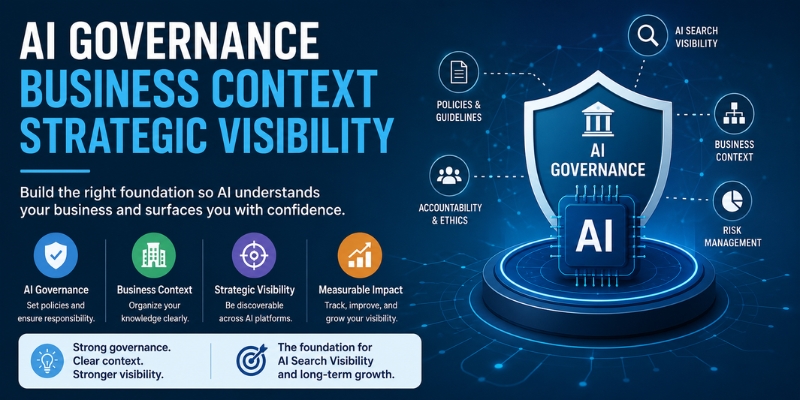
The relationship between clean data, governance, and measurement is also covered in this guide to AI governance, business context, and strategic visibility.
Common Mistakes to Avoid
Mistake 1: Presenting the Phrase as a Secret Algorithm
Do not claim that BrandRank.ai normalization transformation rules reveal private BrandRank.AI technology. Use the term as an educational framework unless an official source publishes a confirmed specification.
Mistake 2: Merging Similar Brand Names
Two businesses can have similar names. Check domains, locations, products, and legal details first.
Mistake 3: Treating Mentions as Citations
A mention is text that names a brand. A citation points to a source. Track them separately.
Mistake 4: Mixing a Company with Its Product
A parent organization and a product are related entities. They should not always use the same record.
Mistake 5: Ignoring Mixed Sentiment
An AI answer can include both praise and criticism. Allow a mixed label.
Mistake 6: Hiding Uncertainty
Some entity matches will be unclear. Use confidence levels and human review.
Mistake 7: Adding Misleading Schema
Structured data should match what visitors can see. Do not add unsupported claims only for search engines.
Mistake 8: Tracking Only One AI Platform
Different platforms may return different brands and sources. Use the same prompts across several tools.
Mistake 9: Removing Original Evidence
Keep the full original answer. It helps reviewers understand why a label was assigned.
Mistake 10: Expecting Instant Results
Better data can improve clarity. It cannot force an AI platform to cite or recommend a company.
Best Practices for BrandRank.ai Normalization Transformation Rules
Best Practice Box
- Use one approved company name.
- Keep product names consistent.
- Document common aliases.
- Record former names and dates.
- Use one canonical domain.
- Redirect old website pages.
- Fix important directory listings.
- Keep public prices current.
- Add accurate structured data.
- Verify official social profiles.
- Track mentions and citations separately.
- Keep original AI answers.
- Use human review for uncertain matches.
- Record changes over time.
- Repeat important prompt tests.
A good system also keeps an audit trail.
The audit trail should contain:
- Original value
- Normalized value
- Transformation result
- Rule applied
- Confidence level
- Review date
- Reviewer
- Change history
This makes BrandRank.ai normalization transformation rules more transparent.
It also helps teams fix errors without rebuilding the full data set.
Brand Data Normalization Checklist
Brand Identity
- Official brand name is consistent
- Legal name is correct
- Aliases are documented
- Former names include dates
- Products are linked to the correct parent company
- Regional brands are clearly identified
- Common misspellings are recorded
Website
- The canonical domain is correct
- HTTPS is active
- Old pages redirect correctly
- About page information is current
- Contact details match
- Product descriptions are current
- Pricing is accurate
- Logos are consistent
Structured Data
- Organization schema matches visible content
- Logo URL works
- Official profile links are verified
- Product schema uses current names
- Author information is clear
- No false claims are included
AI Visibility Tracking
- Important prompts are listed
- Prompt intent is labeled
- Mentions and citations are separate
- Sentiment rules are documented
- Competitor aliases are mapped
- Original answers are stored
- Test dates are recorded
- One time standard is used
- Human review is available
- Duplicate records are removed carefully
Final Takeaway
BrandRank.ai normalization transformation rules are best understood as a practical framework for cleaning brand information and preparing AI-generated answers for analysis. Normalization makes different versions of the same fact consistent. Transformation converts raw text into fields that teams can compare.
The process can cover:
- Brand names
- Product names
- Domains
- Locations
- Citations
- Sources
- Topics
- Sentiment
- Competitors
- Claims
- Prompt intent
- Recommendation strength
The most important rule is accuracy.
- Do not claim access to private BrandRank.AI systems.
- Do not merge entities without evidence.
- Do not treat schema as a guarantee.
- Do not hide uncertainty.
- Start with one trusted brand record.
- Fix public inconsistencies.
- Test real customer prompts.
- Keep the original answers.
- Use the same rules across each platform and test period.
BrandRank.ai normalization transformation rules can then become useful for SEO teams, PR teams, content teams, data analysts, brand managers, and business leaders.
They can also support:
- Answer Engine Optimization
- Generative Engine Optimization
- Entity SEO
- AI visibility measurement
- Reputation management
- Content governance
- Competitor analysis
For more guides on these topics, explore the Artificial Intelligence section of AT Hub Technology.
Frequently Asked Questions
What are BrandRank.ai normalization transformation rules?
BrandRank.ai normalization transformation rules are processes used to clean, standardize, match, and organize brand information before analyzing AI-generated answers. Examples include brand name matching, URL cleaning, citation detection, sentiment classification, and competitor tracking.
Has BrandRank.AI officially published these rules?
BrandRank.AI publicly discusses AI visibility, prompt testing, citation analysis, answer tracking, authority, and brand risk. Its public website does not currently provide a technical rulebook using this exact phrase. This article uses the term as an educational framework.
What is brand data normalization?
Brand data normalization makes different versions of the same fact consistent. For example, “BrandRank AI” and “BrandRank.AI” may be linked to one canonical brand entity after verification.
What is data transformation in AI visibility?
Data transformation converts raw AI answer text into useful fields. These fields may include mention status, citation status, sentiment, topic, recommendation strength, competitors, and claim risk.
What is the difference between normalization and transformation?
Normalization makes values consistent. Transformation converts raw information into a different format that is easier to analyze.
Do normalization transformation rules improve Google rankings?
They can improve data quality and brand consistency, but they do not directly guarantee rankings. Google visibility also depends on content quality, relevance, authority, technical SEO, competition, and user needs.
Can schema markup improve brand clarity?
Accurate schema markup can provide clearer information about an organization, product, person, or article. It should match visible page content. Schema does not guarantee rankings, rich results, or AI citations.
What brand details should be normalized?
Common details include the company name, legal name, domain, logo, product names, previous names, social profiles, locations, dates, source names, URLs, and parent-company relationships.
How often should a company audit its brand data?
A quarterly audit is a good starting point. Companies with frequent product, price, location, or branding changes may need monthly reviews.
Which AI visibility metrics should a company track?
Useful metrics include brand mention rate, citation rate, share of AI voice, prompt coverage, answer position, sentiment, source diversity, claim accuracy, misinformation rate, and entity confusion rate.
Are BrandRank.ai normalization transformation rules the same as AEO?
No. Answer Engine Optimization is a wider practice focused on improving how content and brands appear in AI-generated answers. Normalization and transformation support AEO by improving data consistency and measurement.
Can a small business use these rules?
Yes. A small business can begin with a spreadsheet. It can create one brand record, list aliases, audit important pages, test buyer prompts, and track mentions, citations, competitors, and incorrect claims.
Why should the original AI answer be saved?
The original answer provides evidence for each classification. It allows human review and helps teams correct mistakes when rules change.
What is entity resolution?
Entity resolution is the process of deciding whether two records refer to the same real-world company, person, product, or location. It may use names, domains, descriptions, locations, and official profiles.
What is the safest way to explain this topic?
Explain the term as a practical data and AI visibility framework. Separate confirmed BrandRank.AI product information from general examples. Avoid claiming access to private algorithms, code, APIs, or internal rules.