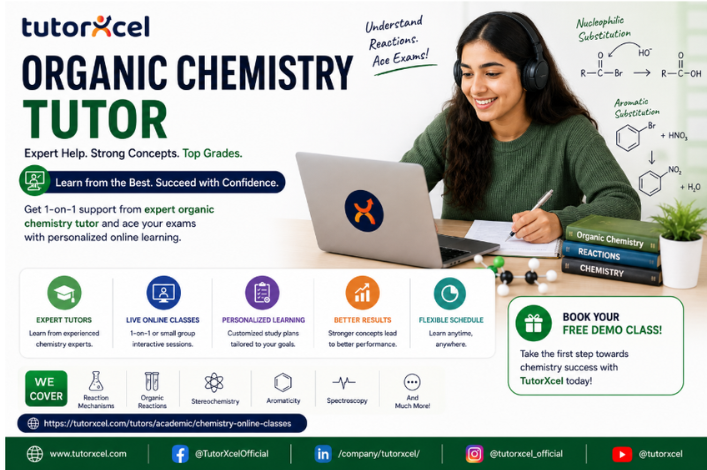
Organic chemistry has long been considered one of the most challenging subjects in science education. Whether you’re a high school student preparing for advanced placement courses, an undergraduate pursuing chemistry or biology, or a pre-med student working toward professional goals, organic chemistry often becomes a defining academic hurdle. Unlike many other science subjects, success in organic chemistry depends on understanding concepts, recognizing patterns, and applying logical reasoning rather than simply memorizing formulas and definitions.
Many students begin the course with confidence after performing well in general chemistry. However, they soon realize that organic chemistry introduces a completely different way of thinking. Topics such as reaction mechanisms, stereochemistry, spectroscopy, and multi-step synthesis require students to visualize molecular behavior, predict chemical reactions, and solve unfamiliar problems under exam conditions.
The difficulty isn’t necessarily because the subject is impossible to learn. More often, students struggle because they don’t receive the individualized guidance needed to master increasingly complex concepts. Classroom lectures usually follow a fixed schedule, making it difficult for instructors to spend additional time on topics that individual students find confusing.
This is where working with an experienced organic chemistry tutor can make a significant difference. Personalized tutoring allows students to learn at their own pace, strengthen weak areas, ask questions freely, and develop the confidence needed to approach even the most difficult chemistry problems.
Whether you’re aiming to improve your grades, prepare for competitive exams, or simply gain a better understanding of the subject, the right guidance can completely change your learning experience.
Table of Contents
Why Organic Chemistry Is Considered Difficult:
Organic chemistry is challenging because every concept connects with previous knowledge. Unlike some subjects where individual chapters can be studied separately, an organic chemistry tutor follows a continuous learning structure.
A weak understanding of foundational concepts can make advanced topics much harder. Students are not only expected to remember chemical reactions but also understand why reactions happen and how different molecules behave.
Some common areas where students struggle include:
- Reaction mechanisms
- Functional groups
- Molecular structures
- Stereochemistry
- Acid-base reactions
- Spectroscopy
- Organic synthesis
- Laboratory concepts
These topics require visualization, logical thinking, and regular practice. Simply reading textbooks or memorizing reaction lists is often not enough to develop the confidence needed for exams.
Common Challenges Students Face in Organic Chemistry:
Every student experiences different difficulties while studying organic chemistry, but some challenges appear consistently across schools and universities.
Memorizing Reactions Without Understanding:
Many students try to memorize hundreds of reactions individually. While memorization has its place, it becomes ineffective when students encounter unfamiliar problems during examinations.
Instead, successful students learn reaction patterns and understand why certain reagents produce specific products. This conceptual understanding allows them to solve new questions confidently.
Difficulty Understanding Reaction Mechanisms
Reaction mechanisms explain how chemical reactions occur step by step. They involve electron movement, bond formation, and bond breaking.
Without proper guidance, these mechanisms often seem confusing because textbooks present multiple reactions that appear unrelated.
A skilled tutor simplifies these processes, helping students recognize recurring patterns that make learning much easier.
Problems Visualizing Three-Dimensional Structures:
Organic molecules exist in three dimensions, making stereochemistry one of the most intimidating topics.
Students frequently struggle with:
- Enantiomers
- Diastereomers
- Chirality
- Newman projections
- Fischer projections
- Chair conformations
Working individually with a tutor allows these concepts to be explained using diagrams, models, and interactive exercises until they become intuitive.
Falling Behind in Fast-Paced Classes
School and university courses often move quickly to complete the syllabus on time.
If students fail to understand one chapter, subsequent lessons become increasingly difficult because each topic depends on previous knowledge.
Personalized tutoring prevents these learning gaps from growing larger.
Why Personalized Tutoring Makes Learning More Effective
Every student has a unique learning style. Some understand concepts through visual explanations, while others prefer solving problems repeatedly until they recognize patterns.
Traditional classrooms rarely provide enough flexibility to accommodate every learning preference.
An experienced organic chemistry tutor adapts lessons according to the student’s individual needs rather than following a rigid teaching schedule.
Instead of teaching an entire classroom, tutors focus entirely on one student’s progress.
This personalized approach offers several important benefits.
Breaking Complex Topics into Smaller Concepts
Organic chemistry often feels overwhelming because students try to learn large chapters all at once.
A tutor divides difficult subjects into manageable sections.
For example, instead of introducing an entire reaction mechanism immediately, lessons may begin by reviewing electron movement, resonance, and bond polarity before progressing toward complete mechanisms. This structured learning process improves comprehension and reduces frustration.
Identifying Knowledge Gaps Early
Sometimes students believe they understand a chapter when, in reality, they have misunderstood a basic concept.
These hidden knowledge gaps become major obstacles later.
An experienced tutor quickly identifies weak areas through targeted questions, quizzes, and discussion.
Instead of simply moving forward, they revisit those topics until the student develops a solid foundation.
This proactive approach prevents confusion from accumulating throughout the course.
Learning at a Comfortable Pace
No two students learn at exactly the same speed.
Some may require additional time to understand nomenclature, while others struggle more with spectroscopy or synthesis.
One of the greatest strengths of individualized tutoring is flexibility.
Lessons can be slowed down when necessary or accelerated when students demonstrate mastery.
There is no pressure to keep up with an entire classroom.
Encouraging Active Participation
Many students hesitate to ask questions during classroom lectures because they worry about interrupting the lesson or appearing unprepared.
Private tutoring creates a supportive environment where curiosity is encouraged.
Students can ask as many questions as needed until every concept becomes clear.
This active participation significantly improves retention compared to passive listening during lectures.
Developing Strong Problem-Solving Skills
Success in organic chemistry depends far more on solving problems than reading theory.
Students who consistently practice applying concepts perform much better than those who spend most of their time memorizing notes.
A qualified online chemistry tutor focuses heavily on practical application.
Rather than simply explaining reactions, tutors guide students through real examination questions and encourage logical thinking at every step.
Students gradually learn how to:
- Analyze reaction pathways logically
- Predict reaction products accurately
- Identify reaction intermediates
- Compare multiple reaction mechanisms
- Interpret spectroscopy data
- Solve synthesis problems systematically
- Avoid common examination mistakes
- Improve speed without sacrificing accuracy
As these analytical skills improve, students become more confident when facing unfamiliar questions during tests and competitive examinations.
Instead of relying on memorization alone, they begin recognizing patterns and applying scientific reasoning independently.
Building Confidence Through Consistent Guidance
Confidence plays a major role in academic performance.
Students who repeatedly struggle with chemistry often begin believing they simply “aren’t good at science.” This mindset can negatively affect motivation and lead to poor performance, even when they have the ability to succeed.
A supportive tutor helps change this perspective by celebrating progress, addressing weaknesses constructively, and providing regular encouragement. As students begin solving problems independently and understanding difficult concepts, their confidence naturally grows.
Over time, this increased confidence extends beyond organic chemistry and positively influences performance in related subjects such as biochemistry, molecular biology, pharmacology, and analytical chemistry.
The Long-Term Benefits of Working with an Organic Chemistry Tutor
Many students initially seek tutoring because they want to improve their grades before an important exam. While higher scores are often the immediate goal, the benefits of personalized tutoring extend well beyond a single semester.
Organic chemistry teaches students to think analytically, approach problems systematically, and connect concepts across multiple scientific disciplines. These abilities become increasingly valuable in advanced coursework and future careers.
Students who receive consistent tutoring often develop:
- Stronger analytical thinking skills
- Better scientific reasoning
- Improved confidence when solving unfamiliar problems
- More effective study habits
- Greater independence in learning
- Improved classroom participation
- Better time management during exams
Rather than relying on memorization, students learn how to understand the “why” behind chemical reactions. This conceptual approach creates a stronger academic foundation that supports continued success in chemistry and related fields.
Why Consistency Matters More Than Last-Minute Preparation
One of the biggest misconceptions about organic chemistry is that students can catch up by studying intensively a few days before an exam.
Unlike subjects that focus primarily on factual recall, organic chemistry requires students to build interconnected knowledge over time. Reaction mechanisms, stereochemistry, spectroscopy, and synthesis all rely on previously learned concepts.
Regular tutoring sessions encourage consistent learning instead of last-minute cramming.
By reviewing concepts weekly, practicing different question types, and addressing misunderstandings as they arise, students retain information more effectively and experience less stress before examinations.
Small improvements made consistently often produce far better results than occasional periods of intensive study.
How Online Tutoring Supports Different Types of Learners
Every student approaches learning differently. Some absorb information best through visual explanations, while others learn more effectively through discussion or repeated practice.
An experienced online chemistry tutor can adapt teaching methods to match each student’s preferred learning style.
For example:
Visual Learners
Visual learners benefit from reaction diagrams, molecular models, flowcharts, color-coded mechanisms, and concept maps that simplify complex topics.
Auditory Learners
Students who learn through listening often benefit from detailed verbal explanations, interactive discussions, and step-by-step reasoning.
Practice-Oriented Learners
Some students understand chemistry only after solving multiple problems.
Tutors can provide progressively challenging exercises that reinforce concepts through repetition and application.
Independent Learners
Many students simply need occasional guidance rather than continuous instruction.
Tutors can help these learners review difficult chapters, answer specific questions, and develop personalized study strategies that encourage independent learning.
Making Organic Chemistry Less Intimidating
Students frequently describe organic chemistry as overwhelming before they have even completed their first chapter. This perception often develops from stories shared by classmates or previous students who found the subject difficult.
While organic chemistry certainly requires dedication, it is far from impossible.
Breaking large topics into smaller sections, practicing regularly, asking questions early, and learning from experienced educators can dramatically reduce anxiety.
Instead of viewing chemistry as a subject filled with endless reactions to memorize, students begin recognizing logical patterns that make problem-solving much easier.
As confidence grows, many students discover that they actually enjoy the challenge of analyzing reactions and predicting molecular behavior.
Finding the Right Learning Support
Academic success depends not only on effort but also on having access to the right resources.
Students preparing for school examinations, university coursework, medical entrance exams, pharmacy programs, or chemistry-related degrees often benefit from additional guidance outside the classroom.
Learning platforms that connect students with experienced educators provide personalized instruction that complements classroom teaching.
If you’re looking for structured support from an experienced organic chemistry tutor, platforms such as TutorXcel offer personalized online learning through qualified educators. Students searching for an online chemistry tutor can explore one-on-one sessions designed to strengthen conceptual understanding, improve problem-solving skills, and provide flexible scheduling that fits individual learning needs.
The goal is not simply to complete assignments or prepare for the next test. Effective tutoring helps students build a strong conceptual foundation that supports long-term academic success.
Frequently Asked Questions
1. Why should I work with an organic chemistry tutor?
An organic chemistry tutor provides personalized instruction, identifies learning gaps, explains complex concepts clearly, and helps students develop stronger problem-solving skills through guided practice.
2. Is online chemistry tutoring as effective as in-person tutoring?
Yes. Online tutoring offers one-on-one instruction, flexible scheduling, interactive learning tools, recorded sessions, and access to experienced tutors regardless of location. Many students find it just as effective, if not more convenient, than traditional face-to-face tutoring.
3. How many tutoring sessions should I take each week?
The ideal frequency depends on your academic goals and current understanding. Most students benefit from one or two sessions per week, while those preparing for important examinations may choose more frequent lessons.
4. Can tutoring help improve my exam scores?
Absolutely. Regular tutoring strengthens conceptual understanding, improves analytical thinking, increases confidence, and provides extensive practice with examination-style questions, all of which contribute to better academic performance.
5. What qualities should I look for in an organic chemistry tutor?
Choose a tutor with strong subject expertise, teaching experience, excellent communication skills, personalized lesson planning, and a teaching approach that matches your learning style.
6. Is tutoring only helpful for students who are struggling?
No. Many high-performing students also work with tutors to deepen their understanding, prepare for competitive examinations, or achieve higher academic goals. Tutoring benefits students at all skill levels.
7. How long does it take to see improvement?
The timeline varies depending on the student’s starting point and consistency. Many students notice increased confidence within a few weeks, while significant improvements in grades often become visible after several weeks of regular practice and guidance.
8. Can tutoring help with laboratory-based organic chemistry?
Yes. Many tutors explain laboratory techniques, reaction mechanisms, spectroscopy interpretation, experimental procedures, and practical applications alongside theoretical concepts, helping students feel more prepared for both coursework and lab assessments.
Conclusion
Organic chemistry has earned its reputation as one of the most demanding subjects in science, but it doesn’t have to be an obstacle to academic success. With the right learning strategies, consistent practice, and personalized guidance, students can transform a challenging subject into one they understand with confidence.
Working with an experienced organic chemistry tutor provides far more than assistance with homework. It offers individualized instruction, targeted feedback, practical problem-solving experience, and study techniques that help students master difficult concepts step by step. Whether the goal is improving classroom performance, preparing for competitive examinations, or building a strong foundation for future scientific studies, personalized tutoring creates an environment where students can learn at their own pace and develop lasting confidence.
The flexibility offered by an online chemistry tutor makes quality education more accessible than ever before. Students can connect with experienced educators, receive customized support, and practice consistently without the limitations of traditional classroom schedules.
Ultimately, success in organic chemistry is not determined by natural talent alone. It comes from understanding concepts deeply, practicing regularly, asking questions when needed, and receiving guidance from knowledgeable instructors. By investing in the right support today, students can improve their grades, strengthen their analytical thinking, and build skills that will benefit them throughout their academic journey and future careers.
Explore Technology Solutions Professional: Role, Skills, Career Path, and Business Value