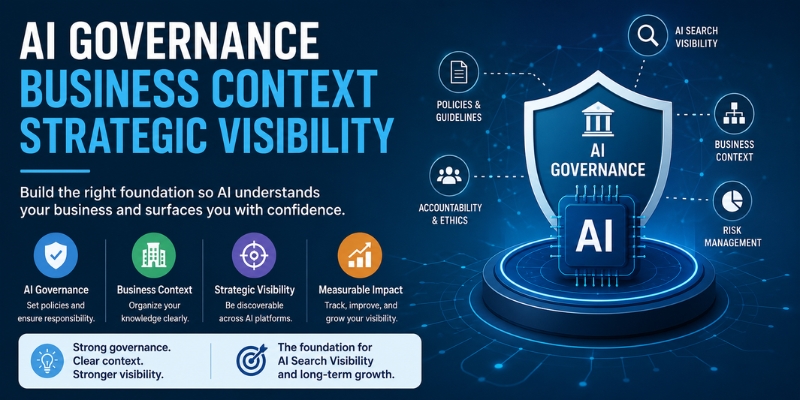
AI governance business context strategic visibility describes the process of managing how AI systems understand, represent, and surface your business inside AI-powered search and answer engines. It is a structured approach that combines governance, accurate business information, and proactive visibility strategy to ensure AI tools describe your brand correctly.
In 2025, AI platforms like Google AI Overviews, ChatGPT, Perplexity, Gemini, and Microsoft Copilot are answering millions of buyer questions every day. Many of those answers mention specific companies. Some brands are described accurately. Others are misrepresented. Many are not mentioned at all.
This guide explains what AI governance business context strategic visibility means, why it matters, and what practical steps your business can take to build a presence inside AI-generated answers.
Table of Contents
What Is AI Governance Business Context Strategic Visibility?
Quick Answer: AI governance business context strategic visibility is the combination of internal data governance, structured public business information, and a proactive AI discoverability strategy. It ensures AI systems can accurately find, understand, and represent your brand in AI-generated answers.
Let us break down each part:
1. AI Governance
AI governance, in this context, is not about regulating AI internally. It is about governing the information your business makes publicly available so that AI systems can read, understand, and use it correctly.
Think of it as quality control for how your brand is described in the world. If the data about your company is inconsistent, outdated, or poorly structured, AI systems will reflect those problems back to users.
2. Business Context
Business context is the body of specific, accurate, structured information that defines what your company does, who it serves, and how it differs from competitors. It is not generic. It is precise.
AI systems do not guess. They synthesize available information. If your public content does not clearly explain your products, your target customers, your pricing model, and your expertise, the AI fills gaps with whatever it can find. The result is often inaccurate.
3. Strategic Visibility
Strategic visibility means appearing intentionally and consistently in the AI answer spaces most relevant to your business. It is not about showing up everywhere. It is about showing up in the right answers, for the right topics, with accurate descriptions.
Together, these three elements form a framework that positions your brand for AI-driven discovery.
Every modern business should treat AI Governance Business Context Strategic Visibility as an ongoing process rather than a one-time SEO project. The better your business context, the more accurately AI systems can represent your company.
Why Business Context Matters for AI
Key Takeaway: AI systems cannot represent your brand well if they do not understand it well. Business context is the information layer that makes accurate AI representation possible.
Traditional search engines ranked pages based on keyword relevance and backlinks. AI search engines work differently. They synthesize meaning from multiple sources, build models of what companies do, and generate answers that may or may not include a source link.
This creates a new challenge. Your website might rank well in organic search but still be poorly described in AI-generated answers. The AI may have encountered outdated press coverage, confusing product descriptions, or conflicting information across your web presence.
When buyers ask an AI tool which vendor to choose, which software to buy, or which service provider to trust, the AI draws on whatever business context it has available. Businesses with rich, structured, consistent public information are far more likely to be described accurately and positively.
Businesses with thin, scattered, or inconsistent public information are at risk of being ignored, misdescribed, or incorrectly compared to competitors.
This is why AI Governance Business Context Strategic Visibility is becoming an important digital marketing discipline for companies that want long-term visibility inside AI-generated answers.
Why It Matters: A study of AI search behavior shows that AI platforms frequently cite and describe companies based on third-party sources, structured data, and FAQ content. Companies without these signals have limited AI representation regardless of their domain authority.
How AI Understands Businesses
Quick Answer: AI systems build their understanding of a business from multiple public sources including website content, schema markup, third-party reviews, press coverage, industry directories, and social profiles. The more consistent and structured these sources are, the more accurately AI represents the brand.
Understanding how AI gathers information is the first step toward improving AI Governance Business Context Strategic Visibility across different AI platforms helps you make better decisions about what content to publish and how to structure it.
1. Crawled Web Content
Large language models are trained on vast amounts of publicly available web content. Your website, blog posts, product pages, and FAQs all contribute to the AI model’s understanding of your brand.
If your website uses vague language, avoids specifics, or is written primarily for keyword rankings rather than clear communication, the AI will struggle to extract accurate meaning from it.
2. Structured Data and Schema Markup
Schema markup is machine-readable code added to web pages that tells search engines and AI crawlers exactly what a piece of content is about. Organization schema, Product schema, FAQ schema, and Review schema all help AI systems understand your business in structured, unambiguous terms.
Businesses without schema markup are relying entirely on AI systems to infer meaning from unstructured text. This leads to errors.
3. Third-Party Sources
AI systems do not rely only on information you publish yourself. They also draw from trusted third-party sources: industry publications, analyst reports, review platforms like G2 and Trustpilot, directories, and news coverage.
If trusted third-party sources describe your business inaccurately or do not describe it at all, that gap appears in AI-generated answers.
4. Entity Recognition
Modern AI systems use entity recognition to build a knowledge graph of companies, products, people, and places. Your business name, product names, and key personnel are all entities. The more these entities appear consistently across high-quality sources, the more confidently an AI can speak about your brand.
Core Components of AI Governance
Definition: AI governance, in a business visibility context, is the set of policies, processes, and responsibilities that ensure a company’s public information is accurate, consistent, structured, and optimized for AI comprehension.
Every component in this framework contributes directly to stronger AI Governance Business Context Strategic Visibility by improving data quality, consistency, and discoverability. Strong AI governance has six core components:
1. Information Accuracy Policy
Assign responsibility for keeping key business information accurate across all public touchpoints. This includes your website, Google Business Profile, industry directories, press releases, and partner listings.
2. Content Consistency Standards
Your company name, description, product names, and category terms should be identical across every platform. Inconsistency confuses both users and AI systems. If you appear as ‘Acme Inc.’ on your website but ‘Acme Incorporated’ on third-party sites, AI models may treat these as different entities.
3. Structured Data Governance
Establish a standard for schema markup implementation across your website. Define who is responsible for maintaining schema tags and reviewing them when product or service information changes.
4. Source Monitoring
Regularly audit what third-party sources are saying about your business. This includes review platforms, news sites, competitor comparison pages, and directory listings. Inaccurate third-party content is one of the most common sources of AI misrepresentation.
5. Content Governance for AI Comprehension
Beyond accuracy, content should be written with AI readability in mind. Short, specific, factual sentences. Clear definitions. Named use cases. Concrete outcomes. These are all signals that help AI systems extract and represent your business accurately.
6. AI Visibility Review Process
Build a recurring process, quarterly at minimum, to run target prompts across AI platforms and review how your brand is being described. Document what is accurate, what is wrong, and what is missing. Then address the gaps systematically.
Building Strong Business Context
Best Practice: Strong business context is built by publishing specific, structured, and authoritative information across your website and trusted external platforms. It is the foundation that AI systems rely on to represent your brand accurately.
Organizations investing in AI Governance Business Context Strategic Visibility should regularly update their website, schema markup, FAQs, and third-party listings to maintain accurate AI representation. Here is a practical checklist for building a strong business context:
Website Content
- Write a clear, specific company description that names your industry, customer type, and core value proposition.
- Create dedicated pages for each product or service with feature descriptions, use cases, and target customer information.
- Publish case studies that describe real customer outcomes with specific results.
- Include a team or leadership page with named experts, credentials, and areas of expertise.
- Maintain a blog or resource section that publishes expert-level content on your core topics.
FAQ and Q&A Content
- Write FAQ sections in natural question-and-answer format, using the exact language your buyers use.
- Cover pricing questions, comparison questions, process questions, and common objections.
- Add FAQ schema markup to every FAQ section so AI crawlers can parse the structure clearly.
Schema Markup
- Implement Organization schema with full company details including name, URL, social profiles, and contact information.
- Add Product or Service schema to core offering pages.
- Use Review and AggregateRating schema where you have legitimate customer reviews.
- Add BreadcrumbList schema for navigational clarity.
External Authority Building
- Pursue placements in relevant industry directories and trade association websites.
- Earn mentions in independent review platforms and analyst reports.
- Contribute expert quotes or articles to respected industry publications.
- Ensure your Google Business Profile is fully complete and accurate.
Strategic Visibility Across AI Search Platforms
Quick Answer: Strategic AI visibility means actively managing how your brand appears across Google AI Overviews, ChatGPT, Perplexity, Gemini, and Copilot by publishing well-structured content that AI systems prefer to cite and synthesize.
Each AI platform has different characteristics but shared preferences: they favor content that is authoritative, specific, well-structured, and independently corroborated. Although every AI platform works differently, AI Governance Business Context Strategic Visibility principles remain the same: publish accurate, structured, trustworthy information.
1. Google AI Overviews
Google AI Overviews draws heavily from indexed web pages, structured data, and Google’s own knowledge graph. Businesses that rank well in organic search and have strong schema markup are more likely to appear in AI Overviews.
Google’s documentation on AI Overviews is available at developers.google.com/search/docs/appearance/ai-overviews and provides guidance on how content is selected for inclusion.
2. ChatGPT and GPT-Based Platforms
ChatGPT’s knowledge comes from training data and, in some versions, real-time web browsing. Businesses that appear consistently in high-authority publications, review sites, and well-structured web pages have better representation inside ChatGPT answers.
3. Perplexity
Perplexity is a real-time web research tool. It actively cites sources. Businesses that have content on trusted websites, active press coverage, and detailed product documentation are more likely to be cited accurately in Perplexity answers.
4. Gemini and Copilot
Google Gemini draws from the same knowledge base as Google Search with additional reasoning layers. Microsoft Copilot is integrated with Bing and rewards businesses with strong Bing-indexed content and consistent business profiles.
The common thread across all platforms: structured information, consistent presence, and authoritative third-party validation.
Business Context vs Traditional SEO: Comparison Table
The table below illustrates how AI governance business context strategic visibility differs from conventional SEO in goals, methods, and outcomes.
| Traditional SEO | AI Governance Business Context |
| Focuses on keywords and backlinks | Focuses on structured information and context clarity |
| Optimizes for search engine crawlers | Optimizes for AI understanding and answer generation |
| Success = rankings and organic clicks | Success = AI mentions, accurate descriptions, citations |
| Measured in impressions and CTR | Measured in mention frequency, sentiment, and accuracy |
| Reactive to algorithm changes | Proactive governance of public business information |
| Largely content-volume driven | Driven by information quality and authority signals |
| Ignores how AI reads your brand | Designed for AI comprehension from the ground up |
This comparison is not about abandoning traditional SEO. It is about recognizing that AI search requires an additional layer of strategy focused on comprehension, accuracy, and authority rather than just keyword placement.
Weak vs Strong Business Context
The following table shows the difference between businesses with poor public information and those with well-governed, structured business context.
| Category | Weak Business Context | Strong Business Context |
| Company description | Generic ‘About Us’ page with vague claims | Clear, specific description of who you serve and how |
| Products/Services | Broad feature lists with no use cases | Use-case pages with customer types and outcomes |
| FAQs | None or very basic | Comprehensive, question-format content tied to buyer intent |
| Schema markup | Missing or minimal | Full schema: Organization, Product, FAQ, Review |
| Third-party mentions | Rare or low-authority | Cited in trusted publications, directories, analyst reports |
| Author credentials | No bios or generic names | Named experts with credentials, LinkedIn, expertise topics |
| Business information | Inconsistent across platforms | Standardized NAP across all public platforms |
AI Governance Framework for Organizations
Definition: An AI governance framework for strategic visibility is a repeatable process that audits, aligns, structures, publishes, measures, and sustains how a business is represented across AI search platforms.
Following this framework helps businesses continuously improve AI Governance Business Context Strategic Visibility instead of reacting only when AI descriptions become inaccurate. The six-stage framework below gives teams a practical starting point.
| Stage | Focus Area | Key Actions | Outcome |
| 1. Audit | Current AI representation | Test prompts across AI platforms | Baseline visibility score |
| 2. Align | Information accuracy | Fix errors, update listings, standardize NAP | Accurate AI descriptions |
| 3. Structure | Content architecture | Add schema, FAQs, comparison pages | Improved AI comprehension |
| 4. Publish | Authority building | Earn mentions, publish expert content | Higher citation rate |
| 5. Measure | KPI tracking | Track mention frequency, sentiment, accuracy | Measurable AI visibility |
| 6. Govern | Ongoing management | Assign ownership, review quarterly | Sustained strategic visibility |
This framework is not a one-time project. AI search platforms update continuously. New competitors earn AI mentions. Existing content becomes outdated. Treating AI governance as an ongoing discipline rather than a single initiative is what separates businesses with sustained visibility from those that fall behind.
For risk management and responsible AI governance principles applicable to enterprise organizations, the NIST AI Risk Management Framework provides a rigorous foundation that can be adapted to AI visibility governance programs.
Best Practices for AI Governance Business Context Strategic Visibility
Best Practice Summary: Treat AI visibility as a governance discipline, not a marketing campaign. Assign ownership, establish standards, monitor regularly, and improve continuously.
These best practices strengthen AI Governance Business Context Strategic Visibility while also improving traditional SEO performance.
1. Publish Information That Answers Real Questions
Think about the questions your buyers ask AI tools before contacting your sales team. What does your product do? Who is it for? How does it compare to alternatives? How much does it cost at a general level? Every one of those questions deserves a well-written, specific answer on your website.
2. Use Specific Language, Not Generic Descriptions
Phrases like ‘industry-leading solutions’ and ‘innovative technology’ mean nothing to an AI system. Specific language like ‘project management software for construction teams with fewer than 50 employees’ gives AI the context it needs to represent you accurately.
3. Create Comparison Content
Buyers ask AI tools to compare vendors constantly. If you do not have comparison content on your own site, the AI will rely entirely on what others say about you. Publish honest, well-structured comparison pages that explain your genuine strengths and differences.
4. Assign Clear Ownership
AI visibility degrades when no one is responsible for it. Assign a team member or team to own the audit, improvement, and monitoring process. This could sit within marketing, SEO, content, or digital transformation depending on your organization.
5. Standardize Business Information Everywhere
Your business name, address, description, product categories, and contact information should be identical across your website, Google Business Profile, LinkedIn, industry directories, and any third-party platform that lists your company.
6. Earn Authority Through Third-Party Mentions
Self-published content is only part of the picture. AI systems weigh third-party citations heavily. Guest articles, press coverage, analyst mentions, and review platform profiles all contribute to how confidently AI systems speak about your brand.
Common Mistakes Businesses Make
Key Takeaway: Most AI visibility problems come from neglect rather than active error. Businesses simply have not governed their public information with AI comprehension in mind.
Many organizations fail to build AI Governance Business Context Strategic Visibility because they treat AI optimization as a technical task instead of an ongoing governance process.
- Publishing vague content that describes what you do in general terms without specifics about customers, use cases, or outcomes.
- Ignoring schema markup, leaving AI crawlers to infer structure from unstructured text.
- Allowing inconsistent business names and descriptions across platforms, creating confusion about brand identity.
- Never auditing what AI platforms actually say about the company.
- Treating AI visibility as a one-time task rather than an ongoing governance responsibility.
- Focusing entirely on keywords without improving the underlying quality and specificity of content.
- Neglecting third-party sources and assuming that the company website alone is enough for AI representation.
- Failing to correct inaccurate AI descriptions by improving the source content those descriptions are drawn from.
- Not tracking competitor AI visibility and therefore missing competitive risks in AI answer spaces.
Pros and Cons of AI Governance Business Context Strategic Visibility
Businesses that invest in AI Governance Business Context Strategic Visibility today are better prepared for the future of AI-driven search.
Pros
- Increases the likelihood that AI platforms accurately describe your brand, products, and services.
- Reduces the risk of being misrepresented or ignored in AI-generated answers that reach high-intent buyers.
- Builds long-term topical authority that benefits both traditional SEO and AI search visibility simultaneously.
- Provides a competitive advantage in markets where most businesses have not yet invested in AI governance.
- Improves internal clarity about company positioning, which also benefits sales and marketing alignment.
- Creates a foundation of structured information that supports multiple channels beyond AI search.
Cons
- Requires an ongoing time investment to audit, update, and monitor AI representations across platforms.
- Results are not immediate. AI systems update their representations over time as new content is indexed.
- AI platforms cannot be directly controlled. Governance reduces errors but does not eliminate them entirely.
- Requires cross-functional cooperation between marketing, product, legal, and IT in larger organizations.
When Businesses Should Invest
AI governance business context strategic visibility is most urgent for:
- B2B companies where buyers research vendors using AI tools before making purchase decisions.
- Brands in competitive categories where multiple similar companies vie for AI answer space.
- Organizations that have experienced inaccurate AI descriptions of their products or services.
- Businesses preparing for digital transformation initiatives where AI search will be a core traffic channel.
- Any company that wants to protect and grow brand reputation in the AI-driven search environment.
How AI Governance Supports AI Search Visibility
Key Takeaway: AI governance creates the foundation. AI search visibility metrics measure the results. You cannot have reliable visibility without governance, and governance without measurement is incomplete.
The relationship between governance and visibility is direct. When a business governs its public information well, AI systems encounter consistent, accurate, and well-structured content. The result is more accurate AI descriptions, more frequent AI mentions, and better positioning against competitors in AI answer spaces.
But governance alone does not tell you whether the strategy is working. That is where measurement becomes essential.
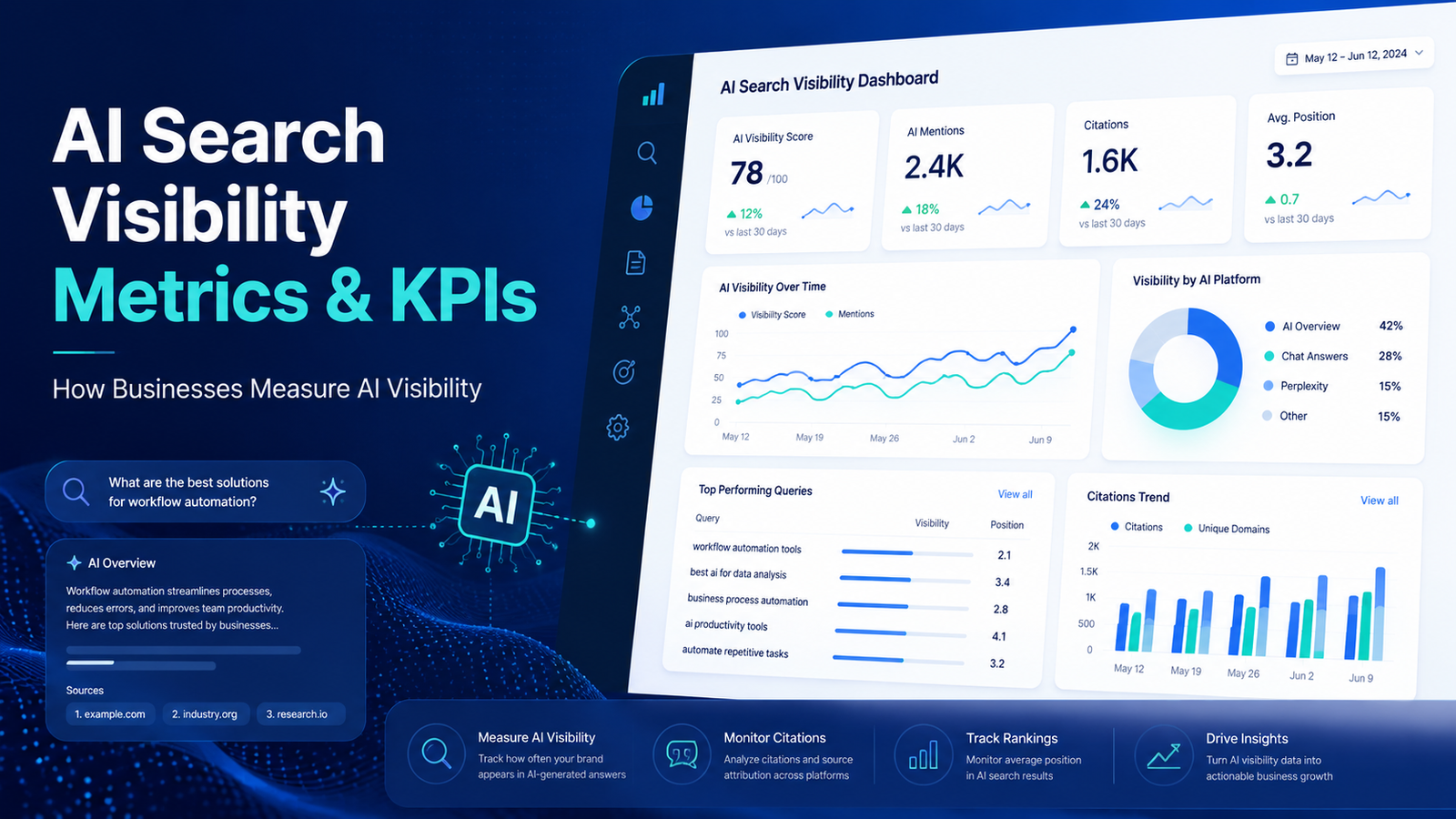
To track the results of your governance efforts, you need a clear set of AI search KPIs. Our complete guide on AI Search Visibility Metrics and KPIs walks through the ten most important metrics businesses should track, including AI mention frequency, brand citation rate, share of AI voice, answer accuracy, and the conversion impact of AI search. It provides a practical testing framework and step-by-step process for benchmarking and improving AI visibility over time.
Think of the relationship this way: governance defines what information AI systems have access to, while visibility metrics tell you how AI systems are actually using that information. Both disciplines are necessary for a complete AI search strategy.
Frequently Asked Questions
What is AI governance business context strategic visibility?
It is the practice of governing a company’s public information so that AI search platforms can accurately find, understand, and represent the brand. It combines information governance, structured business content, and proactive AI discoverability strategy into a single framework.
How can businesses improve AI Governance Business Context Strategic Visibility?
Businesses should publish clear product pages, implement schema markup, maintain consistent business information, earn trusted third-party mentions, monitor AI-generated answers regularly, and measure performance using AI visibility metrics.
Why do AI systems sometimes describe businesses inaccurately?
AI systems draw from whatever public information is available. If a business has vague website content, inconsistent business listings, or limited third-party mentions, the AI fills gaps with inaccurate inferences. Governance reduces these gaps by ensuring public information is complete, accurate, and well-structured.
How is AI governance different from traditional SEO?
Traditional SEO focuses on keyword rankings and organic clicks. AI governance focuses on ensuring AI systems can correctly comprehend and represent your brand. Both disciplines improve your online presence, but they target different systems with different methods.
What types of content improve AI business context?
Product and service pages with specific use cases, FAQ sections in natural question-and-answer format, case studies with measurable outcomes, author bios with credentials, schema markup, and third-party mentions on trusted platforms all contribute to stronger AI business context.
How long does it take to improve AI search visibility through governance?
Results vary. Schema and content improvements can influence AI representations within a few weeks as crawlers re-index updated content. Building third-party authority and earning new citations takes longer, typically three to six months for meaningful improvement in AI mention frequency.
Does schema markup directly influence AI answers?
Schema markup helps AI crawlers parse structured information accurately. While it does not guarantee a specific AI answer, businesses with comprehensive schema markup are more likely to be cited accurately and described specifically in AI-generated responses.
What is the difference between AI governance and AI compliance?
AI compliance typically refers to regulatory and ethical standards for how AI systems are built and deployed. AI governance in this context refers specifically to managing your business’s public information to ensure accurate AI representation. These are related but distinct disciplines.
How often should businesses audit their AI visibility?
A quarterly audit is the minimum recommended frequency. Businesses in fast-moving categories or those that have recently updated products or messaging should audit monthly. Prompt-based testing across major AI platforms is the most reliable audit method.
Can small businesses benefit from AI governance business context strategic visibility?
Yes. In fact, small businesses in local or niche markets often see faster results from AI governance improvements because there is less competition for AI answer space in their specific category. Clear, specific business information is just as important for a ten-person company as for a large enterprise.
What metrics should I track to measure AI governance effectiveness?
Track AI mention frequency, brand citation rate, share of AI voice, answer accuracy, sentiment of AI descriptions, and prompt coverage. A full breakdown of these metrics and how to track them is available in our companion guide on AI Search Visibility Metrics and KPIs on ATHubTechnology.com.
Is AI governance business context strategic visibility the same as GEO?
GEO, or Generative Engine Optimization, is closely related. GEO focuses on optimizing content for AI-generated answers broadly. AI governance business context strategic visibility is a specific application of GEO principles combined with organizational governance practices to ensure systematic, managed AI representation.
What happens if a business ignores AI governance?
Businesses that do not govern their AI visibility risk being described inaccurately, missing from high-intent AI answers, or being overshadowed by competitors who have invested in structured, well-governed public information. As AI search becomes a primary discovery channel, this risk grows over time.
Conclusion
AI Governance Business Context Strategic Visibility is becoming an essential strategy for businesses that want accurate representation inside AI-powered search engines.
The brands that will perform best in AI-driven search are the ones that give AI systems the clearest, most complete, and most consistent picture of who they are, what they do, and who they serve. That picture is built through governance, refined through structured content, and validated through third-party authority.
Start with an audit. Run your most important buyer prompts through major AI platforms today and document what they say about your business. Use what you find to identify gaps, fix inaccuracies, and build a governance process that keeps your AI representation accurate as your business evolves.
The companies investing in AI governance and strategic visibility now are building a compounding advantage. Every piece of structured content published, every schema tag added, and every third-party mention earned makes AI systems incrementally more confident in describing your brand correctly.
Companies that continuously improve AI Governance Business Context Strategic Visibility will be more discoverable, more trustworthy, and better positioned as AI becomes the primary way people search for products, services, and business information, as well as structured content and ongoing governance. Organizations can build lasting visibility across AI search engines and stay ahead in the evolving digital landscape.
For more practical guides on AI search, digital transformation, and technology strategy, explore additional resources at ATHubTechnology.com.