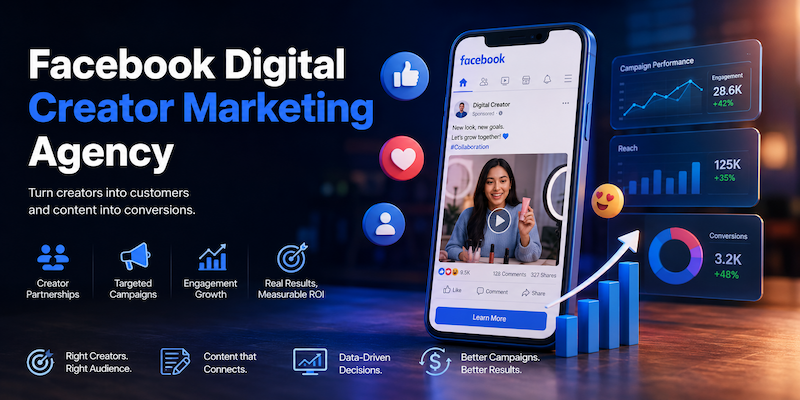
A facebook digital creator marketing agency helps businesses work with creators to reach people through useful, entertaining, and persuasive Facebook content. Instead of relying only on traditional brand advertisements, the agency builds campaigns around people who already know how to attract and engage an audience.
Creator marketing can include videos, Reels, product demonstrations, tutorials, live content, reviews, educational posts, sponsored content, and brand collaborations.
The agency sits between the brand, creators, audience, advertising strategy, and campaign data. Its job is not simply to find someone with many followers. A good agency finds creators who fit the brand, develops the campaign, manages content, tracks results, and improves future campaigns.
Quick Answer: A facebook digital creator marketing agency plans and manages Facebook campaigns that use digital creators to promote brands, products, services, or ideas. It can handle creator research, outreach, content planning, paid promotion, campaign management, tracking, and reporting.
This approach matters because people often respond differently to content from a person than they do to a standard corporate advertisement.
A creator can demonstrate a product in a kitchen, explain software from a desk, visit a local restaurant, compare two products, or answer common customer questions.
That makes creator marketing useful at several stages of the customer journey.
Table of Contents
What Is a Facebook Digital Creator Marketing Agency?
Definition: A facebook digital creator marketing agency is a marketing company or specialist team that connects businesses with Facebook creators and manages creator-led campaigns from strategy through measurement.
The term combines three related areas.
Facebook marketing focuses on reaching and engaging people through Facebook.
Digital creator marketing uses people who produce original online content to communicate a brand message.
Agency services provide the strategy, management, creative support, advertising knowledge, and reporting required to run those campaigns professionally.
This means creator marketing is broader than simply paying someone to publish one sponsored post.
A complete campaign might involve:
- Defining the target customer.
- Finding suitable creators.
- Checking creator quality and audience relevance.
- Agreeing on deliverables.
- Preparing a creative brief.
- Producing creator content.
- Reviewing brand and disclosure requirements.
- Publishing content.
- Supporting strong content with paid campaigns.
- Measuring engagement, leads, sales, or another business goal.
The agency coordinates these moving parts.
What Does a Digital Creator Mean on Facebook?
A digital creator is someone who regularly produces original digital content for an online audience.
The person might create:
- Reels
- Videos
- Tutorials
- Reviews
- Live broadcasts
- Educational posts
- Entertainment
- Product demonstrations
- Industry commentary
- Photos and stories
Creators can work in almost any niche.
A chef may create recipe videos. A fitness coach may demonstrate exercises. A software specialist may teach people how to use business tools. A real estate creator may explain property buying. A local food creator may review restaurants.
Follower count alone does not define the value of a creator.
Audience relevance, credibility, content quality, engagement, brand fit, and the ability to inspire action can matter more.
Key Takeaway: The best Facebook creator for a campaign is not automatically the creator with the largest audience. The right creator has an audience and content style that match the campaign goal.
What Does a Facebook Digital Creator Marketing Agency Do?
The exact service depends on the agency, client, industry, budget, and campaign.
However, most creator-focused agencies work across five major areas.
| Area | What the Agency Does | Main Goal |
|---|---|---|
| Strategy | Defines audience, goals and campaign concept | Create direction |
| Creator sourcing | Finds and evaluates creators | Find strong matches |
| Content | Plans and reviews creator content | Produce useful content |
| Campaign management | Coordinates publishing and promotion | Execute efficiently |
| Measurement | Tracks campaign performance | Improve ROI |
Some agencies specialize mainly in influencer relationships.
Others operate more like full-service digital marketing agencies and combine creator campaigns with paid social media, SEO, email, landing pages, conversion tracking, and broader brand strategy.
For businesses already investing in several channels, this wider approach can be useful.
7 Powerful Facebook Digital Creator Marketing Agency Strategies
1. Start With the Business Goal
A creator campaign should not begin with:
“Which influencer should we hire?”
It should begin with:
“What result are we trying to create?”
That difference is important.
Possible objectives include brand awareness, video views, website visits, leads, app installations, product sales, event registrations, store visits, or new followers.
Each objective can require different creators and content.
For example, a creator who produces entertaining short videos may be excellent for reach but weak for explaining a complex B2B product.
A specialist with a smaller professional audience may generate fewer views but better leads.
Best Practice: Define one primary campaign objective and two or three supporting metrics before contacting creators.
Clear goals also make reporting more meaningful.
Ten thousand video views may sound impressive. But if the campaign objective was qualified leads, video views alone cannot tell you whether the campaign worked.
This same principle applies to broader performance marketing agency strategy, where marketing activity should connect to measurable business outcomes.
2. Choose Creators Based on Relevance, Not Fame
One of the most important jobs of a facebook digital creator marketing agency is creator selection.
Follower count is easy to see, which makes it tempting to use as the main selection metric.
That can be a mistake.
Imagine two creators.
| Factor | Creator A | Creator B |
|---|---|---|
| Followers | 500,000 | 42,000 |
| Relevant audience | 18% | 76% |
| Typical engagement | Low | Strong |
| Industry knowledge | Limited | High |
| Brand fit | Average | Excellent |
Creator A has a much larger audience.
Creator B may still be the stronger marketing choice.
An agency should evaluate factors such as audience demographics, location, topic relevance, previous collaborations, content quality, engagement patterns, communication style, reputation, and brand safety.
The creator should feel natural talking about the product.
Forced recommendations are easy for audiences to notice.
3. Give Creators Structure Without Removing Their Voice
Brands need control over facts, claims, product positioning, and campaign requirements.
But too much control can make creator content feel like an advertisement written by a corporate marketing department.
That removes much of the value of using a creator.
A strong creative brief should explain:
- Campaign objective
- Target audience
- Product information
- Key message
- Required disclosure
- Important facts
- Claims to avoid
- Call to action
- Content format
- Deadline
The creator should still have room to communicate naturally.
Suppose a company sells project management software.
Instead of giving a creator a complete script, the company could ask the creator to demonstrate how they organize a real weekly project.
The product becomes part of the story.
That feels much more natural than reading product features from a script.
Best Practice: Control factual accuracy and brand requirements. Give creators flexibility over storytelling, language, delivery, and personality.
Facebook Creator Marketing vs Traditional Facebook Advertising
Creator marketing and traditional advertising are not the same.
They can also work together.
| Facebook Creator Marketing | Traditional Facebook Advertising |
|---|---|
| Creator-led communication | Brand-led communication |
| Often feels personal | Usually looks commercial |
| Uses creator personality | Uses brand identity |
| Strong for trust and discovery | Strong for controlled distribution |
| Creative style varies by creator | Creative style controlled by brand |
| Audience relationship can add value | Targeting and media buying add value |
| Results depend heavily on creator fit | Results depend heavily on creative and targeting |
A business does not necessarily need to choose one.
Creator content can supply the human storytelling while paid distribution helps scale the strongest message.
That creates a useful combination:
Creator + Content + Distribution + Measurement
The creator makes the message relatable.
The advertising system expands distribution.
The agency connects the pieces.
4. Build Content for Facebook Behavior
A video that works on one platform will not automatically perform the same way everywhere.
Facebook has its own audiences, viewing habits, communities, formats, and distribution systems.
A facebook digital creator marketing agency should therefore create content specifically for the campaign environment.
Strong creator content often gets to the subject quickly.
Consider the difference.
Weak opening:
“Hello everyone. Today I have partnered with a company and I want to tell you about their new product.”
Stronger opening:
“I spent three hours every Monday doing this manually until I found a faster way.”
The second version creates a reason to continue watching.
It introduces a problem.
The product can appear naturally as the solution.
Good creator videos commonly use a simple structure:
Hook → Problem → Demonstration → Result → Call to action
The exact format depends on the campaign, but clarity matters.
People should understand what they are watching without needing a long introduction.
5. Combine Organic Creator Content With Paid Distribution
Organic reach is valuable because it allows content to spread naturally.
But a strong creator campaign does not need to depend entirely on organic distribution.
Paid promotion can help a business reach additional relevant people.
This creates two layers.
Organic layer
The creator publishes content for an existing audience.
This can generate comments, shares, reactions, discussions, and direct responses.
Paid layer
Suitable campaign content can be supported through advertising, subject to the applicable permissions, platform features, and campaign setup.
Paid distribution provides greater control over reach and targeting.
Meta also provides advertising and measurement systems for businesses. Its Audience Network materials, for example, emphasize transparent advertising practices and performance measurement across placements.
Businesses planning campaigns should check current requirements directly through Meta for Business because available tools, advertising rules, creator features, and eligibility requirements can change.
Key Takeaway: Organic creator content provides authenticity and an existing audience relationship. Paid media provides controlled distribution. Combining them can give brands more flexibility.
6. Measure Business Results, Not Vanity Metrics
Likes can be useful.
They should not automatically be treated as business success.
A facebook digital creator marketing agency should measure results based on the original campaign goal.
Useful metrics may include:
| Objective | Useful Metrics |
|---|---|
| Awareness | Reach, impressions, video views |
| Engagement | Comments, shares, reactions |
| Traffic | Link clicks, sessions, landing-page visits |
| Leads | Forms, calls, registrations |
| Ecommerce | Purchases, revenue, conversion rate |
| Content testing | Watch time, CTR, engagement |
| Growth | Followers, returning visitors, subscribers |
Context matters.
A campaign generating 2,000 highly relevant website visitors could be more valuable than one generating 500,000 low-intent video views.
That is why measurement needs to begin before the campaign launches.
Tracking can involve analytics platforms, campaign parameters, landing pages, conversion events, CRM data, promotional codes, and platform reporting.
For businesses trying to understand how visibility is measured beyond standard search rankings, our guide to AI Search Visibility Metrics and KPIs explains the same broader principle: choose metrics that represent meaningful visibility and outcomes rather than relying on one headline number.
7. Turn Winning Creator Content Into a Repeatable System
One successful post is useful.
A repeatable creator marketing system is more valuable.
After several campaigns, a business starts collecting information.
It learns:
- Which creators perform best
- Which hooks hold attention
- Which topics generate comments
- Which content produces clicks
- Which offers convert
- Which audience groups respond
- Which calls to action work
- Which formats underperform
This knowledge can shape the next campaign.
A company may discover, for example, that polished promotional videos generate fewer qualified leads than simple creator demonstrations.
That insight should influence future content.
Key Takeaway: Creator marketing improves when every campaign produces information for the next campaign. Treat creator content as an ongoing testing system rather than isolated sponsored posts.
Real Example: How a Creator Campaign Could Work
Consider a fictional local fitness studio called Northside Fitness.
The studio wants more trial memberships.
It could spend its entire budget on traditional ads.
Instead, it builds a local creator campaign.
Step 1: Define the audience
The studio wants adults living within a practical travel distance of its location.
Step 2: Select creators
The agency identifies three local fitness and lifestyle creators.
None are huge celebrities.
Each has a relevant local audience.
Step 3: Create the concept
Rather than asking them to say, “Join Northside Fitness,” each creator attends a class.
They document the experience.
One creates a beginner-focused video.
Another focuses on the equipment.
The third explains what the first class feels like.
Step 4: Create a clear offer
Viewers receive a simple trial-class offer through a trackable landing page.
Step 5: Publish
The creators publish their content according to the campaign schedule and applicable disclosure requirements.
Step 6: Measure
The studio tracks landing-page visits, trial registrations, cost per registration, and membership conversions.
Step 7: Learn
The beginner video generates the most registrations.
The agency now has an important insight.
Potential customers may be more concerned about getting started than about equipment.
The next campaign can address that concern directly.
That is the difference between simply “posting with influencers” and running a structured creator marketing program.
How to Choose a Facebook Digital Creator Marketing Agency
Choosing an agency should involve more than reviewing its follower count or looking at attractive social media posts.
Ask practical questions.
Does the Agency Understand Your Customer?
An agency needs to understand who buys your product and why.
Without that knowledge, creator selection becomes guesswork.
How Does It Vet Creators?
Ask how creators are evaluated.
Look beyond audience size.
A good process should consider audience relevance, engagement quality, previous content, brand fit, reputation, and campaign suitability.
How Are Results Measured?
Ask what happens after content is published.
You should understand which metrics will be reported and how those metrics connect to your campaign objective.
Who Owns the Content?
Usage rights matter.
A business should know where content can be used, how long it can be used, and whether it can be repurposed for other marketing activities.
Terms depend on the creator agreement.
Does the Agency Understand Paid Media?
This becomes important when creator content will be combined with advertising.
How Does It Handle Brand Safety?
The agency should have a process for reviewing creators and campaign content before a brand commits resources.
Best Practice: Ask an agency to explain one previous campaign from objective through measurement. The answer often reveals more than a portfolio filled with screenshots.
Facebook Digital Creator Marketing Agency vs Influencer Marketing Agency
The terms overlap, but they are not always identical.
An influencer marketing agency usually focuses heavily on influencer discovery, partnerships, campaign negotiation, and sponsored content.
A creator marketing agency may place more emphasis on the content itself.
| Service | Creator Marketing Agency | Influencer Agency |
|---|---|---|
| Creator sourcing | Yes | Yes |
| Influencer relationships | Often | Core service |
| Content production | Strong focus | Varies |
| Paid social strategy | Varies | Varies |
| Creative testing | Often | Sometimes |
| Campaign negotiation | Yes | Strong focus |
| Analytics | Yes | Yes |
In practice, many modern agencies provide both.
The label matters less than the actual service.
Businesses should evaluate capabilities rather than agency terminology.
Digital Creator vs Influencer: What Is the Difference?
A creator primarily creates content.
An influencer primarily has the ability to influence an audience.
One person can be both.
For example, a photographer who teaches lighting techniques through Facebook videos is a digital creator.
As the photographer develops a loyal audience, camera companies may pay them to discuss equipment.
They are now functioning as both creator and influencer.
This distinction helps businesses think more carefully about campaigns.
Sometimes you need reach.
Sometimes you need content production.
Sometimes you need authority.
Sometimes you need all three.
When Should a Business Hire an Agency?
Hiring a facebook digital creator marketing agency makes the most sense when creator campaigns become difficult to manage internally.
A small campaign involving one creator may not require an agency.
A growing program involving dozens of creators, content approvals, contracts, advertising, tracking, deadlines, and reporting is different.
An agency becomes particularly useful when a business lacks internal creator relationships or campaign-management experience.
It may also help companies that already invest heavily in social media but struggle to turn activity into measurable results.
Businesses developing a wider social strategy can also review our guide to Security Company Social Media Marketing Tactics. Although written for security companies, several principles around trust, useful content, and audience communication apply across industries.
When Should You Manage Creator Marketing In-House?
Agency support is not always necessary.
In-house management may work better when you have a small creator network, an experienced social media team, strong internal content skills, straightforward campaigns, and enough time for outreach and reporting.
A hybrid model is another option.
The internal team controls strategy and brand messaging while an agency handles creator discovery and campaign operations.
There is no universal structure.
The best choice depends on workload, expertise, budget, and campaign complexity.
Common Facebook Creator Marketing Mistakes
Several mistakes repeatedly weaken campaigns.
Choosing Creators by Followers Alone
A large following does not guarantee audience relevance.
Giving Creators Corporate Scripts
Over-scripted content can remove the personality that made the creator valuable.
Measuring Only Likes
Likes are one signal, not a complete business outcome.
Ignoring Comments
Comments provide valuable qualitative information.
People reveal objections, questions, interest, and confusion directly under content.
Running One Campaign and Stopping
Creator marketing benefits from testing and learning.
Poor Creator-Brand Fit
A partnership can look unnatural when a creator suddenly promotes something unrelated to their normal content.
Forgetting Disclosure and Platform Requirements
Sponsored campaigns need to follow applicable advertising, disclosure, platform, and local regulatory requirements.
How Much Does a Facebook Digital Creator Marketing Agency Cost?
There is no standard price.
Cost depends on the number of creators, creator size, content requirements, production complexity, usage rights, campaign length, paid media, agency fees, and market.
A simple local campaign might involve only a few creators.
A national campaign could involve dozens or hundreds of partnerships.
Creator fees and agency fees may also be separate.
Businesses should therefore avoid choosing an agency based purely on the cheapest proposal.
Instead, compare what is included.
A proposal should make the scope clear:
strategy + creators + deliverables + rights + management + advertising + measurement
Without those details, two prices cannot be compared fairly.
How to Build a Facebook Creator Campaign Step by Step
A practical workflow looks like this:
- Set one primary objective. Decide whether the campaign should generate awareness, engagement, traffic, leads, or sales.
- Define the audience. Document location, interests, problems, needs, and buying context.
- Create selection criteria. Decide what makes a creator suitable before searching.
- Research creators. Evaluate audience relevance and content quality.
- Create the campaign idea. Build a concept that gives creators something useful to communicate.
- Agree on terms. Confirm deliverables, timing, compensation, rights, and responsibilities.
- Write the brief. Include essential facts while leaving room for creator personality.
- Produce and review content. Check factual accuracy and campaign requirements.
- Publish and distribute. Coordinate organic publishing and any planned paid support.
- Track meaningful outcomes. Measure results against the original objective.
- Document lessons. Record what worked and what failed.
- Repeat the winners. Use campaign data to improve the next creator program.
This process makes creator marketing easier to manage and measure.
Can Creator Marketing Help Small Businesses?
Yes, particularly when audience relevance is more important than national reach.
A local restaurant does not necessarily need a celebrity.
A trusted local food creator may be more useful.
A dental practice may benefit from a local family or health creator.
A specialist B2B company may work with an industry educator who has a small but highly relevant audience.
This is one reason smaller creators can be valuable.
They can operate inside focused communities.
For small companies exploring other practical growth methods, see our guide to the best ways to support local businesses.
How Creator Marketing Fits Into a Wider Digital Strategy
Creator marketing should not operate in isolation.
A person may discover a company through a creator but convert through another channel.
The journey could look like:
Creator video → Google search → Website → Email signup → Retargeting → Purchase
Another journey might be:
Facebook Reel → Landing page → Free trial → Email sequence → Subscription
This is why creator marketing can connect with SEO, content marketing, paid media, email marketing, reputation management, landing-page optimization, and analytics.
A strong agency should understand these relationships.
Creator content generates attention.
The rest of the marketing system must convert that attention into a useful outcome.
Is Facebook Creator Marketing Good for B2B Companies?
It can be.
B2B creator marketing usually looks different from consumer influencer marketing.
A business software company probably does not need a lifestyle celebrity.
It might work with consultants, developers, founders, industry educators, analysts, or other subject experts.
Content can include tutorials, product demonstrations, workflow comparisons, interviews, case studies, and educational videos.
Authority matters more than entertainment in many B2B situations.
A creator with 15,000 highly relevant professionals may therefore offer more value than a general creator with one million unrelated followers.
What Should a Creator Marketing Report Include?
A useful report should answer more than “How many people saw the campaign?”
It should explain what happened and what the business should do next.
A clear report can include campaign objective, creator performance, reach, engagement, content performance, traffic, conversion data, cost metrics, audience insights, top-performing messages, weak-performing content, and recommendations.
The final section matters.
Data without interpretation does not automatically improve marketing.
A good agency should be able to explain why one piece of content outperformed another and what should change in the next campaign.
Future of Facebook Digital Creator Marketing
Creator marketing is becoming part of the wider digital advertising ecosystem rather than remaining a separate experimental channel.
Brands increasingly need content that feels native to the environment where people discover it.
At the same time, measurement remains essential.
The strongest programs are likely to combine human creativity with structured campaign data.
Creators understand audiences.
Brands understand products.
Agencies understand campaigns.
Advertising systems provide distribution.
Analytics provides feedback.
When those elements work together, creator marketing becomes much more than paying for social posts.
It becomes a repeatable customer-acquisition and brand-building process.
Final Takeaway
A facebook digital creator marketing agency helps brands turn creator relationships into organized marketing campaigns.
Its real value is not simply finding popular Facebook accounts.
The agency should connect business goals with the right creators, useful content, controlled distribution, and meaningful measurement.
Businesses considering an agency should focus on creator relevance, campaign strategy, content quality, tracking, transparency, and measurable results.
The best creator campaign does not necessarily have the biggest celebrity or the highest view count.
It reaches the right people with the right message and gives them a clear reason to act.
Frequently Asked Questions
What is a facebook digital creator marketing agency?
A facebook digital creator marketing agency helps brands find creators, plan content, manage collaborations, distribute campaigns, and measure marketing results on Facebook.
What does a Facebook digital creator do?
A Facebook digital creator produces original content such as videos, Reels, tutorials, reviews, photos, educational posts, or entertainment for an online audience.
Is a digital creator the same as an influencer?
Not exactly. Creators primarily produce content, while influencers influence audience decisions. Many successful Facebook personalities perform both roles at the same time.
Can small businesses use Facebook creator marketing?
Yes. Small businesses can work with relevant local or niche creators whose audiences closely match their customers instead of paying for large celebrity partnerships.
How do agencies find Facebook creators?
Agencies may use creator databases, platform tools, manual research, existing relationships, audience analysis, social listening, and campaign data to identify suitable creators.
How should creator marketing success be measured?
Measure success against campaign goals using reach, engagement, website traffic, leads, purchases, revenue, conversion rate, or other meaningful business performance indicators.
Are Facebook creator campaigns only useful for consumer brands?
No. B2B companies can work with industry experts, consultants, educators, founders, and professional creators to explain products and reach specialized business audiences.
Should brands give creators complete scripts?
Usually not. Brands should control important facts and requirements while allowing creators enough freedom to communicate naturally in their established voice and style.
Can creator content be used in Facebook ads?
Creator content may support paid campaigns when appropriate permissions, usage rights, disclosures, advertising requirements, and available Meta features are properly addressed.
What makes a good Facebook creator partnership?
Strong partnerships combine audience relevance, authentic product fit, useful content, clear expectations, fair terms, proper disclosure, and measurable campaign objectives.
Is creator marketing better than Facebook ads?
Neither is universally better. Creator marketing provides personality and audience relationships, while paid advertising provides controlled distribution. Many campaigns benefit from combining both.
How often should brands run creator campaigns?
Frequency depends on goals and resources. Consistent testing usually provides more useful learning than treating creator marketing as a single one-time promotional activity.
