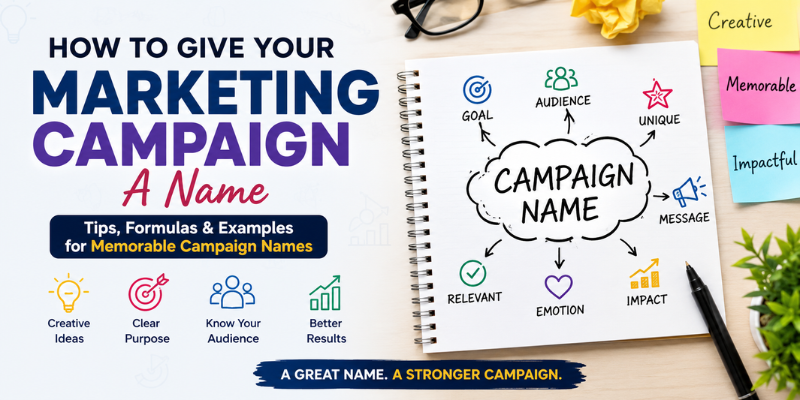
Quick Answer: To give your marketing campaign a name, start by defining your campaign goal and core message. Then brainstorm short, clear, emotional words that connect your offer to your audience. A good campaign name is simple, memorable, and works across all your marketing channels. Check that it is original, then test it before you launch.
Table of Contents
Introduction
Knowing how to give your marketing campaign a name helps your campaign feel clear, focused, and easy to remember. Every great marketing campaign starts with a name. Before you design ads, write emails, or run social media posts, you need a campaign name that ties everything together.
Learning how to give your marketing campaign a name is one of the most useful skills in marketing. A strong name gives your campaign an identity. It helps your team stay aligned, helps customers remember your offer, and makes it easier to track results across channels.
A weak name, on the other hand, creates confusion. It makes ads harder to write, social posts harder to share, and customers less likely to remember you after the campaign ends.
This guide covers everything you need to know, from the basic principles to a step-by-step process, naming formulas, real-world examples, and common mistakes to avoid.
Why Marketing Campaign Names Matter
When you give your marketing campaign a name, you make it easier for customers, team members, and search engines to understand the purpose of the campaign. Most marketers spend hours on ad creative, budget planning, and audience targeting. The campaign name is often decided in minutes. That is a mistake.
Your campaign name is the thread that connects every piece of your marketing effort. It appears in your email subject lines, your ad copy, your social captions, your internal briefs, and your reporting dashboards.
1. Brand Recognition
A named campaign creates a branded experience. When customers see the same campaign name across multiple touchpoints, they start to associate that name with your brand and offer. Recognition builds trust, and trust drives conversions.
2. Customer Memory
People forget generic offers quickly. A campaign name gives customers something to hold onto. When someone asks a friend about a sale they saw, they repeat the campaign name. That word-of-mouth is free advertising.
3. Advertising Efficiency
A clear campaign name makes copywriting faster. When every team member knows the campaign name, they write ads, posts, and emails with consistent language. This saves revision time and keeps messaging sharp.
4. Social Sharing
Campaign names that feel natural and catchy get shared on social media. A short, clever name can function as a hashtag, a caption, or a search term. Generic names rarely generate that kind of organic traction.
5. AI Search Visibility
AI-powered search engines now surface specific campaign information in answer results. A campaign with a clear, searchable name is more likely to appear accurately in AI-generated responses when customers research your brand or category.
If you want to understand how AI platforms discover and describe your campaigns, read our guide on AI Search Visibility Metrics and KPIs to learn how to track and improve your visibility inside AI-generated answers.
Key Takeaway: Your campaign name is not just an internal label. It is a brand asset that affects recognition, memorability, social sharing, advertising efficiency, and AI discoverability. Treat it with the same care as your ad creative.
What Makes a Good Marketing Campaign Name?
The goal is not just to sound creative. The goal is to give your marketing campaign a name that clearly matches your offer, audience, and message. Not every name works. Some campaign names sound great in a meeting but fall flat in the real world. Understanding the characteristics of a strong campaign name helps you evaluate your options before you commit.
| Characteristic | Why It Matters |
| Short | Easy to remember and repeat across channels |
| Unique | Stands out from competitors and avoids confusion |
| Clear | Audience instantly understands what the campaign is about |
| Emotional | Builds connection and increases sharing behaviour |
| Relevant | Matches campaign goals and audience expectations |
| Searchable | Easier to discover through search and social platforms |
| Consistent | Works across print, digital, social, and email without losing meaning |
Definition: A good marketing campaign name is a short, memorable phrase that clearly communicates the campaign’s core message, resonates emotionally with the target audience, and works consistently across all marketing channels.
How to Give Your Marketing Campaign a Name: Step-by-Step
Use this simple process whenever you need to give your marketing campaign a name for a launch, sale, seasonal promotions, event, or brand awareness push.
Step 1: Define Your Campaign Goal
Before you think about words, get clear on what the campaign is trying to achieve. Is it driving sales? Building awareness? Launching a new product? Encouraging sign-ups? Your goal shapes your name.
A campaign designed to drive urgency needs a different name than one designed to build emotional connection. Define the goal first and the naming process becomes much easier.
Step 2: Understand Your Audience
Think about who you are speaking to. What language do they use? What motivates them? What problems are they trying to solve? A campaign name that resonates with a Gen Z audience on social media looks very different from one that speaks to enterprise buyers in email.
Step 3: Identify Your Core Message
Every campaign has one central idea. It might be a discount, a benefit, a feeling, or a transformation. Boil that idea down to its simplest form. One sentence. Then one phrase. That phrase is the starting point for your campaign name.
Step 4: Brainstorm Keywords
Write down every word connected to your campaign. Include product words, benefit words, action words, emotional words, and seasonal words. Do not filter yet. Generate at least 30 words before you start cutting.
Step 5: Use Emotional Words
Campaigns that trigger emotion perform better than those that just describe an offer. Words like bold, free, win, change, grow, now, real, and fresh carry emotional weight. Mix them with your campaign-specific words and see what combinations appear.
Step 6: Keep It Simple
The best campaign names are short. Two to four words is the ideal range. If you need more words to make your name clear, your core message is probably not clear enough yet. Simplify the idea, then simplify the name.
Step 7: Check Competitors
Search for your shortlisted names. See if a competitor is already using something similar. A name that mirrors a competitor creates confusion and legal risk. You want a name that is clearly and uniquely yours.
Step 8: Check for Trademark Conflicts
Before you finalize any campaign name that will run at scale, do a basic trademark search. In the United States, you can use the USPTO TESS database. In other markets, check your national trademark registry. This takes ten minutes and avoids significant headaches later.
Step 9: Test Multiple Names
Narrow your list to three to five options and test them. Show them to people outside your marketing team. Ask customers, colleagues, or friends what each name makes them think of. Their responses will reveal which names communicate your intended message and which ones miss.
Step 10: Launch Consistently
Once you choose a name, use it exactly the same way everywhere. Same capitalisation, same spacing, same version. Consistency across channels reinforces the name in customer memory and creates a unified campaign experience.
Marketing Campaign Naming Formulas
If you are not sure how to give your marketing campaign a name, these formulas can help you start with structure instead of guessing. Here are six proven frameworks with real examples.
| Formula | Structure | Example |
| Brand + Benefit | [Your Brand] + what the customer gains | FreshBox: Eat Better Daily |
| Problem + Solution | Name the pain point, then the fix | No More Guesswork Sale |
| Goal + Action | What the customer wants + what they do | Get Fit, Start Now |
| Season + Offer | Time of year + what you are giving | Winter Warmup Deals |
| Emotion + Outcome | How it feels + what results | Feel Confident. Shop Smart. |
| Audience + Aspiration | Who it is for + what they dream of | New Founders, Big Futures |
Best Practice: Pick one formula that fits your campaign goal and audience, then generate five to ten variations. The formula is not the final answer. It is a starting point that gives your brainstorming structure.
For a broader foundation on campaign strategy before you name your campaign, visit our digital marketing strategies hub for practical guides across all major marketing channels.
Marketing Campaign Name Examples by Industry
These examples show how to give your marketing campaign a name that feels clear, short, and connected to the audience. The table below shows how naming varies by industry while the core principles stay consistent.
| Industry | Campaign Name Example | Why It Works |
| SaaS | Work Smarter, Not Harder | Clear benefit, universal appeal, easy recall |
| Ecommerce | Double Down Days | Urgency, alliteration, memorable rhythm |
| Restaurant | Fresh Starts Every Morning | Emotional, sensory, tied to daily habit |
| Healthcare | Take Control of Your Health | Empowering, action-driven, patient-focused |
| Education | Learn Without Limits | Aspirational, broad appeal, shareable |
| Real Estate | Find Your Forever Home | Emotional, life-stage relevant, warm tone |
| Fitness | Move More, Feel More | Simple, motivational, repetition creates rhythm |
| Beauty | Glow Up Season | Trend-aware, culturally resonant, visual |
| Travel | Your Next Chapter Starts Here | Aspirational, personal, high emotional pull |
| Finance | Money Moves That Matter | Alliterative, empowering, avoids fear language |
Notice that strong campaign names across every industry share the same traits: they are short, specific, emotionally resonant, and easy to remember after a single encounter.
Good vs Bad Marketing Campaign Names
The difference between a good campaign name and a bad one is often obvious in hindsight. Here are common examples of what to avoid and how to improve them.
| Bad Campaign Name | Problem | Better Alternative |
| Summer Sale 2025 | Generic, forgettable, no emotion | Sun, Savings, Summer |
| Promotion Phase One | Corporate, cold, no appeal | The Big Kickoff |
| Multi-Channel Engagement Initiative | Too long, jargon-heavy | Connect More |
| SpecialOfferXtra23 | Confusing spelling, no meaning | Extra Value Week |
| The Best Deal Ever | Overused, unbelievable | Real Savings, Real Fast |
| Q4 Revenue Driver Campaign | Internal language, not customer-facing | End-of-Year Finale |
Key Takeaway: Bad campaign names are usually too generic, too long, or written for internal audiences rather than customers. Always write the campaign name from the customer’s perspective, not the company’s.
Best AI Tools for Campaign Name Ideas
AI tools have become genuinely useful for marketing brainstorming. They do not replace creative judgment, but they can generate dozens of name ideas in seconds, helping you find angles you might not have considered.
1. ChatGPT
ChatGPT is one of the most flexible tools for campaign naming. Give it a clear prompt: describe your campaign goal, your audience, and the tone you want. Ask it to generate 20 campaign name options using specific formulas like Brand + Benefit or Emotion + Outcome. You can refine the output by telling it which names are close and which miss the mark. The HubSpot Marketing Blog has published practical guides on using AI tools in campaign development that are worth reviewing.
2. Google Gemini
Gemini integrates with Google Workspace and can pull context from your documents, briefs, and brand guidelines. If your team stores campaign briefs in Google Docs, Gemini can use that context to generate more relevant name options without starting from scratch.
3. Claude
Claude is strong at nuanced language tasks. It can evaluate name options against criteria you define, explain why certain names work better for specific audiences, and help you write a short creative brief around a chosen campaign name.
4. Perplexity
Perplexity combines real-time web search with AI reasoning. It is useful for checking whether similar campaign names already exist in your category and for surfacing what language competitors are currently using in their campaigns.
5. Naming Generator Tools
Dedicated naming tools like Namelix, Wordoid, and BrandBucket can generate short, brandable phrases based on keywords you provide. These are most useful for finding phonetically pleasant or visually distinctive names when you want something that feels more like a brand than a tagline.
Best Practice: Use AI tools for volume and variation, not final decisions. Generate a large pool of options with AI, then apply your human judgment to evaluate which names actually fit your brand voice, audience, and campaign goals.
Common Mistakes When Naming Marketing Campaigns
Even experienced marketers try to give your marketing campaign a name too quickly, without checking if the name is clear, memorable, or unique, and they fall into predictable naming traps.
Here are the most common ones and how to avoid them.
1. Being Too Generic
Names like ‘Summer Sale’ or ‘Big Promotion’ appear in thousands of campaigns every year. They are invisible. They create no distinction and leave no memory. Always add a specific angle that makes the name yours.
2. Making It Too Long
A campaign name that takes more than two seconds to say out loud is too long. Long names get abbreviated, shortened, or dropped entirely by the team. Keep it to four words maximum.
3. Using Difficult Spelling
If customers cannot spell your campaign name when they search for it, they will not find it. Avoid clever misspellings, unusual punctuation, and names that look different from how they sound.
4. Writing for Internal Audiences
Names like ‘Q4 Revenue Driver Initiative’ make sense in a spreadsheet but mean nothing to a customer. Campaign names should always be written from the customer’s perspective.
5. Copying Competitors
Using a name that closely mirrors a competitor’s campaign creates confusion in the market. Customers cannot tell your campaigns apart, and you risk legal complications. Always search competitors before finalising a name.
6. Ignoring the Audience
A campaign name that works perfectly for one audience can fall flat or feel wrong for another. Language, tone, and cultural references all vary by audience. Refer to your audience research before settling on a name. For guidance on understanding audience needs in your broader marketing strategy, explore the digital marketing guide at ATHubTechnology.com.
For platform-specific guidance on campaign naming and ad structure, Google Ads Help provides practical documentation on how campaign naming affects performance tracking and reporting inside Google Ads.
Pros and Cons of Named Marketing Campaigns
| Aspect | Strong Campaign Name | Weak Campaign Name |
| Brand recognition | Builds over time with repetition | Forgotten after the campaign ends |
| Shareability | Customers repeat it naturally | Too awkward or long to share |
| Advertising cost | Shorter copy, cleaner ads | More words needed to explain the campaign |
| Team alignment | Everyone uses the same name internally | Team uses different versions, creates confusion |
| AI discoverability | AI can surface the named campaign accurately | Vague names get lost in generalist answers |
| Longevity | Can be reused in future iterations | Tied to a single moment with no reuse value |
Frequently Asked Questions
How do you give your marketing campaign a name?
Start by defining your campaign goal and target audience. Identify the core message you want to communicate. Brainstorm keywords that connect your offer to your audience emotionally and practically. Use short, simple language. Combine words using a naming formula such as Brand + Benefit or Emotion + Outcome. Test your shortlist with real people before launching. The best campaign name is clear, memorable, and works consistently across every marketing channel you plan to use.
How do I give your marketing campaign a name that stands out?
To give your marketing campaign a name that stands out, keep it short, use clear benefit words, match the audience’s language, and avoid generic phrases. Test the name with a few real people before launch.
What makes a marketing campaign name effective?
An effective campaign name is short, usually two to four words. It is specific enough to communicate the campaign idea but simple enough to remember after one exposure. It works across print, digital, social, and email without losing meaning. It avoids jargon, corporate language, and generic phrases that could apply to any campaign from any brand.
How long should a marketing campaign name be?
Most effective campaign names are between two and five words. Shorter names are easier to remember, faster to say, and simpler to use as hashtags or ad headlines. Names longer than five words tend to get shortened or dropped by the marketing team over time, creating inconsistency.
Should a campaign name include the brand name?
Not necessarily. Some campaigns benefit from including the brand name when the goal is brand-building and awareness. Others work better as standalone creative names that stand apart from the brand. The decision depends on whether you want the campaign name to feel like a product experience or a marketing event.
Can I use AI tools to name my marketing campaign?
Yes. AI tools like ChatGPT, Gemini, Claude, and Perplexity can generate large volumes of campaign name ideas quickly. They are most useful for brainstorming and exploring angles you might not have considered. However, final decisions should always involve human judgment to ensure the name fits your brand voice, audience, and campaign strategy.
What are some examples of great marketing campaign names?
Strong campaign names tend to be simple, emotionally resonant, and industry-specific. Examples include ‘Move More, Feel More’ for fitness, ‘Glow Up Season’ for beauty, ‘Find Your Forever Home’ for real estate, and ‘Learn Without Limits’ for education. The best examples in each industry share a common trait: they speak directly to the customer’s desire rather than describing the offer in generic terms.
How is naming a campaign different from naming a product?
Product names are permanent and need to stand alone for years. Campaign names are temporary and designed to work within a specific promotional period. Campaign names can be more playful, trend-aware, and experimental. They do not need to carry the full weight of brand identity, but they should feel consistent with it.
Should campaign names include dates or seasons?
Seasonal references like Summer, Winter, or New Year can work well for time-limited campaigns because they create instant urgency and context. However, avoid specific years like 2025 in the campaign name if you plan to reuse or refresh the campaign in future years. Season references are reusable; year references are not.
How do I check if my campaign name is already being used?
Search the name in Google, including in quotation marks for exact match results. Search it on Instagram and X (formerly Twitter) as a hashtag. Run a basic trademark search through your country’s trademark registry. Review competitor websites and ad libraries. This process takes about 30 minutes and is worth doing before any campaign name is finalised.
How does a campaign name affect AI search visibility?
AI-powered search engines surface specific named campaigns when users ask about brands, offers, or categories. A campaign with a clear, searchable name is more likely to be referenced accurately in AI-generated answers. Vague or generic campaign names are rarely cited by AI tools because they cannot be reliably distinguished from competing content. A well-named campaign with consistent online presence creates a stronger signal for AI systems to extract and reference correctly.
What naming formula works best for ecommerce campaigns?
Ecommerce campaigns often benefit from the Season + Offer or Emotion + Outcome formulas. These create urgency and communicate value without over-explaining. Alliteration also works well in ecommerce because it makes names more rhythmic and memorable. Examples include Double Down Days, Flash Friday, and Fresh Finds Week. Short, high-energy names tend to outperform longer descriptive ones in ecommerce environments.
Can the same campaign name be used across multiple languages?
Translating a campaign name is possible but requires careful review by native speakers in each target market. Some names translate cleanly. Others lose meaning, become unintentionally funny, or carry negative connotations in different languages. For global campaigns, it is worth testing the name with native speakers in each key market before launch rather than relying on translation tools alone.
Conclusion
Knowing how to give your marketing campaign a name is a skill that helps every new campaign feel stronger, clearer, and easier to remember. A good name unifies your team, sharpens your messaging, improves customer recall, and gives your campaign a better chance of standing out in a crowded market.
The process is not complicated. Define your goal, understand your audience, build from a naming formula, keep it short and clear, check for conflicts, and test before you commit. Every step takes less time than you expect, and the result is a campaign that runs more smoothly from brief to final report.
Before you launch your next campaign, test your shortlisted names with at least five people outside your team. Their reactions will tell you which name lands, which ones confuse, and which ones feel instantly right. That feedback is worth more than any internal debate.
For more practical marketing guides, campaign strategy resources, and digital growth advice, visit the AT Hub Technology digital marketing hub at athubtechnology.com.