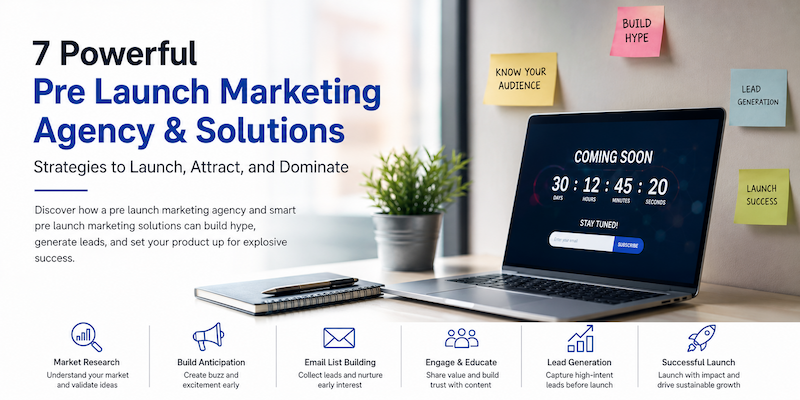
A pre launch marketing agency helps a business attract attention before a new product, service, application, store, or brand becomes available.
Many businesses wait until launch day to begin marketing. They publish a few social media posts, send an email, and expect people to buy.
This approach often fails.
People need time to learn about a new offer. They need to understand the problem, trust the brand, compare choices, and decide whether the product fits their needs.
A planned campaign starts this process early.
It helps the business understand its audience, test its message, collect interested leads, and prepare buyers before the official release.
Quick Answer
A pre launch marketing agency researches the market, defines the audience, develops product messaging, builds a waiting list, creates content, and manages campaigns before launch day. Its goal is to create qualified demand rather than empty attention.
This guide explains how pre launch marketing works, which services matter most, and how to choose the right support for your next launch.
Table of Contents
What Is a Pre Launch Marketing Agency?
Definition
A pre launch marketing agency is a company that plans and manages marketing activities before a product or business officially enters the market.
The agency works between the early planning stage and the public release.
Its job is not limited to posting “coming soon” messages.
A good agency creates a complete path from first awareness to launch-day action.
The work may include:
- Audience research
- Competitor research
- Product positioning
- Brand messaging
- Landing page development
- Email list building
- Content creation
- Social media campaigns
- Paid advertising
- Public relations
- Influencer outreach
- Referral programs
- Beta user recruitment
- Launch event planning
- Campaign measurement
The exact service depends on the product and market.
For example, a software company may need beta users and demo requests. A restaurant may need local press and opening-day bookings. An online course may need webinars and early registration.
The methods are different, but the goal is the same. Explore more about What Is a Performance Marketing Agency?
The business needs to find the right people and give them a clear reason to care.
What Are Pre Launch Marketing Solutions?
Pre launch marketing solutions are the services, tools, and campaigns used to create interest before a launch.
A business can manage these activities internally or hire outside support.
Common solutions include:
- Market validation
- Customer interviews
- Competitor analysis
- Audience segmentation
- Product positioning
- Coming-soon landing pages
- Email waiting lists
- Beta testing programs
- Educational content
- Product demonstrations
- Referral campaigns
- Influencer partnerships
- Paid lead generation
- Press outreach
- Launch countdowns
- Analytics and reporting
A strong campaign does not use every available channel.
It selects the best pre launch marketing solutions based on the audience, offer, budget, and launch timeline.
A business selling software to finance directors may focus on LinkedIn, email, webinars, and direct outreach.
A new skincare brand may focus on Instagram, TikTok, product samples, creators, and customer reviews.
The right strategy depends on where the buyer looks for information and how long the buying decision takes.
Key Takeaway
Good pre launch marketing creates measurable interest. It should produce waiting-list registrations, demo requests, beta users, pre-orders, bookings, or qualified sales conversations.
Why Is Pre Launch Marketing Important?
A product launch is not only one event.
It is the result of weeks or months of research, testing, content, and communication.
Without this preparation, even a strong product can enter the market without enough attention.
It prevents an empty launch
A business may spend months building a product and assume that customers will arrive once it is published.
That rarely happens without an existing audience.
A pre launch campaign creates a group of people who already know about the offer. These people can receive updates, educational material, beta invitations, and launch reminders.
The business does not have to start from zero on release day.
It tests the market
Early marketing helps a business learn whether people understand and want the product.
The team can test:
- Product names
- Headlines
- Benefits
- Pricing ideas
- Landing-page layouts
- Calls to action
- Product features
- Audience segments
- Advertising messages
These tests can reveal weak ideas before the business spends its full launch budget.
The U.S. Small Business Administration explains that market research helps businesses find customers, while competitive analysis helps them develop a unique position. Its market research and competitive analysis guide is a useful external resource for launch planning.
It improves product messaging
Product teams often focus on features.
Customers usually care more about outcomes.
For example, a project management tool may offer automated task assignment. The customer may care more about meeting deadlines and reducing follow-up work.
A pre launch marketing agency turns product details into simple customer benefits.
It provides useful feedback
Early users can show the business what needs to change.
They may identify:
- Confusing features
- Missing information
- Difficult registration steps
- Unclear pricing
- Weak product benefits
- Important customer concerns
- New use cases
- Purchase barriers
This feedback can improve both the product and its marketing.
It helps teams prepare
A launch may involve marketing, product, sales, customer support, design, development, and management teams.
Starting early gives these teams time to prepare:
- Sales scripts
- Product pages
- Support documents
- Email sequences
- Advertisements
- Training material
- Demonstration videos
- Frequently asked questions
- Tracking dashboards
This preparation reduces last-minute mistakes.
Pre Launch Marketing Agency vs General Marketing Agency
A general agency supports ongoing marketing. A pre launch specialist focuses on the period before and around a major release.
| Area | Pre Launch Marketing Agency | General Marketing Agency |
|---|---|---|
| Main goal | Build demand before a release | Support ongoing growth |
| Campaign period | Fixed around a launch date | Usually continuous |
| Audience work | Identifies early buyers | Targets established segments |
| Messaging | Creates the first market position | Improves existing messaging |
| Lead generation | Builds a waiting list or beta group | Generates regular leads |
| Content | Educates people before release | Supports long-term visibility |
| Product feedback | Often included | May not be a main service |
| Reporting | Measures launch readiness | Measures ongoing results |
| Urgency | Works toward a fixed deadline | Uses longer campaign cycles |
Neither type is always better.
An established company launching a small feature may use its current marketing team.
A startup entering a new market may need a specialist who understands validation, waiting lists, beta campaigns, and launch planning.
When Should You Hire a Pre Launch Marketing Agency?
Hiring a pre launch marketing agency can make sense when your team lacks time, experience, or specialist skills.
Consider outside support when:
- You are entering a new market
- You do not know your ideal customer
- Your product needs clearer positioning
- Your internal team is too busy
- You need leads before launch
- You have a fixed release deadline
- You need several marketing channels
- Your previous launch produced weak results
- You need landing pages, content, email, and advertising
- You want an outside view of the product
An agency may not be needed for every release.
You may manage the campaign internally when:
- The launch is small
- Your audience already knows the offer
- You have a skilled marketing team
- The product is an update for current customers
- You already have a strong email list
- Your team has managed similar launches
Best Practice
Hire marketing support before the final launch month. Research, message testing, audience building, and content production need enough time to work.
What Does a Pre Launch Marketing Agency Do?
The agency’s work usually follows a clear sequence.
1. Research the market
The first step is understanding the market.
The agency studies:
- Customer needs
- Market size
- Search behavior
- Buying habits
- Industry trends
- Competitor offers
- Pricing models
- Common objections
- Popular marketing channels
This research helps the team avoid decisions based only on personal opinions.
The agency may use surveys, interviews, website data, search data, social media discussions, and competitor reviews.
2. Define the target audience
A product may be useful to many people, but marketing to everyone creates a weak message.
The pre launch marketing agency identifies the groups most likely to care and buy.
A useful audience profile may include:
- Job role
- Industry
- Business size
- Age group
- Location
- Main problem
- Desired outcome
- Current solution
- Budget level
- Purchase concern
- Preferred channel
The goal is not to create a long fictional customer profile.
The goal is to understand who needs the product, why they need it, and what may stop them from buying.
3. Create the market position
Positioning explains where the product fits in the customer’s mind.
A strong position answers four questions:
- Who is the product for?
- Which problem does it solve?
- How does it solve the problem?
- Why should customers choose it?
For example:
“An appointment management platform for independent clinics that reduces missed visits through automated WhatsApp reminders.”
This statement is clearer than:
“A complete digital solution with advanced features for modern businesses.”
The first version identifies the user, problem, method, and value.
4. Build the launch message
The launch message gives customers a simple reason to pay attention.
It may include:
- A main headline
- A short product description
- Three key benefits
- Supporting evidence
- A clear call to action
- Answers to common concerns
The message should use customer language.
It should not depend on technical words that only the product team understands.
5. Create a landing page
A pre launch landing page gives interested people one place to learn and act.
It usually includes:
- A clear headline
- A simple product explanation
- Key benefits
- Product images or videos
- Social proof
- A waiting-list form
- An early access offer
- Frequently asked questions
- A privacy statement
- One main call to action
The page should focus on one action.
Asking visitors to subscribe, book a call, read five articles, follow social accounts, and contact support at the same time can reduce conversions.
6. Build and nurture a waiting list
A waiting list is one of the most useful pre launch marketing solutions.
It gives the business direct access to interested people.
The agency may offer:
- Early product access
- A launch discount
- A free guide
- A product sample
- A private demonstration
- Priority booking
- Bonus features
- Founder access
After people join, the business should continue communicating with them.
A simple pre launch email sequence can include:
- Welcome and expectation setting
- The problem the product solves
- The story behind the product
- A useful educational tip
- A product preview
- A customer or beta-user result
- A launch-date announcement
- An early access invitation
The emails should provide value rather than repeating “coming soon.”
7 Powerful Pre Launch Marketing Agency Strategies
The following strategies can support many types of product launches.
1. Validate the Product Before Spending Heavily
Validation checks whether the market shows real interest.
This does not always require a finished product.
A business can test demand using:
- A landing page
- Customer interviews
- A clickable product demo
- A small advertising campaign
- A waiting list
- A webinar
- A sample
- A pre-order page
- A manual version of the service
The key is to measure meaningful actions.
A social media like is weaker than a waiting-list registration. A registration is weaker than a paid pre-order.
Quick Answer
Validate demand by asking potential customers to take a real action. Strong actions include joining a beta, booking a demonstration, requesting a quote, or placing a pre-order.
A pre launch marketing agency should define the validation goal before starting a campaign.
For example:
- Get 500 waiting-list registrations
- Recruit 50 beta users
- Book 20 sales demonstrations
- Gain 100 pre-orders
- Reach a 10% landing-page conversion rate
These are examples, not universal targets. The right target depends on the market, price, audience, and campaign size.
2. Build a Clear Product Story
People remember a clear story more easily than a long feature list.
A product story explains:
- The problem
- Why the problem matters
- Why current choices are not enough
- How the new product helps
- What changes for the customer
The story should be honest.
Do not invent a dramatic problem or promise impossible results.
A simple story structure is:
Customers struggle with problem. Existing options often cause frustration. Our product provides solution, helping customers achieve desired outcome.
For example:
“Small restaurants often depend on printed menus that are costly to update. Our digital menu tool lets restaurant owners upload a menu, update prices, and share it through one QR code.”
This message is easy to understand.
3. Create a High-Value Waiting List
A waiting list should offer a clear benefit.
“Join our newsletter” is often too weak.
Better offers may include:
- Get early access
- Reserve your place
- Receive launch pricing
- Join the private beta
- Get a free setup session
- Download the preview
- Receive the first product sample
- Access a founder-only webinar
The pre launch marketing agency should also keep the form simple.
Ask only for information the business needs.
For many campaigns, a name and email address are enough. A business-to-business product may also need a company name, role, or team size.
Waiting-list page checklist
- One clear headline
- One main benefit
- Short supporting copy
- Product image or preview
- Simple registration form
- Privacy information
- Clear next step
- Mobile-friendly design
- Fast loading speed
- Conversion tracking
4. Use Educational Content to Build Trust
People may not be ready to buy when they first discover a new product.
Educational content helps them understand the problem and available solutions.
Useful formats include:
- Blog articles
- Short videos
- Checklists
- Email lessons
- Webinars
- Industry reports
- Templates
- Product comparisons
- Case studies
- Frequently asked questions
The content should answer questions customers already ask.
A cybersecurity company may explain common security risks. A fitness application may share simple training plans. A financial product may explain a difficult process in plain language.
This approach builds trust before asking for a sale.
Natural internal linking opportunities
A Digital Marketing website can link this article to related resources such as:
- How to create a digital marketing strategy
- Lead generation strategies for small businesses
- Landing page optimization tips
- Email marketing automation guide
- Product positioning examples
- Social media campaign planning
- Content marketing funnel guide
- How to measure marketing ROI
Use descriptive anchor text instead of phrases such as “click here.”
5. Recruit Beta Users and Early Supporters
Beta users test the product before the full release.
They can identify problems, suggest improvements, and provide early proof.
A beta program should explain:
- Who can join
- What users will receive
- What the business expects
- How long testing will last
- How users can share feedback
- Whether participation is private
- What happens after the beta
Do not recruit people only because they are friends or followers.
The best beta users match the real target audience.
A pre launch marketing agency may recruit them through:
- Email lists
- Professional communities
- Social media groups
- Direct outreach
- Partner networks
- Industry events
- Paid advertisements
- Customer referrals
Beta feedback can support product development, but it can also improve the launch campaign.
Users may provide useful phrases, testimonials, questions, and use cases.
Always ask permission before publishing a name, quote, logo, or result.
6. Create a Referral Campaign
A referral campaign encourages interested users to invite other people.
It can help a waiting list grow without depending only on advertising.
Possible rewards include:
- Earlier access
- A larger discount
- Bonus features
- Free usage credits
- A product upgrade
- A gift
- Access to a private event
- Entry into a giveaway
The reward should fit the product.
A business software company may offer additional usage credits. A consumer brand may offer a free sample or launch bundle.
Keep the process easy.
Users should receive a clear referral link and see what they can earn.
Best Practice
Reward useful referrals, not empty clicks. A referred person should complete a valid registration or another defined action before the reward is counted.
7. Coordinate the Final Launch Countdown
The final countdown brings all pre launch marketing solutions together.
A countdown may begin seven, fourteen, or thirty days before release.
The schedule can include:
- Product previews
- Founder messages
- User stories
- Feature explanations
- Demonstration videos
- Live question sessions
- Launch offers
- Reminder emails
- Social media posts
- Press outreach
- Partner announcements
Each message should add useful information.
Posting “five days left” without explaining the value can become repetitive.
A better countdown answers a different customer question each day.
Example seven-day countdown
| Day | Main Message | Desired Action |
|---|---|---|
| Day 7 | Explain the main customer problem | Join the waiting list |
| Day 6 | Show how the product works | Watch the demonstration |
| Day 5 | Share a beta-user story | Read the result |
| Day 4 | Answer common concerns | Visit the FAQ |
| Day 3 | Explain pricing or plans | Compare the options |
| Day 2 | Share the early access benefit | Confirm interest |
| Day 1 | Announce the exact release time | Set a reminder |
| Launch day | Open access and explain next steps | Buy, register, or book |
A Realistic Pre Launch Marketing Example
Consider a startup preparing to launch an appointment reminder platform for small dental clinics.
The founders first describe the product as:
“An artificial intelligence communication platform with advanced workflow automation.”
The description sounds technical and does not show the main value.
After interviewing clinic managers, the team learns that missed appointments create lost income and extra administrative work.
The message changes to:
“Reduce missed dental appointments with automatic WhatsApp and SMS reminders.”
This version identifies the problem and outcome.
Stage 1: Research
The team interviews 15 clinic managers.
It learns that:
- Most clinics confirm visits manually
- Staff spend hours sending reminders
- Patients often miss calls
- WhatsApp receives faster responses
- Managers want simple monthly pricing
- Setup time is a major concern
Stage 2: Landing page
The pre launch marketing agency creates a page with:
- A clear missed-appointment headline
- A two-minute product video
- Three main benefits
- A beta registration form
- A setup-time FAQ
- A call to join the early access group
Stage 3: Lead generation
The agency uses:
- LinkedIn outreach
- Dental industry groups
- Search advertisements
- A missed-appointment cost calculator
- An email guide for clinic managers
- Partnerships with dental consultants
Stage 4: Beta campaign
Twenty clinics join the beta.
The team watches how they use the product and learns that many users need bilingual message templates.
The startup adds this feature before launch.
Stage 5: Launch
Beta users receive priority pricing. Interested leads receive a demonstration invitation. The agency publishes a customer story and runs a seven-day email countdown.
This example shows why pre launch marketing is more than promotion.
The process improves the product, message, audience, and launch plan.
How to Build a Pre Launch Marketing Plan
Use the following steps to create a practical campaign.
Step 1: Set one main launch goal
Choose the result that matters most.
Examples include:
- Waiting-list registrations
- Beta users
- Pre-orders
- Product demonstrations
- Free-trial accounts
- Event bookings
- Sales calls
Do not use ten equal goals.
A clear main goal makes campaign decisions easier.
Step 2: Define the audience
Identify the people most likely to need the product.
Write down:
- Their main problem
- Their desired outcome
- Their current solution
- Their reason for changing
- Their main concern
- Where they seek information
Step 3: Write the core message
Explain the product in one or two simple sentences.
Remove unclear claims such as:
- Revolutionary
- World-class
- Best-in-class
- Next-generation
- Industry-leading
- Game-changing
Use a direct benefit that the customer can understand.
Step 4: Choose the conversion action
Decide what visitors should do.
Possible actions include:
- Join the waiting list
- Apply for beta access
- Book a demonstration
- Reserve a product
- Register for an event
- Download a preview
Step 5: Select the right channels
Choose channels based on audience behavior.
| Audience | Useful Channels |
|---|---|
| Business decision-makers | LinkedIn, email, webinars, industry publications |
| Local consumers | Google Business Profile, local media, social media, community groups |
| Software users | Search, product communities, email, demonstrations |
| Young consumers | Short videos, creators, social communities |
| Professional services | Search, LinkedIn, email, referral partners |
| Existing customers | Email, in-product messages, account managers |
Step 6: Create the content calendar
Plan what the business will publish and when.
Include:
- Content topic
- Format
- Channel
- Owner
- Due date
- Call to action
- Tracking link
- Campaign stage
Step 7: Set up measurement
Track results from the beginning.
Do not wait until launch day to add analytics.
Important Pre Launch Marketing Metrics
A pre launch marketing agency should report more than impressions and follower growth.
Useful metrics include:
Landing-page conversion rate
This measures the percentage of visitors who complete the main action.
A low conversion rate may indicate weak traffic, unclear messaging, poor design, or an unattractive offer.
Cost per lead
This shows how much the business spends to gain one registered lead.
Compare lead cost by campaign, channel, message, and audience.
Qualified lead rate
Not every lead matches the target market.
Measure how many registrations meet the ideal customer requirements.
Email engagement
Track:
- Delivery rate
- Open rate
- Click rate
- Reply rate
- Unsubscribe rate
- Launch conversion rate
Do not judge the campaign using one email metric alone.
Referral rate
This measures how many users invite another person.
It can show whether the offer is interesting enough to share.
Beta participation
Track how many accepted beta users actually test the product and submit feedback.
Pre-order or booking value
For campaigns that accept payments or reservations, track the value generated before launch.
Customer feedback themes
Group feedback into topics such as pricing, features, setup, trust, and usability.
This information can be as important as numerical data.
Pre Launch Marketing Timeline
The right timeline depends on product complexity.
A simple local campaign may need four to six weeks. A major software or consumer product may need several months.
| Period | Main Activities |
|---|---|
| 12 to 16 weeks before | Research, interviews, competitor review, positioning |
| 8 to 12 weeks before | Landing page, message testing, content preparation |
| 6 to 8 weeks before | Waiting list, beta recruitment, early advertising |
| 4 to 6 weeks before | Educational content, demos, partnerships, PR |
| 2 to 4 weeks before | Testimonials, referral campaign, launch offer |
| Final week | Countdown, reminders, media outreach, team checks |
| Launch day | Announcement, access, support, live tracking |
| After launch | Follow-up, retargeting, feedback, campaign review |
Key Takeaway
Start with research rather than promotion. A campaign built on an unclear audience or weak product message will waste time and advertising money.
Common Pre Launch Marketing Mistakes
Starting too late
A business cannot build trust, test messages, recruit users, and prepare content in a few days.
Begin before the product is fully finished.
Focusing only on follower numbers
A large social media following does not always produce sales.
Track registrations, demonstrations, pre-orders, and qualified conversations.
Targeting everyone
Broad targeting creates unclear messaging and expensive campaigns.
Start with the group that has the strongest need.
Sharing too little information
Mystery can create interest, but hiding the main product value may confuse people.
Explain enough for the audience to understand why the launch matters.
Making false scarcity claims
Do not use fake waiting lists, false countdowns, or limited offers that never end.
These methods damage trust.
Ignoring early users
Beta users and waiting-list members need regular communication.
Do not collect their email addresses and remain silent until launch day.
Using too many channels
A small team may struggle to manage search, email, five social platforms, influencers, events, and public relations at once.
Choose fewer channels and manage them well.
Failing to prepare customer support
A successful launch can create many questions.
Prepare answers, documentation, response rules, and contact options before the release.
How to Choose a Pre Launch Marketing Agency
Not every agency is suitable for every product.
Ask the following questions.
Does the agency understand your type of market?
Business-to-business software, local services, consumer products, mobile applications, and professional services need different approaches.
Relevant experience can reduce the learning period.
Can it explain its research process?
A reliable agency should explain how it will study customers, competitors, and demand.
Be careful when an agency recommends channels before learning about the product.
Which work will it manage?
Confirm whether the proposal includes:
- Strategy
- Copywriting
- Design
- Landing-page development
- Advertising
- Email automation
- Content
- Public relations
- Reporting
Do not assume every service is included.
How will success be measured?
The agency should connect activities to clear outcomes.
Useful measures include qualified leads, registrations, beta users, demonstrations, pre-orders, and launch sales.
Who owns the assets?
Confirm ownership of:
- Advertising accounts
- Landing pages
- Email lists
- Design files
- Tracking data
- Written content
- Customer information
- Domains and software accounts
Your business should retain access to important marketing assets.
How often will the agency report?
Agree on a reporting schedule and format.
Launch campaigns move quickly. Monthly reporting may be too slow during the final stages.
Pre Launch Marketing Agency Selection Checklist
Use this checklist before signing an agreement:
- The agency understands the product
- The target audience is clearly defined
- Research is included
- Deliverables are listed
- Responsibilities are clear
- The campaign timeline is realistic
- Success metrics are defined
- Advertising costs are separate
- Asset ownership is confirmed
- Data access is included
- Reporting dates are agreed
- Revision limits are clear
- Cancellation terms are written
- Customer privacy requirements are covered
- Post-launch support is explained
Frequently Asked Questions
What is pre launch marketing?
Pre launch marketing includes research, audience building, content, advertising, and lead generation completed before a product, service, business, or major feature becomes publicly available.
What does a pre launch marketing agency do?
A pre launch marketing agency validates demand, defines the audience, creates product messaging, builds landing pages, collects leads, manages campaigns, and prepares launch-day communication.
When should pre launch marketing begin?
Most campaigns should begin at least six to twelve weeks before release. Complex products, new markets, and major launches may require several months of preparation.
Is pre launch marketing only for startups?
No. Established companies also use pre launch marketing when releasing products, entering markets, opening locations, adding services, or introducing important features.
What are the best pre launch marketing solutions?
The best solutions often include customer research, clear positioning, a focused landing page, email collection, useful content, beta testing, referrals, and measurable launch goals.
How do I create interest before a product launch?
Explain the problem clearly, share helpful content, offer early access, show product previews, recruit beta users, collect emails, and communicate regularly with interested people.
Should I offer a pre launch discount?
A discount can encourage early action, but it is not always necessary. Early access, bonus features, priority service, or exclusive content may provide stronger value.
What should a pre launch landing page include?
Include a clear headline, product benefit, short explanation, visual preview, trust signals, simple registration form, privacy notice, frequently asked questions, and one main call to action.
How do I measure a pre launch campaign?
Track qualified leads, landing-page conversions, cost per lead, email engagement, beta participation, referrals, demonstrations, pre-orders, bookings, and feedback from potential customers.
Can a small business manage pre launch marketing internally?
Yes. A small business can manage a focused campaign using customer interviews, one landing page, an email list, useful content, and one or two suitable channels.
How long should a pre launch campaign last?
A small campaign may last four to six weeks. A complex product launch may require three to six months of research, testing, audience building, and preparation.
What is the biggest pre launch marketing mistake?
The biggest mistake is starting promotion without understanding the customer. Weak audience research often leads to unclear messaging, poor targeting, low-quality leads, and wasted spending.
Final Takeaway
A successful launch begins before launch day.
A pre launch marketing agency helps a business understand its audience, validate demand, create a clear message, and build a group of interested potential customers.
The best campaigns do not depend only on hype.
They combine research, useful content, honest communication, lead generation, testing, and careful measurement.
Start by identifying the customer problem. Build a simple message around the result your product provides. Create one clear conversion action. Then choose the pre launch marketing solutions that match your audience and budget.
A smaller, focused campaign can perform better than a large campaign without a clear strategy.
The real goal is not to make the most noise.
It is to reach the right people, learn from their response, and enter the market with evidence that customers understand and value the offer.